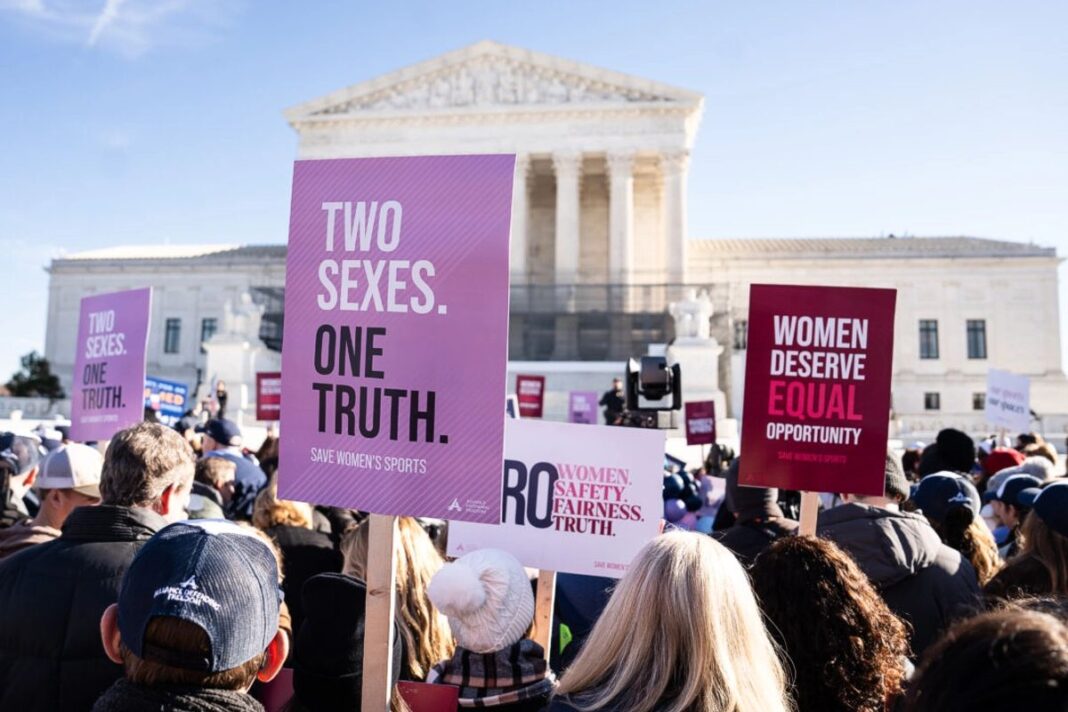


The justices seemed inclined to back two state bans on boys’ participation in girls’ sports.
The Supreme Court seemed poised on Jan. 13 to uphold Idaho and West Virginia bans on boys’ participation in girls’ sports, setting up a potentially game-changing decision for female athletes.
Two federal appeals courts had ruled against the laws, indicating they illegally discriminated against athletes on the basis of sex and “transgender status.”
During oral arguments, the justices seemed somewhat divided, but multiple conservative justices indicated they thought the bans could pass constitutional and legal muster.
Here are some of the main takeaways from the oral arguments.
1. Reckoning With Previous Gender Precedent
One of the major precedents, or prior Supreme Court decisions, that could influence the justices’ ruling is Bostock v. Clayton County. Writing for the majority in that case, Justice Neil Gorsuch said in 2020 that an employer who “fires an individual merely for being gay or transgender” violates Title VII of the Civil Rights Act.
That law bars discrimination on the basis of sex but Gorsuch said “it is impossible to discriminate against a person for being homosexual or transgender without discriminating against that individual based on sex.”
Lower courts and attorneys have cited Bostock v. Clayton County to support left-leaning positions on gender identity, but the justices have indicated that ruling was relatively limited.
Both Gorsuch and Chief Justice John Roberts joined the majority in Bostock but seemed to suggest on Jan. 13 that they thought that precedent might not apply to women’s sports.
Gorsuch, in particular, suggested he wasn’t willing to extend the reasoning in Bostock to Title IX, which is the civil rights law at issue in West Virginia’s case. That law bars sex-based discrimination in federally funded educational institutions.
While speaking with attorney Joshua Block, who was challenging West Virginia’s law, Gorsuch suggested the sports cases were “very different than Title VII.”
Justice Sonia Sotomayor told Idaho Solicitor General Alan Hurst that he made “no sense” in one of his arguments and suggested he wanted to subject the law to an inappropriately low level of scrutiny.
2. Definition of ‘Sex’
One of the primary criticisms appeals courts leveled at the bans was that they discriminated against people on the basis of their sex.
During oral argument, multiple justices questioned how to define “sex.”
“What is that definition for equal protection purposes?” Justice Samuel Alito asked. “What does it mean to be a boy or a girl or a man or a woman?”
When Kathleen Hartnett, an attorney challenging Idaho’s law, said she didn’t have a definition, Alito expressed skepticism.
The Justice Department spoke during oral argument in support of the states. Principal Deputy Solicitor General Hashim M. Mooppan told Alito that the best way to interpret “sex” under Title IX was in reference to reproduction.
3. Reach of Decision
The justices also wrestled with how their ruling could impact other issues like locker rooms and certain activities.
Mooppan had argued that discrimination occurred when individuals were similarly situated. That wasn’t the case for men and women, he suggested, because of inherent biological differences. “That’s not discrimination, that’s a distinction,” he said.
Justice Elena Kagan suggested Mooppan’s reasoning might impact chess clubs. “I think a lot of people would say, you know, if you look at the ranks of chess grand masters, there are not a whole lot of women there.”
She added, “I think there are a lot of chess grand masters who would tell you that women, just like for whatever reason, they’re … not as good at this.”
Justice Brett Kavanaugh was more skeptical of a possible spillover effect and suggested Congress had focused Title IX on sports.
4. Concerns About Biology
One of the criticisms appeals courts had for the bans was that they applied to individuals who may not have undergone puberty, and therefore had lower levels of testosterone.
Multiple justices grappled with those concerns during oral arguments. Justice Amy Coney Barrett, often considered a swing vote, asked Hurst how his legal theory would apply to “six-year-olds, where there’s no difference between boys and girls in terms of athletic ability, testosterone levels, et cetera.”
She later asked why the court didn’t need more factual research to determine the importance of testosterone levels. “Do we have to defer to the state?” she asked, alluding to the state’s determination about the scientific evidence.
Kavanaugh seemed hesitant to issue a broad decision blocking state bans because of factors like scientific uncertainty surrounding the issue. “Why would we … jump in and try to constitutionalize a rule for the whole country?” he asked.
5. Sotomayor Worries Athlete Will Live in ‘Infamy’
It is possible that the Supreme Court won’t end up ruling on the challenge to the Idaho law because the male university student, Lindsay Hecox, who brought it asked to withdraw the case.
Attorneys for Hecox told the Supreme Court that he wished to abandon his appeal for multiple reasons, including that public scrutiny would distract from Hecox’s schoolwork.
The Supreme Court previously deferred ruling on the request to dismiss the case as moot, but Sotomayor seemed sympathetic to the request during oral argument.
“To say [Hecox] misrepresented her intent is going a little extreme when she honored all her previous intent—intents and only changed her mind when new circumstances arose, i.e., the notoriety of this case, correct?” Sotomayor asked Hurst.
Sotomayor went on to ask Hurst about Hecox’s name being on the case. “Do you dispute that having a case named after you makes your infamy … live forever?” she asked Hurst.
Idaho has urged the court not to dismiss the case, which is expected to be decided by the end of June.
By Sam Dorman and Matthew Vadum