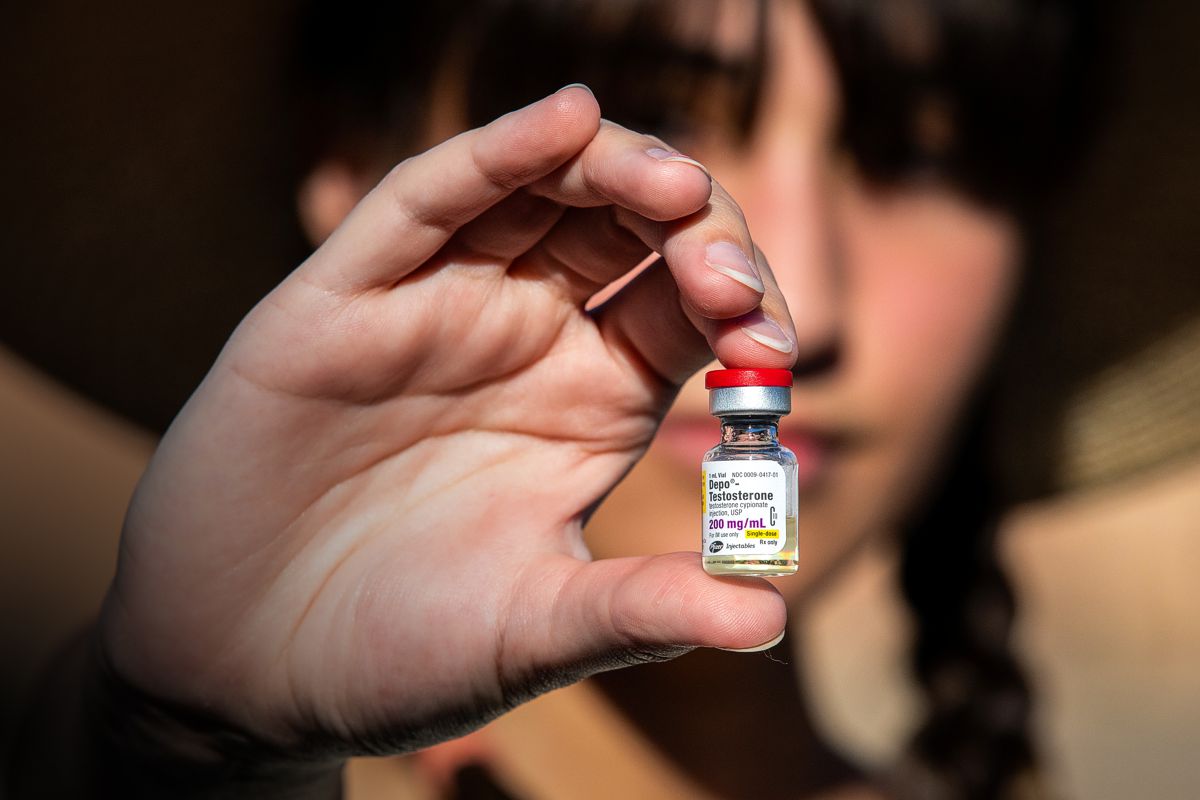


Chloe Cole grew up a tomboy, was diagnosed with attention-deficit hyperactivity disorder (ADHD) by age 7, and referred for autism screening by age 17.
Cole began identifying as a boy during adolescence and sought physical changes to match.
Doctors readily consented to medical intervention. They prescribed puberty blockers and testosterone at age 13. At 15, surgeons performed a double mastectomy, she told The Epoch Times.
But doctors didn’t address her neurological issues first. The same gender specialist who referred her for breast surgery later referred her for autism screening. Cole has described herself as being on the autism spectrum, but said she was never formally diagnosed.
Cole is now a leading campaigner against interventions to transition children with gender dysphoria.
She said many of those she knew personally when she was involved in the transgender community, as well as many of the detransitioners she knows, “are either somewhere on the autism spectrum, or they have been diagnosed with similar conditions, like ADHD.”
Her observations are increasingly supported by research. For at least a decade, studies have reported links among transgender identity, autism, and other neurological conditions. These connections have recently gained greater public attention.
Growing evidence of an autism–transgender link is already prompting some nations to recommend neurological screening before intervention. In America, the treatment model remains unchanged, and the predominant “affirmation” model makes the link difficult to investigate.
Autism and Gender Dysphoria
A report published this month by the British think tank Centre for Social Justice showed that autism and ADHD were “overrepresented,” or disproportionately high, among youth with gender dysphoria.
The report, citing data from the UK’s National Health Service, showed 32.4 percent of gender dysphoria referrals had an autism diagnosis, and 11.7 percent had an ADHD diagnosis.
Those numbers were 16 times higher than the national population averages for autism, and more than twice as high for ADHD. The population-wide averages for autism and ADHD in the United Kingdom are estimated at 2 percent and 5 percent, respectively.
“Individuals with autism spectrum disorder are far more likely to identify as transgender,” Joseph Nicolosi Jr., a licensed clinical psychologist and researcher in California, told The Epoch Times via email.
A pair of studies conducted in 2016 and 2019 indicate that autistic children are between four and seven times more likely to experience gender dysphoria or gender variance, he said. A 2019 study was conducted by researchers at the Uniformed Services University of the Health Sciences, and a 2016 study was conducted at New York University.
Nicolosi said there are several reasons for the connection, including “rigid thinking.”
For example, if a boy with autism lacks stereotypical male interests, he may doubt he is a boy and assume he must be a girl. Reading social cues is often hard for those with autism, so they may perceive same-sex peers as getting along better than they do.
“This heightens their sense of alienation from their peers,” Nicolosi said.
Cole recalled having difficulty coping with her body beginning to mature around the fourth grade, younger than most of her peers.
“The older I got, the less I associated with femininity, and I didn’t really feel like I fit in—especially with my female peers—but with my peers in general,” she said.
“It’s a common sentiment amongst people who have either ADHD or autism.”
Erin Friday, who gained national attention for successfully steering her ADHD daughter away from identifying as a transgender male, said she knows many detransitioners who are on the autism spectrum. A detransitioner is someone who had previously taken steps to transition to the opposite gender.
But most of the medical community doesn’t recognize transgender identity as a maladaptive coping mechanism, she told The Epoch Times.
They view autism and transgender identity as complementary and natural, instead of looking at causality, she said.
“This is the intersection of autism and transgenderism, like peas and carrots, it goes together,” Friday said. “They’re not even looking at … what is the causality?”
She observed that some hospitals offering pediatric transgender care have integrated autism and gender dysphoria services.
“It’s a feeder,” she said. “So it gives an endless stream of patients.”
Children’s National Hospital in Washington runs a Gender and Autism Program that treats autistic patients with gender dysphoria, illustrating the recognized connection between the two, she noted.
“We do not understand why autism and gender expansiveness often occur together, but we do know that this co-occurrence can be complex to navigate for young people and their families,” the website states.
The hospital did not respond to a request for comment.