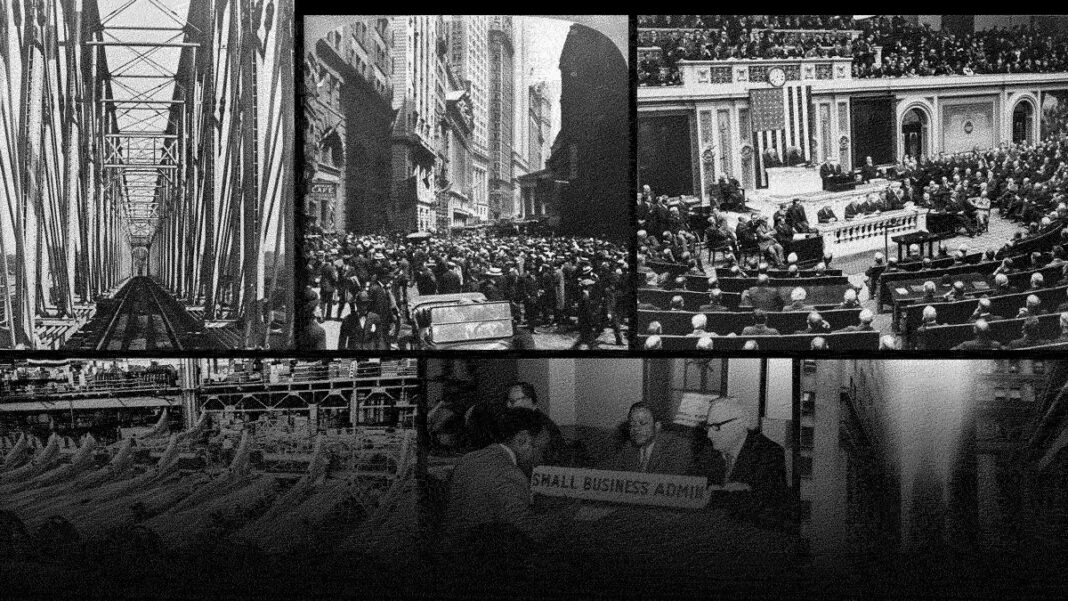


World War II marked America’s rise as the world’s superpower, but the nation’s economic foundations were laid decades before, historians say.
As America marks its 250th anniversary, it also celebrates the foundations of its prosperity: a tradition of innovation and entrepreneurship, free-market capitalism, and institutions that have helped transform it into a global superpower.
Over two-and-a-half centuries, the country has achieved remarkable economic growth, evolving from a largely agrarian society into the world’s leading economy.
Its path, however, has not been easy. America’s political and economic systems faced severe tests from the Civil War to the Great Depression. Yet time and again, the country has defied predictions of decline and recovered strongly from each crisis.
Arthur Herman, historian and author of “Founder’s Fire: From 1776 to the Age of Trump,” argues that the defining characteristic of the American economy has been a culture of risk-taking that stretches back to the nation’s earliest settlements.
Americans tend to view risk as “an opportunity instead of a danger signal,” Herman told The Epoch Times, adding that this mindset has encouraged entrepreneurship and innovation for generations.
Although World War II marked the United States’ emergence as the world’s undisputed superpower, many historians note that its economic foundations were laid decades earlier.
It was in the years after the Civil War that a series of founders including John D. Rockefeller, Andrew Carnegie, Cornelius Vanderbilt, and James J. Hill “created a modern industrial economy,” Herman said.
One of the greatest economic drivers during that period was the railroad boom.
“The railroads were sort of the internet and AI combined in the 19th century,” Herman said.
America’s railroads transformed the nation’s economy by connecting distant markets and unlocking the continent’s vast natural resources. Many of the companies that became successful in the 19th century did so because of their connections to that new mode of transportation.
For much of the 19th century, Great Britain was the world’s dominant power due to the Industrial Revolution and the strength of the nation’s Royal Navy. Yet toward the end of the century, the United States emerged as Britain’s main economic rival.
America’s abundant natural resources and advances in transportation, steelmaking, electricity, and mass production turned the nation into an industrial powerhouse.
Unlike many countries in Europe and Asia, the United States also encouraged entrepreneurship by limiting government interference, giving innovators greater freedom to take risks, generate new ideas, and expand their businesses, Herman said.
“By the time we get to 1900, the turn of the century, the United States was already the dominant economic power on earth, far surpassing the productivity of the British Empire and that of Germany,” he said.
By Emel Akan
Read Full Article on TheEpochTimes.com