

High-tech developers and hyperscalers are financing a nuclear renaissance and will mass-produce portable reactors. Not next decade. Next year.
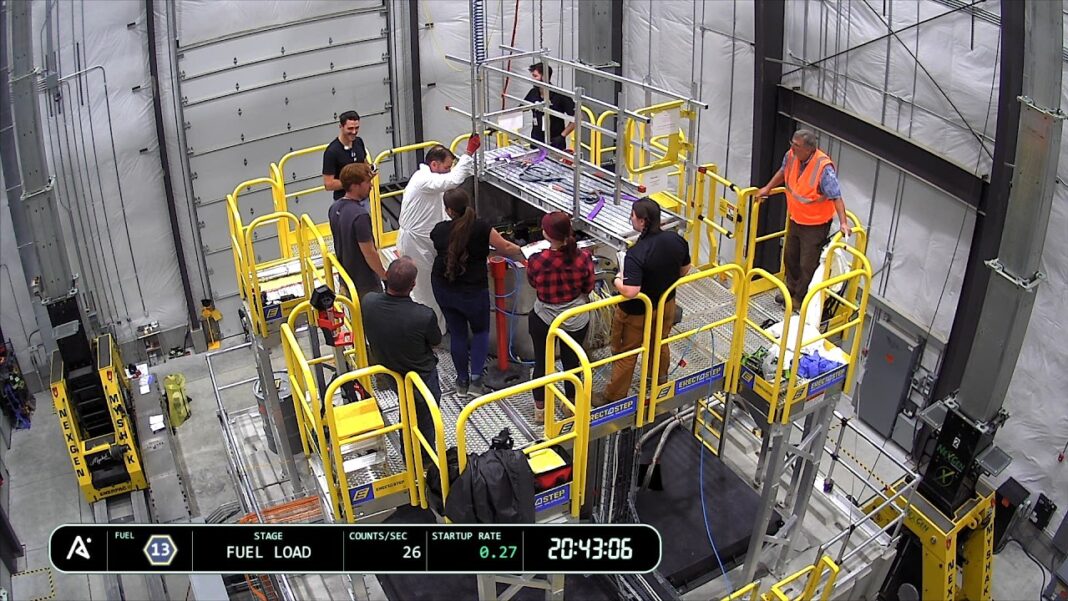
IDAHO FALLS, Idaho—History was made with the flip of a switch at 12:30 a.m. on June 4, under partly cloudy skies and a waning three-quarter moon in Idaho’s Arco Desert, when a prototype reactor sustained a nuclear chain reaction, becoming the first new design to achieve “criticality,” or viability, in the United States since 1973.
In that midnight milestone’s wake, the future is following fast. Since Antares Nuclear’s Mark-0 design was validated in early June, three other novel reactor designs have met the U.S. Department of Energy’s criticality requirements and, according to Energy Secretary Chris Wright. Up to four more could do so by year’s end.
While technologies, fuels, and applications vary, these prototypes share common traits. All are far smaller than the conventional reactors with massive cement cooling towers, and all are designed to be mass-produced, portable, and scalable. Several can fit in the bed of a pickup truck.
The nuclear energy surge is a convergence of rare bipartisan accord with stymied science and spiking electricity demand, spurred by power-hungry data centers and the integration of artificial intelligence and quantum computing into an electron-dependent world where the average U.S. home has 21 digital devices.
High-tech investors and hyperscalers are financing much of the innovation and pressuring the energy department to accelerate approvals to bring these new energy sources to market.
Not next decade.
Next year.
First-Movers
Antares Nuclear is one of 10 companies selected by the Department of Energy in August 2025 to develop “first mover” innovations under a reactor pilot program authorized by President Donald Trump. In four executive orders in May 2025, the president called for licensing 10 new reactors by 2030 and quadrupling the nation’s nuclear energy capacity by 2050.
The United States maintains the world’s largest nuclear power industry, with 96 reactors across 28 states that produce nearly 20 percent of the nation’s electricity, according to the U.S. Energy Information Association.
But since 1990, while 18 reactors have been retired, only two new ones have been built in the United States, largely because of costs, long timelines, regulatory entanglements, and public perception after the Three Mile Island, Chernobyl, and Fukushima nuclear accidents.
Although deployments have languished for a half-century, nuclear technologies have advanced, with U.S. companies developing more than 30 new reactor designs. Meanwhile, successive administrations and Congress—in scarce consensus—have been deregulating and subsidizing the industry since 2024’s ADVANCE Act adoption to meet a projected 25 percent increase in electricity demand by 2030 and more than 70 percent increase by 2050.
Criticality, a no-power proofing of theoretical physics, is generally the first step in being licensed by the Nuclear Regulatory Commission to produce and sell commercial nuclear reactors.
Trump’s executive orders overhaul the commission and streamline approvals, meaning new reactors could be for sale within six months to a year, Wright said on June 25 in Idaho Falls after meeting with developers at the Idaho National Laboratory.
Qualifying for the pilot reactor program launched by Trump’s executive orders, or for enrollment in the energy department’s newly established nuclear launchpad program, gives developers access to the Idaho National Laboratory, an 890-square-mile sagebrush sprawl in the Arco Desert, where atomic power was first used to create electricity in 1951. Specifically, they gain access to the Materials and Fuels Complex, a 40-minute drive from the lab’s Idaho Falls administrative offices.
Prototypes by Aalo Atomics and Valar Atomics also reached criticality under the pilot reactor program, while Deployable Energy did so as a launchpad participant. On criticality’s “cusp” at the national lab and elsewhere are micro-reactors from Radiant Industries, Natura Resources, Last Energy, Atomic Alchemy, Deep Fission, and Oklo.
By John Haughey