

Immigration and Customs Enforcement’s operations in Minnesota continue to capture the attention of public officials, celebrities, and prominent voices on the right justifying ICE’s fatal shooting of Alex Pretti Saturday while the left looks on in horror, calling it murder.
At risk of reading into a post from their official X account too much, the mere presence of ICE agents – armed, masked, federal agents wearing body armor – has apparently caused offense to the state’s Libertarian Party.
On Sunday, the Libertarian Party of Minnesota posted an image of ICE agents in the field adding a cutout of former President George Washington from the famous oil painting done in 1796 by Gilbert Stuart with the caption, “What The F*ck Is This?”
— Libertarian Party of Minnesota (@LPofMN) January 25, 2026
The painting where the image comes from, known as the “Landsdowne Portrait,” was a gift to former British Prime Minister William Petty, the Marquis of Landsdowne.
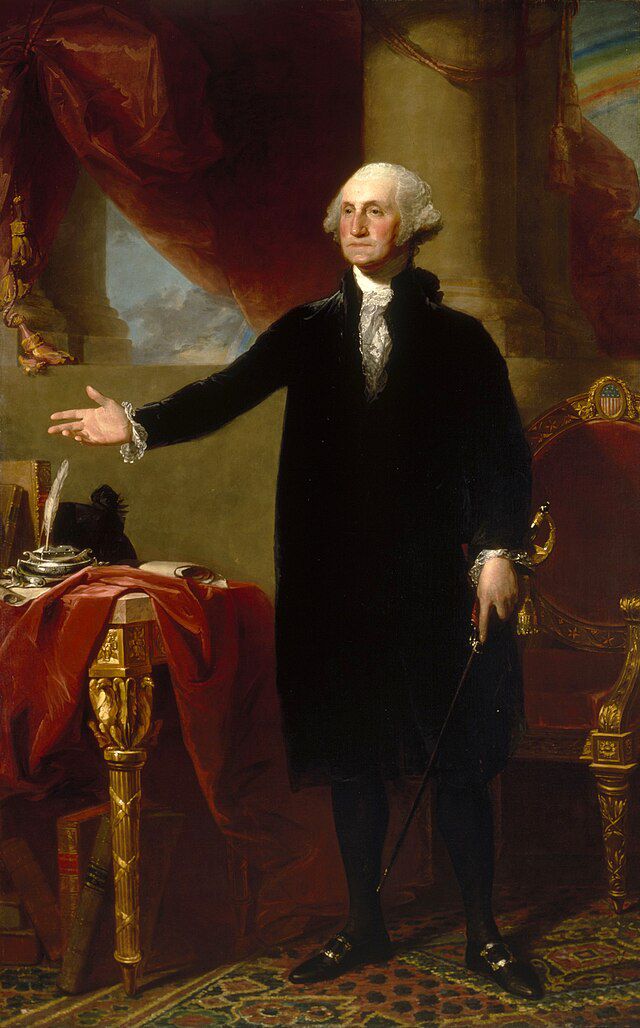
An advertisement for the painting during its first exhibition read, “He is surrounded with allegorical emblems of his public life in the service of his country, which are highly illustrative of the great and tremendous storms which have frequently prevailed. These storms have abated, and the appearance of the rainbow is introduced in the background as a sign.”
In a more contemporary context, Washington’s extended arm is particularly meme-worthy, appropriated for other uses as if the commander-in-chief was expressing his concern or disapproval with whatever issue the meme’s creator happens to use it for. In this instance, the message is clear: Washington is not happy with the presence of armed ICE agents in Minnesota. But would he not be? We cannot resurrect the man to ask him, but we can take a bit of knowledge from his time in office dealing with the Whiskey Rebellion.
In 1791, Secretary of the Treasury Alexander Hamilton proposed an excise tax “upon spirits distilled within the United States, and for appropriating the same.” After Congress passed this new whiskey tax, frontiersmen living in Western Pennsylvania declared their opposition, feeling this was an abuse of federal authority. The following year, Washington issued a proclamation, urging compliance with the law.
Now therefore I George Washington, President of the United States, do by these presents most earnestly admonish and exhort all persons whom it may concern, to refrain and desist from all unlawful combinations and proceedings whatsoever, having for object or tending to obstruct the operation of the laws aforesaid; inasmuch as all lawful ways and means will be strictly put in execution, for bringing to justice the infractors thereof and securing obedience thereto.
Protests against the whiskey tax turned violent by 1794 with the whiskey rebels gathering around Pittsburgh that July and setting fire to the home of Regional Tax Collection Supervisor John Neville. The president took action, organizing a militia of nearly thirteen thousand men which he personally led in the field. The rebellion quickly fell apart as one hundred and fifty rebels were arrested and tried for treason. Two men were found guilty, but Washington pardoned them both. The Whiskey Rebellion stands as the federal government’s first true test in enforcing the law.
In Minnesota, we are seeing another case of blatant disregard for federal law. From their post, the Libertarian Party seems to believe the first president would not approve of ICE doing its job. But his handling of the Whiskey Rebellion says otherwise. Libertarians tend to invoke the founders only from their revolutionary years – a principled group of brave, patriotic men who risked their lives to oust tyrannical overreach by the British.
This is only half the story. Washington stood against the British, but he later stood at the helm of a new nation. Violent opposition to a federal government in its infancy was handled decisively, setting the standard for future executives to do the same.