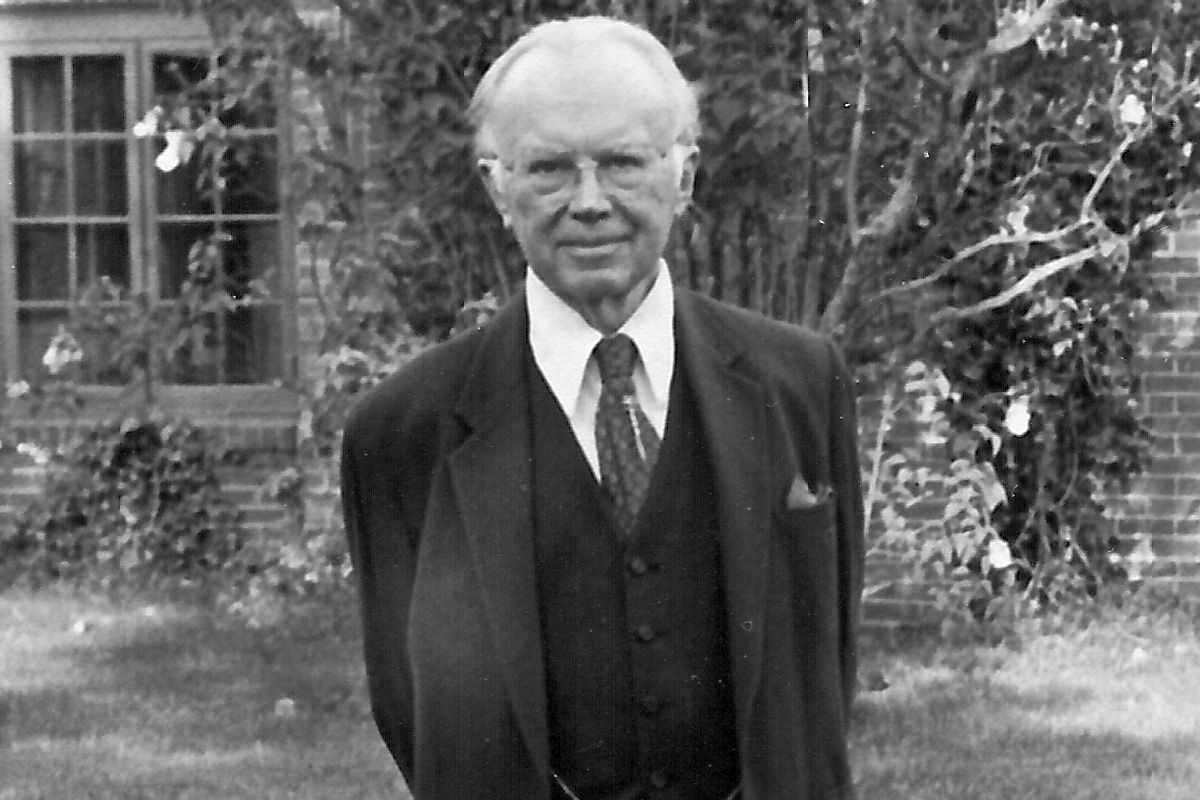


Russell Kirk foresaw today’s cultural collapse in England. The twentieth-century conservative educator knew what open borders would do to the former British superpower. He didn’t have a time machine in 1953—just reason and common sense.
Russell Kirk was born in Michigan in 1918, at the end of World War I. As a youth he saw the rise of clashing world powers and sweeping new ideologies. He endured the Great Depression as a teenager and served a non-combat Army role in World War II.
The united front against the Axis powers was a loose coalition of clashing ideas. The second half of the century lay ahead after two global conflicts. Allies who fought side by side held different ideas for peace and progress.
Kirk blended the libertarian mind of his contemporary Albert Jay Nock with the philosophy of eighteenth-century Irish conservative Edmund Burke. Against progressive academia, he formulated a worldview of “conservative” thought. For Kirk, it wasn’t simply a political theory. It was a moral perspective on life.
Kirk’s journals, National Review and Modern Age, are still strong today. His seminal work, however, is an edited version of his doctoral dissertation titled The Conservative Mind. With Burke as its grandfather, Kirk traced the development of Western conservative philosophy from the American Revolution to the mid-twentieth century.
Freedom depends on Christian morality
According to Kirk, “liberty, equality, and fraternity” are vain if not “rooted in Christian morality.” Transcendent good and evil with reward and punishment protect individual rights and national prosperity from collapse. Freedom and prosperity depend on self governance. That comes only when people understand the meaning and purpose of society itself.
Christianity teaches us not to justify our own desires. “Men’s passions are held in check only by the punishments of divine wrath and the tender affections of piety,” Kirk wrote. We realize focused desires are good and productive, but passions run amok only tear down. The filter of morality uses them to build civilization. Marriage, family, and innovation spring from fulfilling disciplined desires.
Untamed impulses ravage society: from individual to family to community to nation. When people seek fulfillment without moral responsibility, they conflate desires with needs. Meeting these “needs” becomes a right. “If rights are confused thus with desires,” Kirk mused, people suspect “some vast, intangible conspiracy thwarts their attainment of what they are told is their inalienable birthright.” This is the amoral, materialistic plague of Marxism in all its forms.
Pure materialism destroys prosperity
Rural culture, not mere economy, most embodied conservative principles for Kirk. He strongly believed in economic freedom, but enduring growth requires Christian morality. Though cities naturally created the most economic strength, Kirk didn’t want the urban to crush the rural.
“[T]he conservative elements in a nation are menaced,” Kirk reasoned, “when rural population commences to decline.” He worried cities would favor foreign labor and callously disregard its effects on rural areas. Rapid immigration during the industrial revolution, he believed, was a threat to culture. It was “the triumph of urban interests over the rural population,” and it sacrificed moral culture on the altar of immediate gains. “[E]conomic appetite” alone wasn’t conservative because the culture still needed the moral compass of religion.
Unassimilated immigration threatens culture
Kirk feared England and America were throwing culture to the wind for unvetted laborers. Short-term prosperity would come, but at what cost? Kirk observed that the migrant labor in the industrial age “changed the character of the American population.” He noted even the cultural shock from incoming Italians and Polish on a mostly Irish community. Imagine what he would think of England’s situation today!
Though a born and bred American, Kirk showed an affection for England. He recognized its need to restore the conservatism it contributed to the West. “[T]he American Constitution is British,” Kirk observed, “but Britain now needs to learn from her children.” If a culture is to survive, society can’t treat its heritage as a museum relic, or worse, a cancer to cure.
A misguided compassion for “refugees” is piercing England with a thousand cuts. For the island nation, as with Europe, open borders is beckoning Muslims from Pakistan and Bangladesh. Uncontrolled immigration threatens a nation’s cultivated norms. The remnants of centuries of Judeo-Christian tradition are succumbing to the demands of a third-world form of Islam.
Cultural heritage is a safeguard against collapse
“Men cannot improve society by setting fire to it,” Kirk sternly warned, “they must seek out its old virtues, and bring them back into the light.” Marxist revolutionaries, however, are quick to incinerate the moral inheritance that gave them their prosperity. Instead of preserving virtues and whittling off kinks, they seek to replace culture completely.
When the Parliament introduced a bill to ban first-cousin marriages, Prime Minister Keir Starmer refused to vote for it. Despite a recent study showing the risk of harmful genetic effects on children, he bowed to the pressure of foreign cultures. As Russell Kirk expressed, “the shell of Christendom has been broken” as “the marriage bond is relaxed.” The sensitivities of third-world invaders matters more to Starmer than truth and the cries of native citizens.
England stands at a crossroads. A software game’s propaganda backfired into “Amelia” being an icon of resistance and Western preservation. “The man who venerates his ancestors and thinks of his posterity,” Kirk contended, “will stand up resolutely against [the] Vandals of the intellect, who are reducing modern civilization to ashes.” Secular authoritarians are playing with fire.
A warning for England and America
“England is faced with a long and dreadful decay,” Kirk observed even 70 years ago. The cultural and economic delusions of the Labor Party are trying to speed up that decay. Kirk never lost hope that “England is great still, [and] capable of regeneration,” but warned that “if committed to the hands of the doctrinaire innovator, she must fall.”
For England’s offspring across the pond, Kirk also left admonitions and warnings. America must humbly show the dying cultures of the world “the preservation of justice and peace.” Ultimately, Kirk realized, “Americans will have it in their power to become the saviours of most that is lovely and honorable in civilization.”