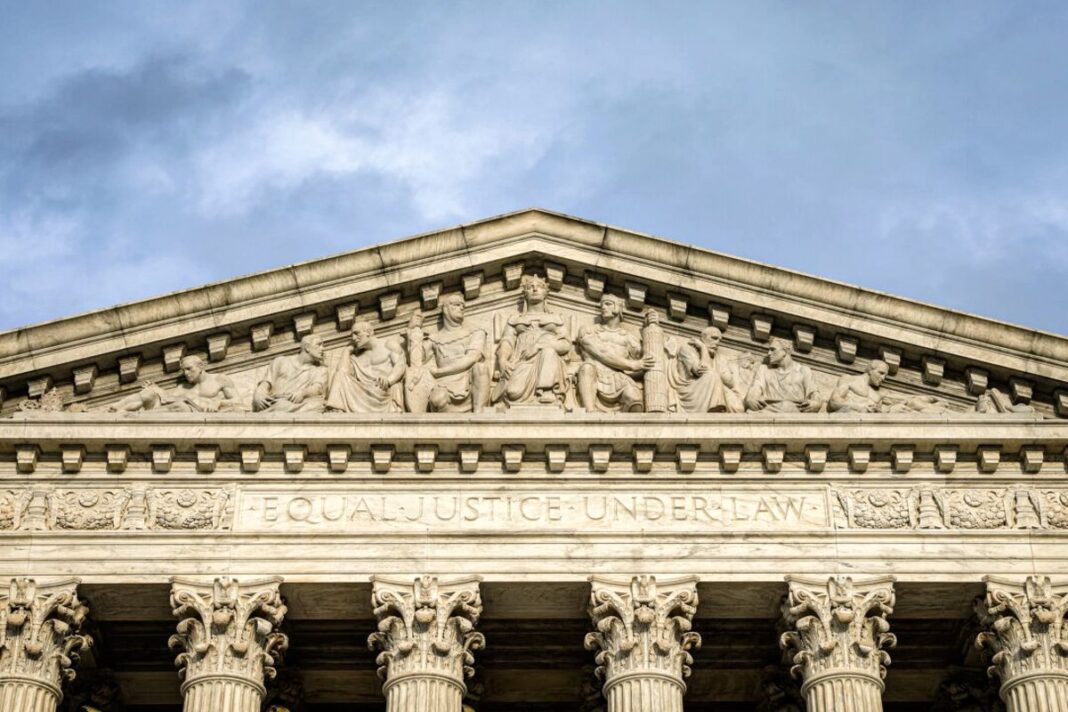


The dissenting opinion said the court is giving police officers ‘license to inflict gratuitous pain on a nonviolent protester.’
The U.S. Supreme Court on March 23 ruled 6–3 that qualified immunity prevents a protester from suing a police officer for allegedly using excessive force during an arrest at a state capitol.
Qualified immunity, a rule created by the courts, shields government officials, including police officers, from individual liability unless the wrongdoer violated a clearly established right. Civil libertarians have become increasingly critical of qualified immunity in recent years, saying it allows government officials to escape liability for sometimes egregious wrongdoing.
The high court’s new ruling in Zorn v. Linton took the form of an unsigned opinion.
Justice Sonia Sotomayor filed a dissenting opinion, which was joined by Justices Elena Kagan and Ketanji Brown Jackson.
The case goes back to Jan. 8, 2015, when the respondent, Shela Linton, attended a sit-in at the Vermont Capitol to demand universal health care. The official occasion was the inauguration of then-Gov. Peter Shumlin.
Linton said she intended to refuse to leave and expected to be removed by force, according to the opinion.
“That’s the point of the sit-in part of the protest,” she later said.
As the Capitol closed for the day, police officers informed Linton and the other protesters that they could face trespassing charges. They declined to leave, and the police began arresting them one at a time.
Sgt. Jacob Zorn asked Linton to stand, but she would not do so. He said he would have to use force to remove her, and she still refused to rise. Zorn held onto Linton’s arm, placed it behind her back, applied pressure to her wrist in what is known as a pain-compliance technique, and lifted her to her feet, the opinion said.
Linton sued the officer under 42 U.S.C. Section 1983, a federal law that allows individuals to sue governments for civil rights violations. She alleged Zorn violated her Fourth Amendment rights by using excessive force, stating that she experienced arm injuries and psychological disorders as a result of the encounter.
“After the incident, Ms. Linton suffered so acutely from her physical and psychological injuries that she was unable to seek care for herself,” Linton’s attorneys said in a brief.