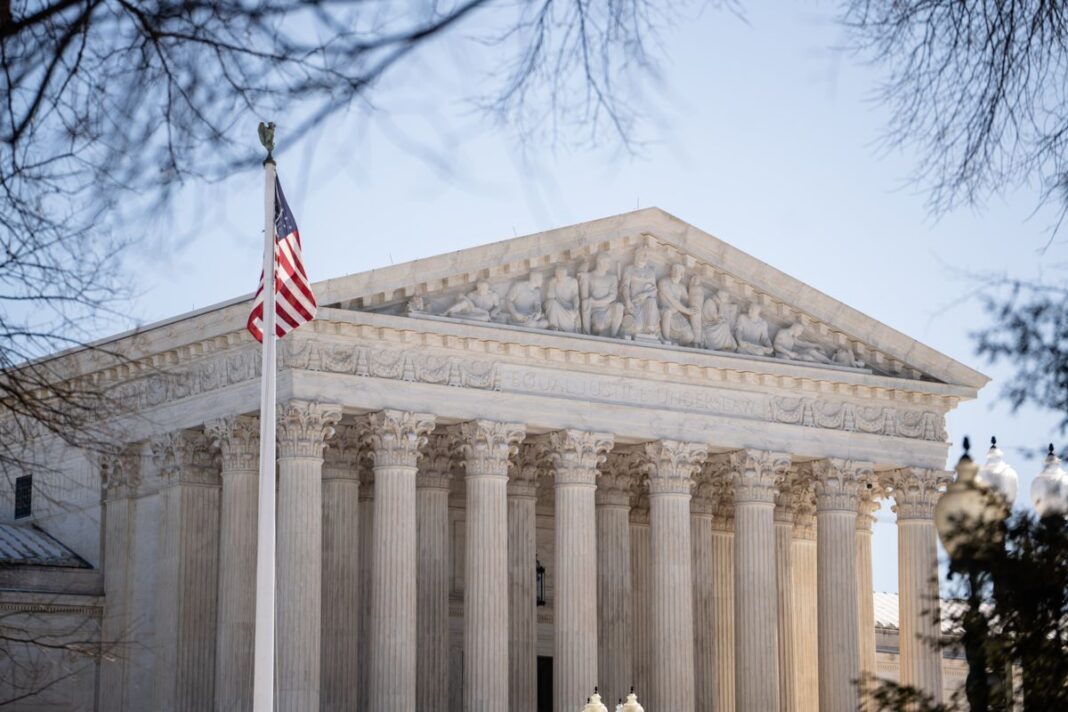


The high court said vote-dilution claims against Mississippi and North Dakota need to be reexamined after its recent landmark redistricting ruling.
The U.S. Supreme Court on May 18 ordered lower courts to reconsider rulings in two redistricting cases that concern whether private individuals may sue to enforce a federal law that bans discriminatory voting practices.
The court directed the lower courts to take another look at the cases from Mississippi and North Dakota in light of its recent landmark ruling limiting the use of race in redistricting efforts.
Justice Ketanji Brown Jackson dissented from both new rulings.
In Louisiana v. Callais, a majority of the court had said April 29 that race may not be the predominant, overriding reason for how congressional district lines are drawn. The case focused on the Pelican State’s decision to add a majority-black district after a lower court said omitting the district would violate the Section 2 nondiscrimination provisions of the federal Voting Rights Act.
On Monday, the nation’s highest court summarily disposed of the two cases, State Board of Election Commissioners v. Mississippi State Conference of the National Association for the Advancement of Colored People (NAACP), and Turtle Mountain Band of Chippewa Indians v. Howe, in unsigned orders. The court did not explain its decisions.
Lawyers call this process, which disposes of cases without holding an oral argument, GVR, which stands for grant, vacate, and remand.
The Supreme Court follows this procedure when it wants lower courts to reconsider their rulings using a new legal framework from a recent decision without delving deeply into the specifics of the cases.