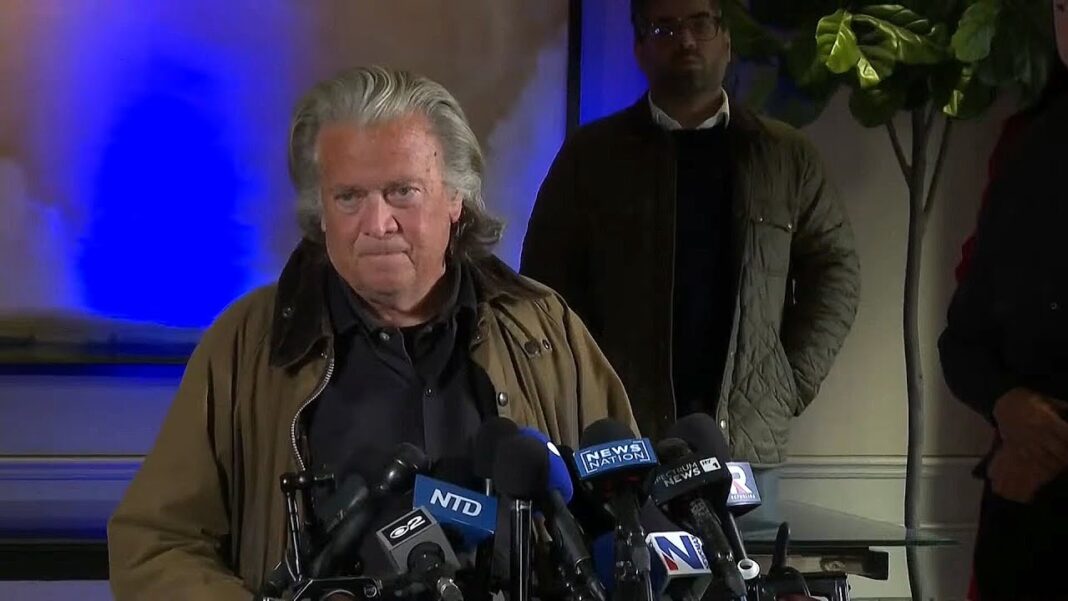


The former presidential adviser served four months in prison for contempt in 2024.
The Supreme Court on April 6 cleared the way for the Trump administration to dismiss the criminal contempt case against Steve Bannon over his failure to honor congressional subpoenas.
The high court granted Bannon’s petition in an unsigned order. The court did not explain its order. No justices dissented.
The Supreme Court sent the case back to the U.S. Court of Appeals for the District of Columbia Circuit for further consideration, as that court considers a pending motion to dismiss the indictment.
Bannon, an ally of President Donald Trump who served in the first Trump White House, was already convicted and imprisoned for four months in 2024 in the contempt case, but both Bannon and the Trump administration now want the case to be thrown out.
Bannon had been convicted by a federal jury in the nation’s capital on two counts of contempt of Congress for not providing documents or testimony to a Democratic-led House committee that was investigating the Jan. 6, 2021, security breach at the U.S. Capitol. At the time of the breach, Congress was in the process of certifying the results of the 2020 presidential election. Joe Biden was inaugurated as president on Jan. 20, 2021.
Bannon had said the committee’s investigation and the charges later brought against him by the Biden administration were politically motivated.
At the sentencing hearing, prosecutor J.P. Cooney said Bannon opted to “thumb his nose at Congress,” adding that Bannon was “not above the law, and that’s what makes this case important.”
The Supreme Court turned away Bannon’s request to delay his imprisonment while the appeal played out. He served the sentence and was released a week before Trump beat then-Vice President Kamala Harris, the Democratic presidential nominee, in November 2024.
Bannon filed a petition with the Supreme Court in October 2025, asking the justices to throw out his convictions that were made under 2 U.S.C. Section 192, the criminal contempt-of-Congress statute.
The petition said the law is the only federal criminal statute in which “willful” mens rea—Latin for “guilty mind,” a legal term meaning criminal intent—requires merely “intentional” conduct. In that law, Congress criminalized “willfully … [defaulting]” on a legally authorized congressional subpoena, the petition said.
The D.C. Circuit found that “willfully” required only intentional conduct, which meant that the government did not have to prove that the subpoena recipient understood his conduct was unlawful.
Three circuit court judges dissented from that court’s May 2025 ruling, finding that the interpretation was inconsistent with 150 years of case law, violated basic rules of legal interpretation, and would seriously harm the separation of powers.
The separation of powers is a constitutional doctrine that divides the government into three branches to prevent any single branch from accumulating too much power.
The Supreme Court’s longtime position is that in the criminal context, “to prove willfulness, the Government must demonstrate that an individual knew that his conduct was unlawful,” the petition said.
“Congress conspicuously omitted ‘willfully’ when criminalizing a different set of actions. The use of two different mens rea requirements demonstrates that ‘willfully’ was meant to impose a heightened standard,” the petition reads.
The petition said Bannon relied in good faith on his attorney’s advice to delay complying with a subpoena until executive privilege disputes were resolved, as they had previously been on three prior occasions involving his testimony.
ven though he was advised he was acting lawfully, Bannon was indicted and the federal district court prevented him from presenting evidence or argument to the jury about his reliance on his attorney’s advice or on executive privilege, according to the petition.
The Department of Justice filed a brief in February supporting Bannon’s petition.