

California’s shadow cannabis industry linked to Chinese organized crime and narco-slavery.
YREKA, Calif.—A convoy of sheriff’s deputies heads into a vast network of illegal marijuana grow operations in the foothills of Mount Shasta in California’s Siskiyou County.
They drive into a dusty encampment strewn with garbage and piles of empty plastic fertilizer containers, a blight on the otherwise scenic landscape.
The morning raid is nothing new for Siskiyou County Sheriff Jeremiah LaRue.
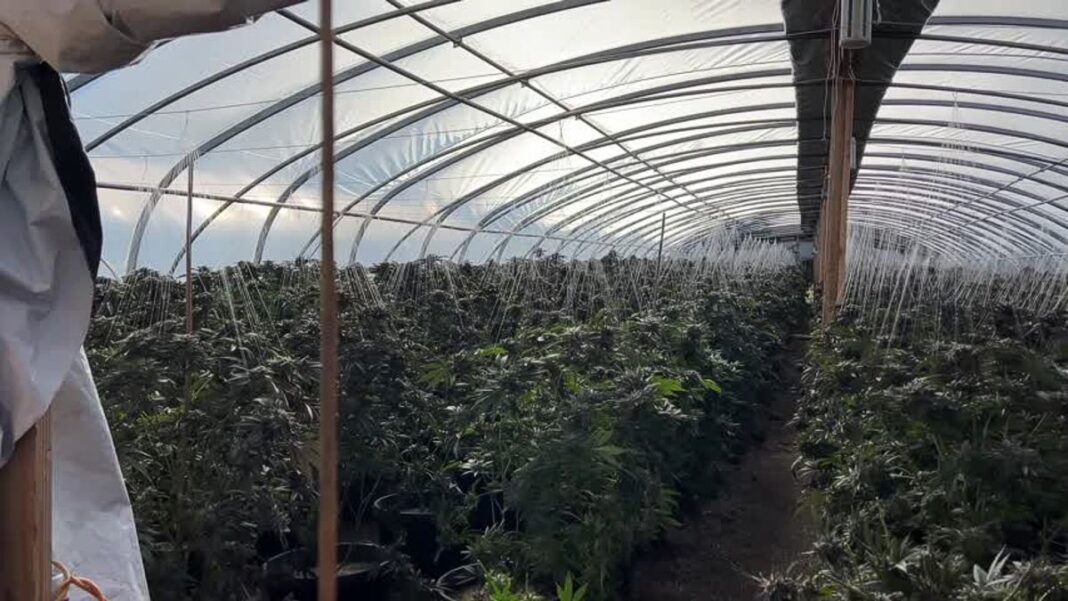
Thousands of makeshift greenhouses known as “hoop houses”—each one containing hundreds of illegally grown cannabis plants—are operating in the county at any given time, LaRue told The Epoch Times, as his deputies scoured the Mount Shasta Vista subdivision, a 20-minute drive northeast of Weed, Calif.
The sheriff’s office has counted 2,732 hoop houses using satellite and aerial imagery in the subdivision alone.
By the time he arrived at the scene on June 4, all the occupants had fled.
Spotters at these illegal grow sites—sometimes armed with AK-47s and rifles, according to nearby residents—alert laborers to leave the camp when they see sheriff’s deputies approaching.
Except for a few roosters, an older German shepherd, and a couple of curious pups, the site was abandoned. The occupants had already cleared out when an advance team of investigators approached the camp earlier that morning.
They know the drill.
About 430 flowering marijuana plants were found in each of two 30-by-100 foot hoop houses. Agents from the regional North State Marijuana Investigation Team weighed about 900 pounds of freshly cut marijuana plants that were hanging to dry in another slightly larger greenhouse.
All the marijuana was destroyed. No one was arrested, according to the sheriff’s office.
The team had served a search warrant on the same property last August and arrested the property owner, Haizhou Wang, then 56, who was on-site at the time.
Cannabis industry experts estimate that more than 30 million pounds of illicit marijuana are grown in the United States annually.
Siskiyou County alone produces about 17.8 million pounds of illegal marijuana every year, with a “low-end” estimated local street value of about $3.6 billion based on sales at $200 a pound, according to the sheriff’s office.
A typical pound of processed black-market marijuana may sell for a couple hundred dollars in California, but can sell for $1,500 in Midwest and East Coast markets and much more in other countries, according to both the sheriff’s office and the California Department of Cannabis Control.
The Chinese Connection
Even as the potency of marijuana has increased exponentially, black-market prices have remained stable, according to the U.S. Drug Enforcement Administration (DEA).
Over the past two decades, Chinese and other Asian crime syndicates have taken control of the black-market marijuana trade.
“These organized crime groups, as well as Mexican cartels, are profiting from both illegal cultivation and sales, and from exploiting the ‘legal’ market,” the agency states in its 2025 National Drug Threat Assessment.
Under federal law, the cultivation and sale of any marijuana remains illegal, but in states that have legalized or decriminalized cannabis, organized crime has only proliferated—not shrunk as cannabis proponents promised.
Chinese transcontinental criminal organizations now dominate the cultivation and distribution of marijuana throughout the United States from California to Maine, with real estate purchases for both indoor and outdoor grows funded via family and community connections in China and the United States, according to the DEA.
“Undocumented Chinese immigrants, many of whom spent years in Mexico and were lured to the United States with offers of legal employment, staff many of the grow sites alongside undocumented Mexican immigrants in similar circumstances. The undocumented migrants are closely monitored by the Chinese [transcontinental criminal organization] members who own and manage the grows,” according to the assessment.
“Most of the grow sites are located in states where the cannabis industry is ‘legal,’ though most do not follow the established licensure process or have obtained their licenses through falsified means. They face little prison time, if any, when caught, and often move to a new location in the same state or to another ‘legal’ state once discovered.”
An extensive money laundering network involving “registered marijuana grows using straw owners, casinos, and mortgage fraud,” fueled by the Chinese underground banking system with a main hub in New York City, is used to send illicit cannabis proceeds to mainland China, according to the assessment.
In 2024, Oklahoma accounted for 66 percent of the illicit marijuana seized nationwide while California accounted for 15 percent, followed by Maine, Missouri, and Indiana with 3 percent each.
Within the United States, large shipments of marijuana are usually hauled in semi-trailers, while smaller amounts are transported in personal vehicles using a “shotgun approach” to minimize risk.
“The ‘shotgun approach’ involves sending multiple vehicles, usually carrying no more than a couple hundred pounds of marijuana each, to the same destination to avoid the loss of a single, large shipment,” according to the assessment.
By Brad Jones