

Increasing ‘dark transit’ traffic undermines Iran’s claim it controls Hormuz, but an Aug. 18 missile attack undermines U.S. assurances of safe passage.
With the recent expiration of the 60-day memorandum of understanding between the United States and Iran, there’s little indication either side is backing down from dueling narratives about who controls access to the Persian Gulf through the Strait of Hormuz.
It remains a tale of two straits.
Tehran maintains that the 104-mile-long waterway is closed to ships unless they enter and exit the Gulf through the Iranian Unilateral Scheme, or northern route, that previously was exclusively used for inbound traffic.
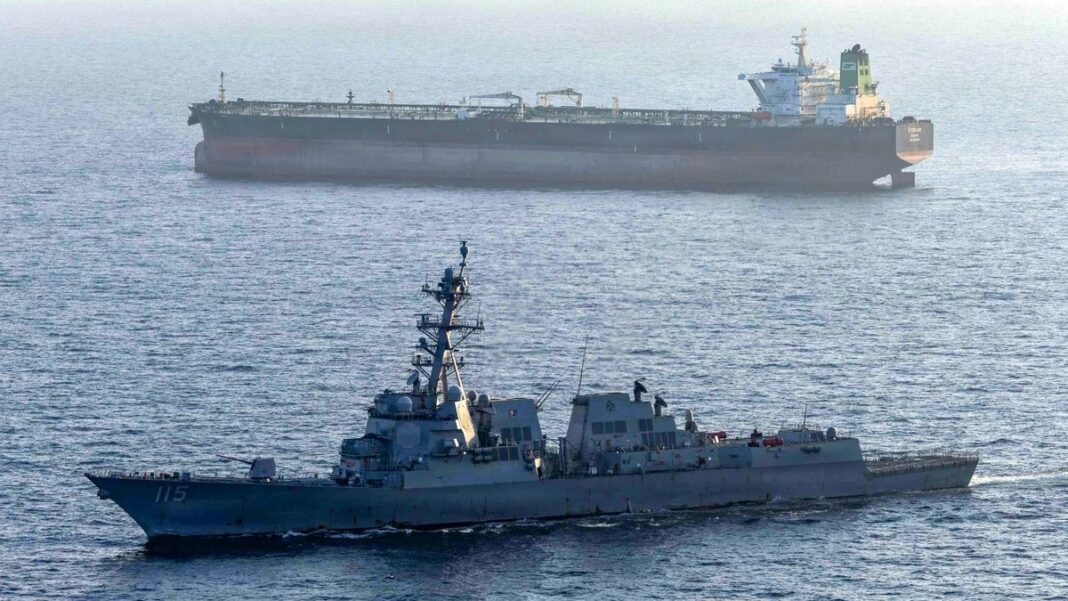
Global shippers refute any Iranian claim of sovereignty and Washington maintains that ships are moving through the United Nations’ authorized southern route along the Omani coast, which was formerly designed for outbound traffic into the Gulf of Oman, under the protection of U.S. Navy destroyers.
U.S. Energy Secretary Chris Wright on Aug. 14 said that between 14 million and 15 million barrels of crude per day were being exported from the Gulf, including 5 million to 7 million daily by Kuwait, Saudi Arabia, and the United Arab Emirates via a “shuttle system” in which large tankers transit the southern route and offload to ships in the Gulf of Oman. That’s about three-quarters of the volume before the war began on Feb. 28.
But ship-tracking services such as Kpler, Lloyd’s List Intelligence, and MarineTraffic maintain that those claims cannot be verified because, it appears, much of this traffic is in “dark transits,” meaning without transponders and other electronic navigation beacons on.
U.S. President Donald Trump said this traffic through the southern route affirms that the strait is open for all but Iranian ships, re-emphasizing that the U.S. Navy will sustain its global blockade of Iranian shipping and that it is slowly strangling Tehran’s economy.
“The Naval Blockade remains in full force and effect,” Trump wrote in an Aug. 18 Truth Social post. “The Hormuz Strait is open and operating. All water mines have been removed or detonated.”
There are, on average, 20 U.S. Navy warships in the Gulf of Oman, spearheaded by an ever-present carrier battle group—the USS Abraham Lincoln remains on station awaiting relief from the USS George Washington—with destroyers moving in and out of the Persian Gulf through the strait as a shield for commercial shipping through the southern route.
U.S. Treasury Secretary Scott Bessent, in numerous recent media comments, has confirmed that the U.S. Navy blockade, and the economic isolation it imposes, is how the Trump administration aims to negotiate with Iran while the Navy protects shipping on the southern route.
By John Haughey