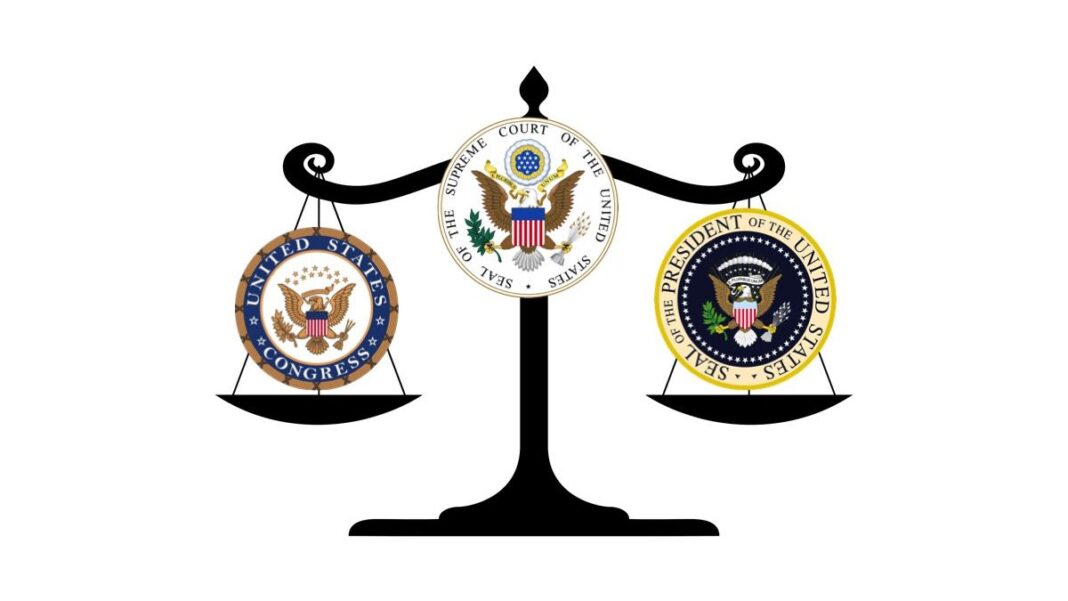


Scholars pontificate on the brilliance of the separation of powers in our Constitution as a means of protecting citizens by limiting the power of each branch of our government. They talk as if each branch actively works to control the power of the other branches to protect citizens. Unfortunately, these scholars miss reality. The three branches of our government work together to enhance federal powers at the expense of citizens. As the power of the federal government increases, the rights of the individual shrink.
The framework of our Constitution is so broad and vague as to allow the federal government to be capitalist, communist or socialist, or as now, a “wokeist” system. Moreover, the federal government can tax us as much as it needs to satisfy its wants. From 1932 to 1981, the marginal tax rate in the U.S. ranged between 63% – 91%. Today, it’s hard to believe, the federal government can’t live on $5 trillion a year.
Cementing this divide, the U.S. Supreme Court, shortly after our Constitution was ratified, adopted the English doctrine (not a law) of sovereign immunity, i.e. “The King (now the federal government) Can Do No Wrong.” The court’s decision adopted the doctrine as the law of the land. In simple terms, no one can sue the federal government without its consent. While the federal government has consented to being sued on routine matters (e.g., torts, breaches of contract, copyright violations, open records laws, and violations of civil rights when government officials are acting illegally but under color of law), the doctrine of sovereign immunity still bars citizens from challenging the illegal operations of government.
Presently the United States is a system of political rulers and citizen subjects. Citizens can change this system by electing members of Congress who will serve as trustees of the Constitution and fiduciaries to us. Our founders attempted to implement this vision though the Oath’s clause, by not recognizing political parties in the Constitution, and by vesting all legislative power in the Congress. Unfortunately, Congress has abandoned its duties under the Constitution and the Executive and the judiciary have vigorously grabbed additional powers.
Notwithstanding Congress being granted all legislative power, it has delegated much of its legislative power to the Executive. Once such delegation occurs, the president though Executive Orders, proclamations and agency rulemakings, determines the law of the nation. Routinely Congress passes a law but the president ignores it, or the president uses agency rulemakings to substitute its will for the intentions of Congress. Examples include the open southern border, lockdowns in the pandemic, stripping legally held permits from the fossil fuel industry, and imposing climate change regulations without any authorizing law.
Compounding this travesty of congressional delegation of legislative powers to the Executive branch, the federal courts, since the founding of the Republic, have operated as super-legislatures. While the Constitution clearly mandates “All legislative Powers … shall be vested in a Congress of the United States,” the U.S. Supreme Court gladly approved of Congress delegating its legislative authority away, requiring only that Congress indicate some “intelligible principal” to the agency implementing the law. “An ‘intelligible principle’ could be anything in the ‘public interest, convenience, or necessity’ or considered ‘just and reasonable.’ Being put in such subjective terms gives agencies vast discretion when enacting new rules.”
As a super-legislature, with almost unreviewable power, the Supreme Court created rights under National Environmental Policy Act that allow environmental groups to enjoin any action they believe is not the correct environmental decision. This decision gives the environmental activists the ability to control governmental permitting decisions that encompass new oil, gas and manufacturing decisions. Another example, is the Supreme Court creating a federal right to an abortion by “discovering” some non-existent penumbra of previously unknown rights in the constitution. Simply, the Supreme Court has rewritten the Constitution in cases too numerous to mention, especially during the period 1937 – 1944.
Even in routine administrative rulemakings involving a vague statute, the Supreme Court allows the agency fills in the blanks, rather than making Congress do its work.
As the Supreme Court and the Executive expand their power, Congress is placed in a state of helplessness. It does not matter how the law reads; the law is what the court or agency says it means until Congress can gather the votes to overrule the decisions of the other branches. In a divided Congress this is almost an impossible effort.
Once in this state of helplessness, Congress has only one power to control the administrative state; the power of the purse. Under our Constitution “No Money shall be drawn from the Treasury, but in Consequence of Appropriations made by Law.” If one party is in control of the Executive and both houses of Congress, the will of the Executive generally prevails as Congress is a mere rubber stamp. However, if a minority party controls just one house of Congress, it can refuse to appropriate the monies needed to run administrative state. While Congress could not eliminate the Executive or Judicial branches, it could dramatically scale back their funding as a means of reigning in a massive federal government.
While withholding the funds to operate the administrative state is viewed by many as abhorrent; it is the only constitutional power Congress can exercise that cannot be blocked by the other branches. If Congress fears using its power of the purse against the administrative state or an out-of-control judiciary, then it is a useless branch of government.
As citizens we can speak out, protest, demonstrate, complain at government meetings, send nasty letters to our elected officials, but in the end, we will be ignored if government wants to ignore us. Government controls our money. In most instances, government, through the withholding tax, has its money before we get our pay checks. Government controls the police to ensure we do nothing other than what it permits. The federal government has even designated parents speaking-out at school board meetings to be domestic terrorists. Moreover, government has and will most likely use, the military and its weapons to ensure citizens act only in ways acceptable to it. Police even blocked the road on the truckers’ convoy so it could not protest in DC. The truckers’ convoy had to good sense to avoid the grave danger of protesting when the police and likely the federal government would use force to stop them. Had they been Black Lives Matter, they could have burned down the city and it would have been called a peaceful protest. That is life under a woke American government.
The only power we the people have to control government is our power to vote for our members of Congress. We do not vote for President, the Supreme Court or the millions of nameless bureaucrats that make laws everyday through rulemakings. Our right to vote for members of Congress is extraordinarily powerful. It is a legal mechanism for a peaceful revolution. With our votes we can vote out all elected officials over six years and elect a Congress that is a trustee of the Constitution and a fiduciary to the people.