

An ‘economic cutoff’ imposed on the CCP would damage China’s economy five to seven times more than those of the U.S. and its allies, said a Dartmouth professor.
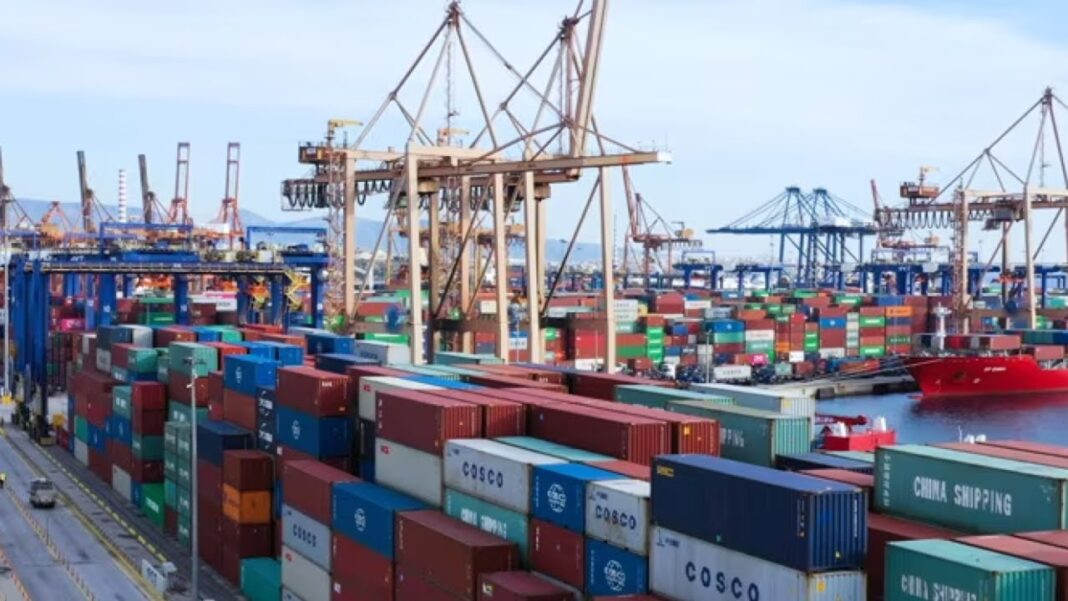
If trade disputes between the United States and China spiraled into total export-import bans, both nations’ economies would be devastated. But China’s economy—reliant on exporting products that can be manufactured elsewhere—would suffer far more and for far longer, researchers say.
According to Dartmouth Professor Stephen Brooks, if the United States and its allies imposed “an economic cutoff” on China, damage to its economy would be five to seven times more than damage to the United States’ economy, and its gross domestic product would degrade 15 percent to 51 percent within a year.
Brooks, co-author of “Command of Commerce: America’s Enduring Economic Power Advantage over China,” was among four experts who participated in a Dec. 5 discussion on “critical supply chains in an age of great power rivalry” at the Brookings Institution’s Strobe Talbott Center in Washington.
All agreed that the United States—especially if working with the European Union, Japan, South Korea, and Taiwan—is better positioned to weather a “trade war” than China’s ruling Chinese Communist Party (CCP).
That assessment is contrary to the conventional wisdom that there’s no way for such countries to hurt China without hurting themselves as much, said Brooks.
“That’s mostly wrong,” he said. “A big reason that’s misunderstood is China likes to say it’s 12 feet tall, and then our government says, ‘Yep, they’re 12 feet tall.’”
China is, indeed, the world’s leading processor of critical minerals that are essential in modern manufacturing, including military applications. Its industries control 90 percent of the global magnet market, as documented in a recent Congressional report.
According to the report, China-based processors refine 85 percent to 90 percent of rare earths and control at least 75 percent of the global market for 30 of 54 commodities deemed “essential to national security” by the U.S. Geologic Survey in its 2025 Critical Minerals List.
U.S. manufacturers are 100 percent import-reliant for 12, and more than 50 percent import-reliant for 29, of those 54 commodities. Since April, the CCP has imposed “export control restrictions” on 12 rare earths—classified collectively as one critical mineral on the survey’s list—including five in October.
China has since suspended restrictions for a year on the five it sanctioned in the October trade negotiations with President Donald Trump, but restrictions imposed on seven other rare earths remain intact.
The CCP’s manipulation of global minerals markets is, “by far, the best weapon China had,” Brooks said. “I don’t see yet anything nearly as close to rare earths as a super valuable weapon that China has.”
“Therefore,” he said, “China may well have just used its best weapon. If I was a Chinese strategist, I would have held actually that in reserve for what I would call a true crisis.”
If the United States expanded export restrictions on Chinese industries, they “would have such amazing power,” Brooks said. “In terms of things China needs from the U.S. and its allies to make what it wants to make, I can’t stretch my arms wide enough.”
The book “Command of Commerce,” published in April after three years of research with co-author Ben Vagle, a 2025 Knight-Hennessy Scholar, exposed skewed and misinterpreted data, poorly defined standards in measuring economies, and a “quite shocking” revelation that “no one has actually modeled what, exactly, would happen if there was a cut-off” in trade with China, Brooks said.
Among the discoveries: “China’s economy is one-third smaller than it’s currently measured to be, not 3 percent—33 percent—which means China’s economy is more like half of our size rather than two-thirds,” Brooks said.
Noting that “the Soviet Union, at its peak of economic power in 1975, was at 57 percent of U.S. GDP,” Brooks said the assessment reached in his research is that “China is not yet as large relative to us as the Soviet Union was during the Cold War.”
By John Haughey