
Cotton Op-Ed in the WSJ: Is it possible Covid-19 came from the laboratory in Wuhan

5Mind. The Meme Platform

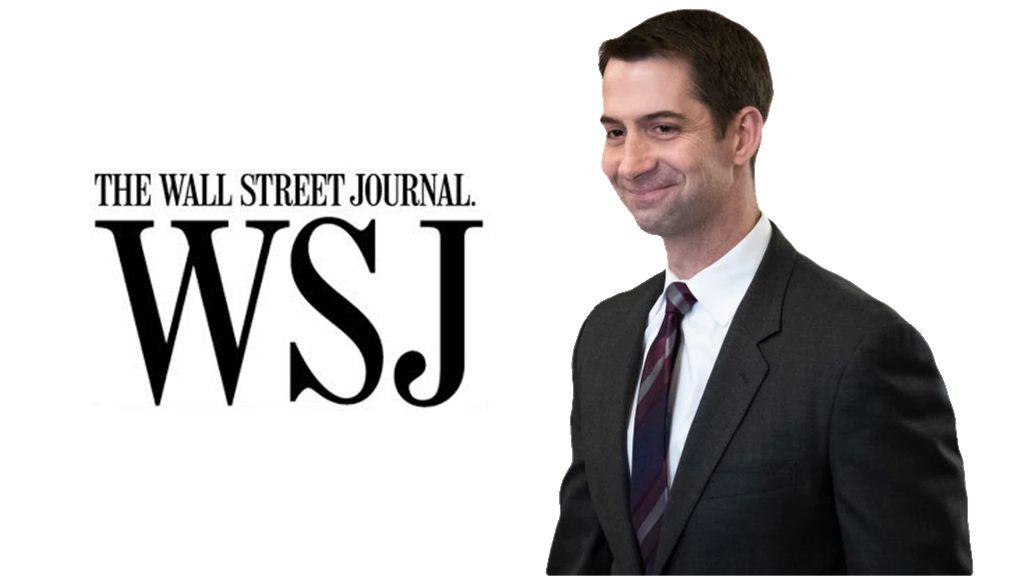
The U.S. government is investigating whether the Covid-19 virus came from a government laboratory in Wuhan, China. The Chinese Communist Party denies the possibility. “There is no way this virus came from us,” claimed Yuan Zhiming over the weekend. Mr. Yuan is a top researcher at the Wuhan Institute of Virology, which studies some of the world’s deadliest pathogens. He is also secretary of the lab’s Communist Party committee. He accuses me of “deliberately trying to mislead people” for suggesting his laboratory as a possible origin for the pandemic.

Beijing has claimed that the virus originated in a Wuhan “wet market,” where wild animals were sold. But evidence to counter this theory emerged in January. Chinese researchers reported in the Lancet Jan. 24 that the first known cases had no contact with the market, and Chinese state media acknowledged the finding. There’s no evidence the market sold bats or pangolins, the animals from which the virus is thought to have jumped to humans. And the bat species that carries it isn’t found within 100 miles of Wuhan.

Wuhan has two labs where we know bats and humans interacted. One is the Institute of Virology, eight miles from the wet market; the other is the Wuhan Center for Disease Control and Prevention, barely 300 yards from the market.

Both labs collect live animals to study viruses. Their researchers travel to caves across China to capture bats for this purpose. Chinese state media released a minidocumentary in mid-December following a team of Wuhan CDC researchers collecting viruses from bats in caves. The researchers fretted openly about the risk of infection.

These risks were not limited to the field. The Washington Post reported last week that in 2018 U.S. diplomats in China warned of “a serious shortage of appropriately trained technicians and investigators needed to safely operate” the Institute of Virology. The Wuhan CDC operates at even lower biosafety standards.

While the Chinese government denies the possibility of a lab leak, its actions tell a different story. The Chinese military posted its top epidemiologist to the Institute of Virology in January. In February Chairman Xi Jinping urged swift implementation of new biosafety rules to govern pathogens in laboratory settings. Academic papers about the virus’s origins are now subject to prior restraint by the government.

In early January, enforcers threatened doctors who warned their colleagues about the virus. Among them was Li Wenliang, who died of Covid-19 in February. Laboratories working to sequence the virus’s genetic code were ordered to destroy their samples. The laboratory that first published the virus’s genome was shut down, Hong Kong’s South China Morning Post reported in February.

This evidence is circumstantial, to be sure, but it all points toward the Wuhan labs. Thanks to the Chinese coverup, we may never have direct, conclusive evidence-intelligence rarely works that way-but Americans justifiably can use common sense to follow the inherent logic of events to their likely conclusion.

By: Senator Tom Cotton

Contact Your Elected Officials
The Thinking Conservative
The Thinking Conservativehttps://www.thethinkingconservative.com/
The goal of THE THINKING CONSERVATIVE is to help us educate ourselves on conservative topics of importance to our freedom and our pursuit of happiness. We do this by sharing conservative opinions on all kinds of subjects, from all types of people, and all kinds of media, in a way that will challenge our perceptions and help us to make educated choices.

US Natural Gas Market Shielded From Global Price Shocks During Iran War

Analysts say East Asia could see hikes in energy costs after an Iranian strike wrecked Qatari LNG infrastructure that met 20 percent of the world’s demand.

Israel Targets Checkpoints That Hold Back Iranian Uprising

For decades, one of the most visible expressions of state power in Iran has not been found in govt. buildings or military bases, but in the streets.

The Limits of Power—and the Power Behind the Regime

Western policymakers assume regimes fall when they lose legitimacy. History shows they collapse when they lose the power—and money—to enforce control.

Momentum Builds for Regime Change in Cuba

Momentum builds for regime change in Cuba as Cuba’s leadership faces increased strain from U.S. policy and mounting protests on the island.
00:01:55

US Has a New Ally in Latin America—Here’s Why It Matters

“We are going to take back our country,” newly minted Chilean President José Antonio Kast told a crowd of thousands as he took office March 11.

FedEx Rolls Out Same-Day Delivery Service

FedEx launched a same-day delivery service as shipping and retail companies compete to meet growing customer expectations for near-instant order fulfillment.

Suspicious Drone Incursion Causes Alarm at US Bomber Base

Suspicious drone activity recently caused alarm at a U.S. military base in Louisiana that hosts long-range strategic bombers.

Stocks Slip, Oil Holds Above $100 as Iran Tensions Cloud Sentiment

U.S. stocks opened lower while oil prices held above $100 a barrel on March 24, as lingering doubts over easing Middle East tensions weighed on sentiment.

FCC Bans Foreign-Made Routers Citing National Security Risks

FCC banned all imports of foreign-made commercial routers March 23, a move that targets Chinese-linked brands found to pose national security risks.

Markwayne Mullin Sworn In as DHS Secretary

Former Oklahoma Senator Markwayne Mullin was sworn in at the White House as the new Secretary of the Department of Homeland Security (DHS).
00:27:39

US Looking to Seize Iranian Defectors’ Money: Bessent

Treasury Sec. Scott Bessent said that the US is moving to seize funds transferred abroad by Iranian defectors, so it can be to returned to the Iranian people.

Trump Says He’s ‘Not Putting Troops Anywhere’ Amid Iran War

President Donald Trump met with Japanese Prime Minister Sanae Takaichi to discuss the Iran war, saying he is not inclined to send U.S. ground troops.

US Agencies Terminated or Reduced 95 Wasteful Contracts Worth $2 Billion: DOGE

Federal agencies canceled or scaled back 95 wasteful contracts worth up to $2B in the last four weeks, saving taxpayers $757M.
spot_img

Related Articles

Popular Categories

MAGA Business Central