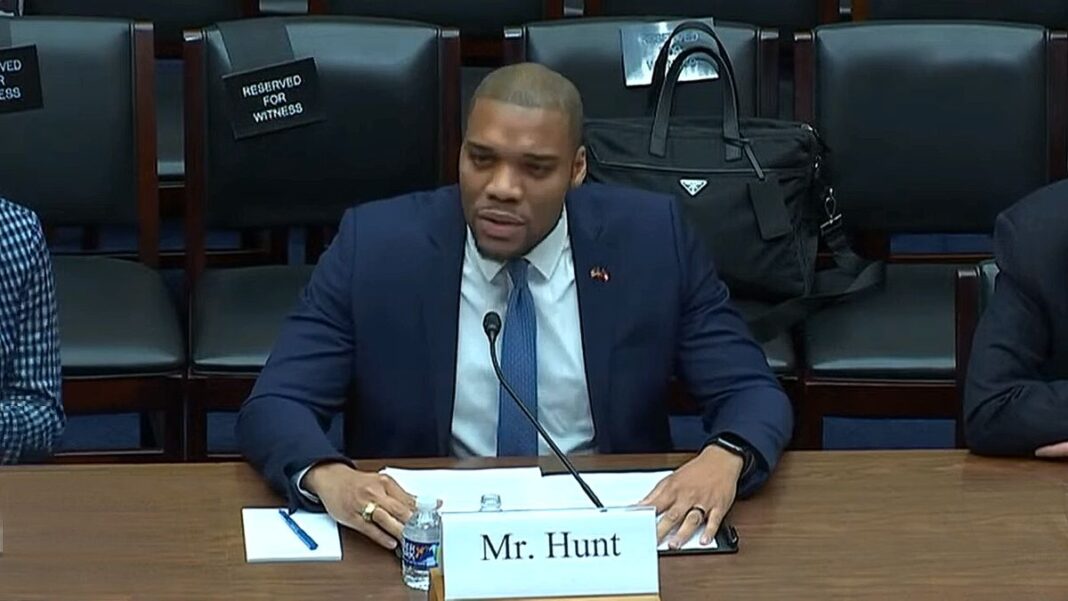


Statement before the House Committee on Oversight and Accountability Subcommittee on National Security, the Border, and Foreign Affairs
Good afternoon,
Chairman Grothman, Ranking Member Garcia, and Members of the subcommittee, thank you for the opportunity to testify today about the state of our military’s readiness.
I’m Jeremy Hunt, and I have the honor of serving as Chairman of Veterans on Duty, a nonprofit policy advocacy organization made up of veterans who are concerned about the state of our military and the strength of our national security. Many of us have deployed to Afghanistan, Iraq, and — in my case — Western Ukraine. During my time on active duty as an Army intelligence officer, I helped train the Ukrainian Armed Forces for what was then a hypothetical scenario of Russia launching an invasion against Ukraine. Five years later, I watched video footage of Yavoriv Training Center in L’viv, where I lived for many months, become engulfed in flames after a Russian attack.
That footage reminded me, yet again, that our adversaries abroad are more emboldened than ever. And it’s not just Russia. China continues its multi-generational effort to supplant the United States as the world’s leading superpower. The Chinese Communist Party is building hypersonic missiles that our radar systems can barely detect, spying on Americans without consequence, and threatening the sovereignty of Taiwan. And of course, threats remain from barbaric regimes in North Korea and Iran. In light of these rising threats, there is growing concern that our United States military simply isn’t ready.
We stand amidst a once-in-a-generation military recruitment crisis. At the end of FY 2022, the Army fell 15,000 soldiers short of its recruiting goal, missing by 25%. Our military is facing the worst recruitment challenge since the advent of the all-volunteer force after the Vietnam War. Apart from these manning shortfalls, other readiness issues abound.
Just last year, the Navy reported $2 billion in shipyard backlogs for their service fleet. This report came during the same year that the USS Connecticut — an indispensable fast-attack submarine — crashed into a seamount, due to an avoidable human error. Avoidable accidents abound in the sky as well. The National Commission on Military Aviation Safety found that from 2013 to 2020, our military lost 224 personnel and 186 aircraft worth over $11.6 billion to avoidable aircraft accidents. The Commission found that distracting aviation professionals “from their primary aviation duties with additional duties” is a leading cause for the uptick in accidents.
There are many factors that led us to this dangerous position. Global supply chain challenges have made it difficult for the Services to maintain their vehicles and equipment. Low nationwide unemployment rates have created a challenging environment for military recruitment. And of course, with rising teen obesity rates, data shows that only about 23% of America’s youth are even eligible to enlist, shallowing the recruitment pool. COVID prohibited recruiters from high schools, depriving the military of one its most important tools.
These factors do matter and play an important role in the recruitment crisis. However, they are factors beyond the military’s control. I’d like to focus on a few things the military can control.
The Reagan Institute annually conducts a “trust in the military” poll, which analyzes the public’s faith and confidence in the military. It should be of concern that the survey found an astonishing double digit decrease in the number of Americans with strong confidence in our Armed Forces. Pew had similar findings. The Reagan Institute survey found that the politicization of a long-apolitical institution was especially concerning to many of the Americans polled.
This politicization can be best described in terms of priorities and practices. That is, things the Pentagon says are important: priorities, and things the Pentagon does: practices.
When Secretary Austin was sworn into office, he shifted the Pentagon’s priorities away from the National Defense Strategy and towards issues that can be perceived as political. While he rightly identified China as a “pacing threat,” he also expressed an emphasis on policies atypical to the military’s core purpose — to prepare for war and win wars. These include climate change, domestic extremism, and diversity, equity, and inclusion (DEI). All are priorities that are more appropriate to the domestic political debate, all are priorities favorable to the party-in-power, and all are priorities that represent an odd fit for an institution purposed for a violent clash of arms against a tough and determined adversary. This has led to the perception that the Pentagon serves a political party, rather than the American people as a whole. As a matter of practices, the Pentagon has followed through on this political agenda. In the wake of the Supreme Court’s Dobbs decision, Secretary Austin made an unprecedented political announcement that the Department of Defense would pay for servicemembers and their families to travel to different states to receive abortions and offer three weeks of paid vacation for those seeking abortions, shoving the Department of Defense into one of the most polarizing political issues of our time.
Further, recent presidential administrations have ordered the replacement of longstanding Equal Opportunity programs with a new DEI bureaucracy. The current program subjects some servicemembers to 11-week resident DEI training classes — despite the military’s history of leading the fight against discrimination. There was no measurable increase in racist incidents that demonstrated a need for such a dramatic increase in the number of DEI bureaucrats or such an extreme training requirement.
Rather than focusing on new enemy battle tactics, the Navy recently mandated gender-sensitivity training, and released a video encouraging sailors to closely police the use of pronouns and everyday language, declaring that those who fail to comply aren’t “allies” of their fellow sailors. One intelligence officer framed the problem as one of messaging and priorities. “I know more about how to administer a transgender urinalysis,” he said, “than I do about the range of Chinese anti-ship missiles.”
There are other examples too numerous to count. My alma mater West Point lectures cadets about “addressing whiteness,” while the Air Force Academy has started the bizarre practice of appointing cadet DEI officials. The Academy also has a DEI reading room, with some hotly politicized materials that teach race essentialism and collective guilt and portray the United States as an inherently racist country that can only be salvaged by the wholesale implementation of progressive politics. I want to be clear: No service academy should have a DEI reading room any more than there should be a Rush Limbaugh reading room. To do so is inappropriate and irrelevant to the military’s mission.
In spring of 2021, Secretary Austin ordered a military-wide “stand down” to address “extremism in the ranks.” This was done in the wake of the January 6 attack on the U.S. Capitol. He also formed a Countering Extremism Working Group. Yet, according to the Defense Department’s own records, fewer than 100 members of the military have been “subject to official action due to engagement in prohibited extremist activity.” That number represents about 0.005% of the military out of 2.1 million active and reserve personnel. Nevertheless, the Defense Department spent 5,359,000 hours on extremism prevention and the Department’s FY 2023 budget request contained $34.2 million to “counter extremist activities.” The Pentagon’s massive public affairs bureaucracy is commonly seen messaging on political hobby horse issues like the latest climate action initiative or upcoming “Pride” events. Sometimes these nakedly political social media efforts are done at embarrassing times, such as during the Fall of Kabul, in the wake of a military accident, or when Chinese surveillance balloons penetrate our airspace. As America watches the Chinese military grow in power and the largest land war in Europe since the Second World War unfold, we are given the impression that our military serves other masters beyond our national defense. It’s no wonder that the percentage of Americans who said they had a “great deal” of trust in the military dropped from 70% in 2018 to 48% in 2022, according to recent polls. Even worse, a recent Heritage
Foundation poll found that 65% of the active-duty military personnel surveyed are concerned about the growing politicization of the military.
The military did not find itself in this dangerous position by coincidence. The great men and women of our Armed Forces never asked to be thrust into the toxicity of American politics. These distractions came from political appointees that elevated political considerations above the needs of our national defense. And these policies have been defended by a military bureaucracy that should know better.
The Pentagon cannot magically make American teens fit for duty or eager to serve. Nor can they reverse cultural considerations beyond their power. The low unemployment rate will continue to pose a challenge for recruiters across the country. But we can change the recent policies that have left our military unfocused, untrained, unmanned, and unprepared for combat. Congress has an opportunity to help take politics out of the military and refocus the Department of Defense back to what it was made to do: deter, fight and win our Nation’s wars.
I look forward to your questions.
Prepared Statement by:
JEREMY HUNT
Chairman
Veterans On Duty