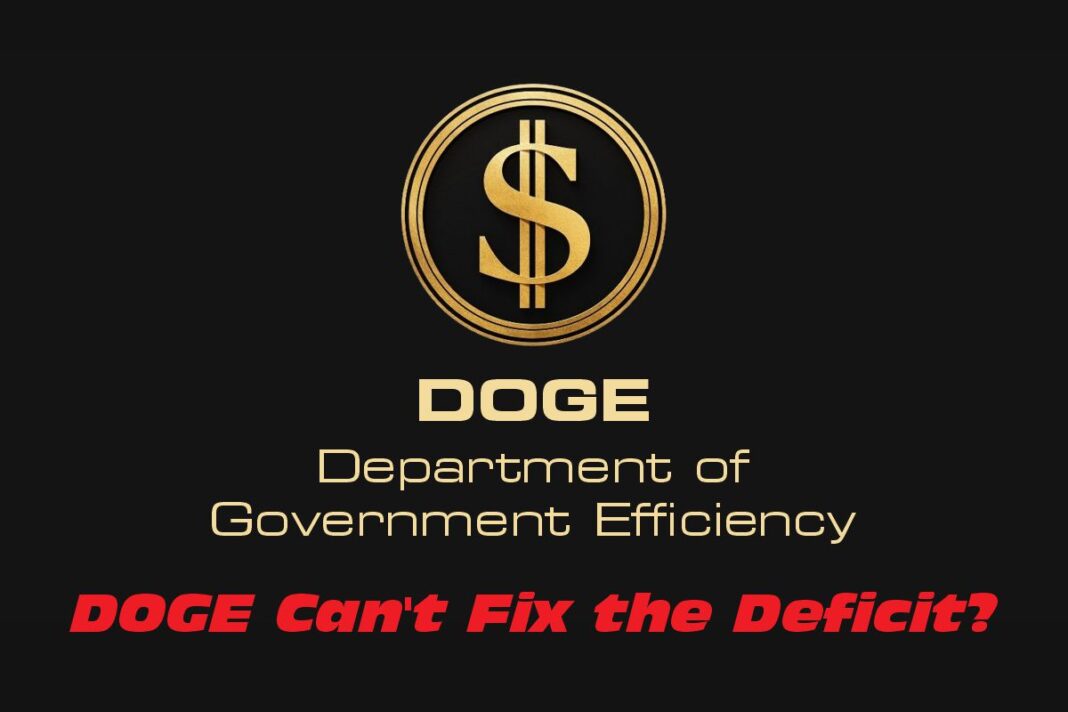


No, DOGE can’t fix the deficit. Here’s why.

5Mind. The Meme Platform
The Hill Header

Back on the campaign trail in November, Elon Musk and Donald Trump presented the Department of Government Efficiency as the next big solution to wasteful government spending and bureaucracy. For many Americans this makes for a compelling pitch — the U.S. debt today is so high that interest payments alone cost the government almost $1 trillion per year. 

In theory, reining in the national debt is a bipartisan slam dunk. In practice, the process of picking where to cut expenses or raise taxes invariably leads to some degree of political blowback.

After a month of action, how has DOGE actually managed to cut back on spending, and more importantly, how does it stack up with America’s looming debt crisis? (Hint: The numbers aren’t even close.)

The U.S. debt today stands at more than $36 trillion. But rather than ogle at the things one could buy with that money (Such as all of the gold that has ever been mined on Earth four times over), we must understand how to reduce the debt. To do that, we need to understand where that debt comes from.

Over the past 10 years, the U.S. government spent a total of $61 trillion and brought in $45 trillion in revenue. That means in the average year, the government spent $6.1 trillion, and $1.6 trillion of that was deficit spending.

Conventional wisdom would tell us government spending looks very different under Democrats and Republicans, but it isn’t so. In fact, deficits (and approvals of long-term debt) under Trump have been higher than the averages under Presidents Joe Biden and President Barack Obama.

Regardless of the party in charge, federal spending is mostly composed of four familiar categories, which we can call “The Big Four.”

  • Medicare and Medicaid: Makes up approximately 23 percent of annual spending, or about $1.4 trillion.
  • Social Security: Makes up approximately 21 percent of annual spending, or $1.3 trillion.
  • Defense: Makes up approximately 12 percent of annual spending, or approximately $750 billion.
  • Interest Payments: Make up approximately 11 percent of annual spending or approximately $700 billion (Note: $700 billion is a historical average, the current value is $1 trillion).

By Ryan Chapman

Read Full Article onTheHill.com

Contact Your Elected Officials
The Hill
The Hillhttps://thehill.com/
The Hill is a comprehensive source of Congressional news, connecting the players, defining the issues, and engaging Washington’s decision makers in the debate.

Ring That Bell

If I could travel back in time to 1776,...

Thoughts On America 250

Before you, American reader, is the honor, blessing, and privilege of celebrating the 250th anniversary of our nation. A nation toward which God has been merciful, shining His great grace.
00:09:03

Two birthdays apart

The Bicentennial was not just a commemoration of 200 years of independence – it was a coast‑to‑coast block party of red, white and blue.
00:02:31

Is Charlie Kirk’s Assassination Looking More Like a Conspiracy?

Enough videos have been posted to the internet, plenty...

Is There a 9/11 WTC and 9/10 Charlie Kirk Connection?

Strange parallels in online stories raise questions about whether Israelis and Mossad intelligence are our allies or adversaries.

Judge Blocks USPS Ballot Rule Tied to Trump’s Election Integrity Order

Judge blocked the U.S.P.S. from implementing a Trump admin. proposal to boost election integrity by enhancing ballot tracking and verification.

US Median Sales Price of Homes Hits Record High of $408,838

The median sales price of homes in the US hit a record high of $408,838 for the four weeks ending June 28, real estate brokerage Redfin said in a July 2 statement.
00:02:00

Rare Copy of Declaration of Independence Found in UK

Historians hail the significance of the finding, announced just...

Trump Administration Proposes Rule That Could Save Medicare Patients More Than $1 Billion

Trump administration officials are proposing a rule that would reduce Medicare spending on hospital services and drugs.

Trump Shares New US Passport Design on Truth Social

The mockup shows limited-edition passports planned for a July...
00:05:14

Trump Cancels Signing of Housing Affordability Bill, Says SAVE Act Should Be Passed First

Trump canceled signing of a bipartisan housing bill aimed at lowering home prices, saying an election integrity bill should be passed by Congress first.
00:39:13

Trump Signs Orders to Boost Development in Quantum Computing

President Trump signed two executive orders to accelerate quantum computing development and strengthen U.S. leadership in this emerging technology sector.

Banning Hospitals’ Certain Contracts Could Save Americans $45 Billion, Report Finds

A ban on certain contracts between hospital systems and health insurers could save Americans around $45 billion, according to a report.
spot_img

Related Articles

Popular Categories

MAGA Business Central