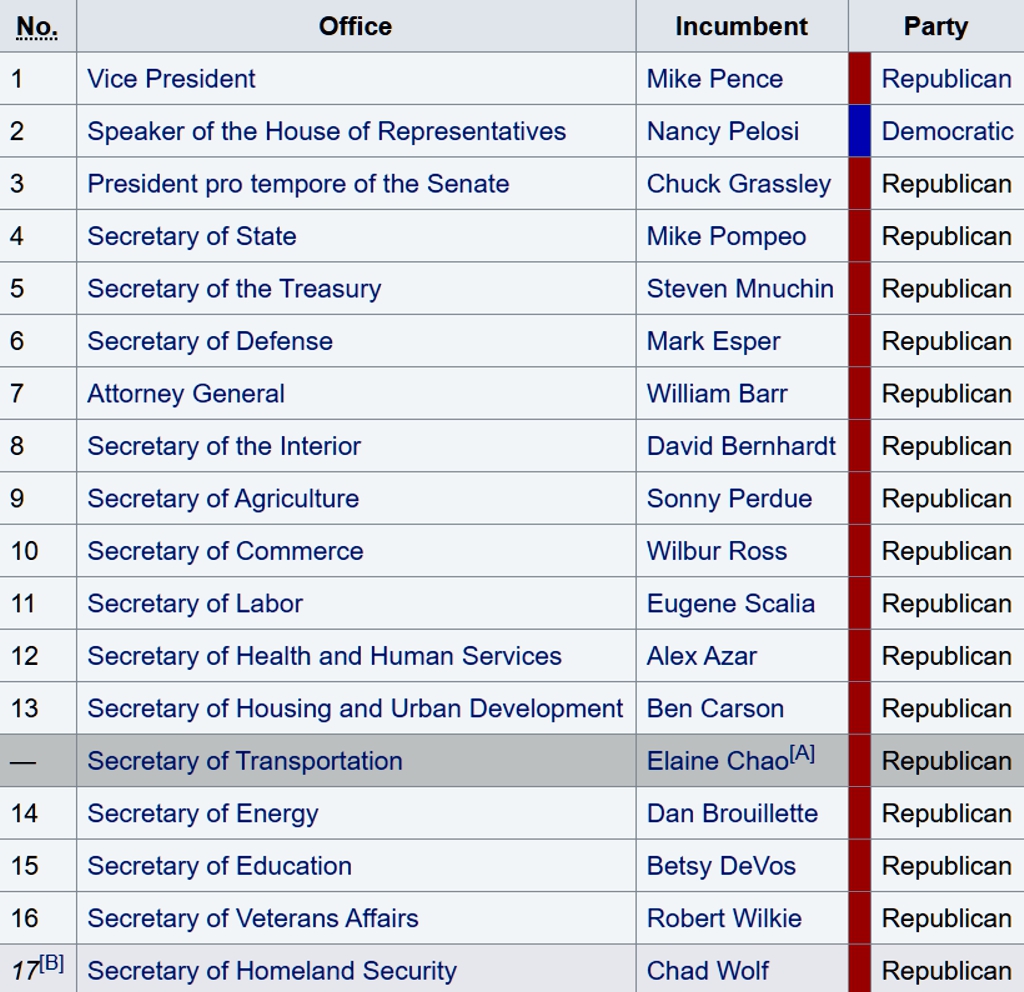


The United States presidential line of succession is the order in which officials of the United States federal government assume the powers and duties of the office of president of the United States if the incumbent president becomes incapacitated, dies, resigns, or is removed from office. The order of succession specifies that the office passes to the vice president; if the vice presidency is simultaneously vacant, or if the vice president is also incapacitated, the powers and duties of the presidency pass to the speaker of the House of Representatives, president pro tempore of the Senate, and then Cabinet secretaries, depending on eligibility. (Source Wikipedia)
Constitution of the United States
Article II
Section 1
The executive Power shall be vested in a President of the United States of America. He shall hold his Office during the Term of four Years, and, together with the Vice President, chosen for the same Term, be elected, as follows
Each State shall appoint, in such Manner as the Legislature thereof may direct, a Number of Electors, equal to the whole Number of Senators and Representatives to which the State may be entitled in the Congress: but no Senator or Representative, or Person holding an Office of Trust or Profit under the United States, shall be appointed an Elector.
The Electors shall meet in their respective States, and vote by Ballot for two Persons, of whom one at least shall not be an Inhabitant of the same State with themselves. And they shall make a List of all the Persons voted for, and of the Number of Votes for each; which List they shall sign and certify, and transmit sealed to the Seat of the Government of the United States, directed to the President of the Senate. The President of the Senate shall, in the presence of the Senate and House of Representatives, open all the Certificates, and the Votes shall then be counted. The Person having the greatest Number of Votes shall be the President, if such Number be a Majority of the whole Number of Electors appointed; and if there be more than one who have such Majority, and have an equal Number of Votes, then the House of Representatives shall immediately chuse by Ballot one of them for President; and if no Person have a Majority, then from the five highest on the List the said House shall in like manner chuse the President. But in chusing the President, the Votes shall be taken by States, the Representation from each State having one Vote; A quorum for this Purpose shall consist of a Member or Members from two thirds of the States, and a Majority of all the States shall be necessary to a Choice. In every Case, after the Choice of the President, the Person having the greatest Number of Votes of the Electors shall be the Vice President. But if there should remain two or more who have equal Votes, the Senate shall chuse from them by Ballot the Vice President.
The Congress may determine the Time of chusing the Electors, and the Day on which they shall give their Votes; which Day shall be the same throughout the United States.
No Person except a natural born Citizen, or a Citizen of the United States, at the time of the Adoption of this Constitution, shall be eligible to the Office of President; neither shall any Person be eligible to that Office who shall not have attained to the Age of thirty five Years, and been fourteen Years a Resident within the United States.
In Case of the Removal of the President from Office, or of his Death, Resignation, or Inability to discharge the Powers and Duties of the said Office, the Same shall devolve on the Vice President, and the Congress may by law provide for the Case of Removal, Death, Resignation or Inability, both of the President and Vice President, declaring what Officer shall then act as President, and such Officer shall act accordingly, until the Disability be removed, or a President shall be elected.
The President shall, at stated Times, receive for his Services, a Compensation, which shall neither be encreased nor diminished during the Period for which he shall have been elected, and he shall not receive within that Period any other Emolument from the United States, or any of them.
Before he enter on the Execution of his Office, he shall take the following Oath or Affirmation:– I do solemly swear (or affirm) that I will faithfully execute the Office of President of the United States, and will to the best of my Ability, preserve, protect and defend the Constitution of the United States.
Section 2
The President shall be Commander in Chief of the Army and Navy of the United States, and of the Militia of the several States, when called into the actual Service of the United States; he may require the Opinion, in writing, of the principal Officer in each of the executive Departments, upon any Subject relating to the Duties of their respective Offices, and he shall have Power to grant Reprieves and Pardons for Offences against the United States, except in Cases of Impeachment.
He shall have Power, by and with the Advice and Consent of the Senate, to make Treaties, provided two thirds of the Senators present concur; and he shall nominate, and by and with the Advice and Consent of the Senate, shall appoint Ambassadors, other public Ministers and Consuls, Judges of the supreme Court, and all other Officers of the United States, whose Appointments are not herein otherwise provided for, and which shall be established by Law: but the Congress may by Law vest the Appointment of such inferior Officers, as they think proper, in the President alone, in the Courts of Law, or in the Heads of Departments.
The President shall have Power to fill up all Vacancies that may happen during the Recess of the Senate, by granting Commissions which shall expire at the End of their next Session.
Section 3
He shall from time to time give to the Congress Information of the State of the Union, and recommend to their Consideration such Measures as he shall judge necessary and expedient; he may, on extraordinary Occasions, convene both Houses, or either of them, and in Case of Disagreement between them, with Respect to the Time of Adjournment, he may adjourn them to such Time as he shall think proper; he shall receive Ambassadors and other public Ministers; he shall take Care that the Laws be faithfully executed, and shall Commission all the Officers of the United States.
Section 4
The President, Vice President and all civil Officers of the United States, shall be removed from Office on Impeachment for, and Conviction of, Treason, Bribery, or other high Crimes and Misdemeanors.
Presidential Succession Act
On July 18, 1947, President Harry Truman signed the Presidential Succession Act. The original act of 1792 had placed the Senate president pro tempore and Speaker of the House in the line of succession, but in 1886 Congress had removed them. The 1947 law reinserted those officials, but placed the Speaker ahead of the president pro tempore.
Throughout most of the 19th century, the Senate assumed it was empowered to elect a president pro tempore only during the absence of a vice president. But what should senators do at the end of a session? Since Congress was customarily out of session for half of each year, what would happen in that era of high mortality rates if both the president and vice president died during the adjournment period and there was no designated president pro tempore? For decades, the Senate relied upon an elaborate charade in which the vice president would voluntarily leave the chamber before the end of a session to enable the Senate to elect a president pro tempore. Fearing that the presidency might thus accidentally slip into the hands of the opposition, vice presidents occasionally refused to perform this little courtesy when the opposing party held the Senate majority.
In 1886 Congress replaced the two congressional officials in the line of succession with cabinet officers, in the order of their agencies’ creation. Proponents of this change argued that the Senate elected its presidents pro tempore based on parliamentary rather than executive skills. No president pro tempore had ever served as president, while six former secretaries of state had been elected to that office.
When the 1945 death of Franklin Roosevelt propelled Vice President Truman into the presidency, Truman urged placing the Speaker, as an elected representative of his district, as well as the chosen leader of the “elected representatives of the people,” next in line to the vice president. Since one could make the same argument for the president pro tempore, Truman’s decision may have reflected his strained relations with 78-year-old President Pro Tempore Kenneth McKellar and his warm friendship with 65-year-old House Speaker Sam Rayburn. After all, it was in Rayburn’s hideaway office, where he had gone for a late afternoon glass of bourbon, that Truman first learned of his own elevation to the presidency.
2020 order of succession