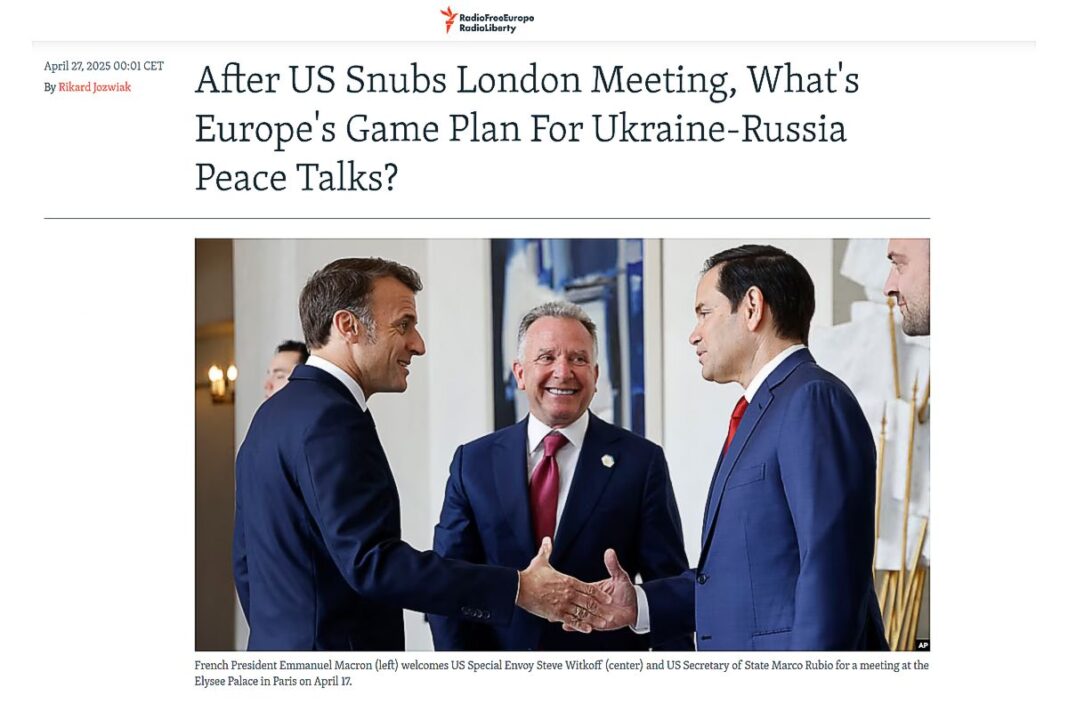


Russia has long warned that any unconditional ceasefire in Ukraine of the 30-day sort that Zelensky has proposed could create an opening for NATO to expand its military influence in that country. Hitherto dismissed as a conspiracy theory by the West, Radio Liberty just let the cat out of the bag. The unnamed officials who they cited in their recent article confirmed that they envisage this “buy[ing] the Europeans time to assemble a ‘reassurance force’ in the Western part of Ukraine” and organize “air patrols” there.

Their reported game plan is “keeping the Americans onboard” the peace process, “sequencing” the conflict by clinching a ceasefire that’ll later lead to a lasting peace, and using the aforesaid interim period to carry out the abovementioned military moves for pressuring Russia into more concessions. What’s omitted from Radio Liberty’s article is that Russia has threatened to target Western troops in Ukraine, who Secretary of Defense Pete Hegseth earlier said wouldn’t enjoy Article 5 guarantees from the US.
Even if Putin agrees to this concession that’s assessed to be among one of the five significant differences between him and Trump that prompted Trump’s angry post against Putin, Radio Liberty reported that this still wouldn’t lead to de jure European recognition of Russia’s territorial gains. The same goes for them lifting sanctions or returning any of its €200 billion of seized assets. More sanctions might even soon be imposed and the windfall profits from those assets will “bankroll Ukraine’s military needs”.
Given what Radio Liberty revealed, Russia can therefore expect nothing in return from the EU if Putin concedes to allow their troops and aircraft to deploy in and patrol over Western Ukraine. Any hopes of restoring Ukraine’s antebellum buffer state status would be crushed, and it can’t be ruled out that the EU’s zone of military activity could later expand to the Dnieper or beyond. One of the special operation’s goals was to prevent the West’s eastward military expansion so that would be another major concession.
Putin’s decades-long close friend and influential senior aide Nikolay Patrushev just told TASS earlier this week that “For the second year in a row, NATO is holding the largest exercises in decades near our borders, where it is practicing scenarios of offensive actions over a large area – from Vilnius to Odessa, the seizure of the Kaliningrad region, the blocking of shipping in the Baltic and Black Seas, and preventive strikes on the permanent bases of Russian nuclear deterrent forces.”
Secretary of the Security Council Sergey Shoigu told the same outlet several days prior that “Over the past year, the number of military contingents of NATO countries deployed near the western borders of the Russian Federation has increased almost 2.5 times…NATO is moving to a new combat readiness system, which provides for the possibility of deploying a 100,000-strong group of troops near the borders of Russia within 10 days, 300,000 by the end of 30 days, and 800,000 by the end of 180 days.”
When the EU’s prioritization of the Baltic Defence Line and Poland’s complementary East Shield are added to the equation, coupled with plans for expanding the “military Schengen” to speed up the eastward deployment of troops and equipment, the trappings of Operation Barbarossa 2.0 are apparent. Putin can’t influence what NATO does within the bloc’s borders, but he has the power to stop its de facto expansion into Western Ukraine during a ceasefire, which could partially hinder its speculative plans.
Conceding to them, which he might agree to do for the five reasons mentioned in the second half of this analysis here from early March, would lead to Russia’s mutual defense ally Belarus being surrounded by NATO along its northern, western, and then southern flanks. That could make it a tempting future target, but Western aggression might be deterred by the continued deployment of Russia’s Oreshniks and tactical nuclear weapons, the latter of which Belarus has already been authorized to use at its discretion.
Conceding to Western troops in Ukraine in exchange for the economic and strategic benefits that Russia hopes to reap from the US if their nascent “New Détente” takes off after a peace deal would therefore entail conventional security costs that could be managed through the means that were just described. At the same time, however, hardliners like Patrushev, Shoigu, and honorary chairman of Russia’s influential Council on Foreign and Defense Policy Sergey Karaganov could dissuade him from such a deal.
Putin must therefore decide whether this is an acceptable trade-off or if Russia should risk losing its post-conflict strategic partnership with the US by continuing to oppose NATO’s de facto expansion into Western Ukraine, including via military means if EU forces move into there without Russian approval. His decision will determine not only the future of this conflict, but also Russia’s contingency planning vis-à-vis a possible hot war with NATO, thus making this the defining moment of his quarter-century rule.