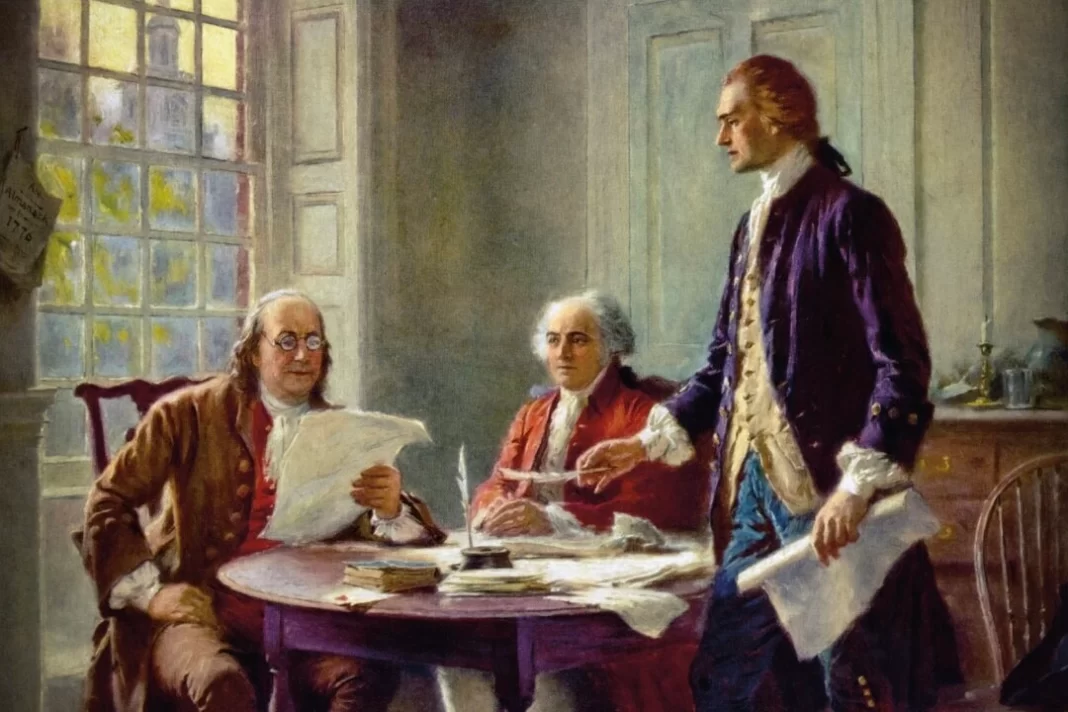
It’s the middle of the summer, and once more our thoughts turn to that special place in our consciousness we reserve for July 4. We will again celebrate what we have and how we got it. We may even argue over how to keep it, but left or right, rich or otherwise, people of every ilk will come together to rejoice that we are in America – that we are Americans.
But there is another date also in July that stands recognition – that of July 14 – the French Revolution. And as history tells us, the French were there with us in our fight against the British, certainly for their own reasons, but there nonetheless.
What is interesting is that most citizens today – American or French – do not realize how unique circumstances (in each country) at the time played a key role in determining why the two revolutions had such disparate trajectories and outcomes. Location along with intent, ideology, inequality, class division, cessation, and subsequent government formation were critical in how the wars were fought and what happened afterwards. In fact the entire context in which each country waged their campaigns for liberty gave rise to many of the cultural distinctions which still exist today between France and America.
Often compared because of similarities in ideology, era and impact, dissimilarities made a difference between the American (1775-1783) and French Revolution (1789) in context, complexity and outcome.
As you will see, in several ways, the American patriots held a distinct advantage in their fight for independence and a new country, which the French did not enjoy. As a result, the setbacks in prosecuting the war and its aftermath had less to do with the French themselves and more with the inherent conditions and circumstances over which the French had little control and with which the partisans had to contend.
Initially, one can clearly contrast the general orientation of the two countries regarding how the war was fought and why. Pragmatic Americans, influenced early by Puritan settlers in New England, looked towards history – keen to employ the tangible lessons they have learned from it. They turned towards experience as their compass in gaining their freedoms. The French, in contrast, primarily ensconced in a feudal system of repression, but because of Enlightenment principles,
exalted reason as opposed to experience, while deprecating religion as well as the divine.
Location – Colony vs. Country
Venue was a key factor differentiating the two wars. America’s War for independence occurred 3,000 miles from the monarchy ruling it in Great Britain. The French Revolution took place amidst the feudal system within France itself, a factor which threatened the French monarchy, directly.
Intent – Freedom vs. Overthrow
Location also affected the intent of each revolution. American revolutionaries were not looking to overthrow the British monarchy. Their aim was merely to be free from its long distance objectionable rule, employing Enlightenment ideas about natural rights and human rights as the basis for their claims.
What precipitated the French revolution involved French partisans demanding change, especially in the way they were governed. In essence, Americans intended to break away to form a new government and establish a new form of government within their own country. The French intended to either tear down or significantly alter the existing French system of government.
Ideology – Locke vs. Rousseau
Members of the Continental Congress in the American colonies drafted the Declaration of Independence to separate themselves from Britain and to express their belief that every individual has the equal right to “life, liberty and the pursuit of happiness.” The American ideology was based on the works of British philosopher John Locke. France’s Declaration of the Rights of Man and of the Citizen was founded on the teachings of French philosopher Jean-Jacques Rousseau, written with the aim to create social equality and end political inequalities of King Louis XVI.
One of the key differences, therefore, between the American and French Revolutions is that, unlike the French in their fight for equality, Americans did not fight for an abstraction.
Partisans fought for “liberty, equality, and fraternity.” But the problem is that both historical experience and the principles of Classical Liberalism demonstrate that neither equality nor fraternity can be achieved through coercion by the state. Perfect equality, advocated by Rousseau in his work, The Social Contract, is elusive at best and, even if it could be achieved, would be inconsistent with liberty (freedom). Whereas Americans struggled for tangible goals, the French took on the Herculean effort of striving for abstractions.
With respect to abstractions and universal truths, although the Declaration of Independence incorporates them into the body of the text, historical context is important.
The individuals who signed the Declaration understood they were not establishing a national government or founding a national Union when they signed it. They well understood they were simply explaining to a foreign power why it had become “necessary for one people to dissolve the political bands which have connected them with another” and that declared “the causes which impel them to the separation.” The Declaration was a document of dissolution.
Inequality – Representation vs. Repression
Americans initially took up arms against the British to defend and preserve the traditional rights of Englishmen. The slogan “no taxation without representation” aptly summed up one of their chief complaints. The right to not be taxed without the consent of one’s elected representatives was one of the most prized rights of Englishmen. When this became impossible to achieve within the British Empire, Americans declared their independence and then won it on the battlefield. That is, Americans fought for tangible goals; they fought to preserve their traditional rights rather than to overturn an established social order.
Taxation played a role in both wars, however, the people’s objections to the taxes in each country were dissimilar. Americans objected to the fact that colonists had no say in how the collected taxes were spent – “taxation without representation.” However, American revolutionaries themselves, like George Washington and Thomas Jefferson, were financially successful and lived relatively comfortable lives. In contrast, the revolting French peasants were starving and destitute partially as a result of over-taxation, and thus their fight was in part instinctual – survival. French revolutionists also objected to the inequality in the apportionment of taxes — French clergy and noblemen were taxed less than commoners.
Class Divisions vs. Ideology
A significant difference exists in the categories of people fighting in each revolution. In France, the combatants were largely separated by economic classes – the rich from the poor, the lower class or the third estate to the upper class. For Americans, the separations were ideological, in that the warring parties were divided over loyalty to the crown and absolute monarchy versus the desire for freedom for American colonists. In some cases, differing political and philosophical views led to divisions within families and resulted in some soldiers fighting brother against brother in many colonies like New York.
Cessation – Victory vs. Continued Instability
The Treaty of Paris outlined cessation conditions to end the American War for Independence, and its signing on Sept. 3, 1783, marked the conflict’s end and later allowed for the United States of America to be formed. Unrest and conflict, however, continued within France into the 19th century. This political instability and persistent violence make the conclusion of the French Revolution of 1789 rather indeterminate. Although the notorious “Reign of Terror” ended in 1794 and a new constitution was approved in 1795, Napoleon Bonaparte’s coup d’état on Nov. 9, 1799, is most often considered to be the final end of the French Revolution.
Establishing Government
After independence was secure, Americans looked to experience and what history teaches to guide them in securing their freedoms by establishing government on a secure and concrete basis. Forrest McDonald notes in his work Novus Ordo Seclorum: The Intellectual Origins of the Constitution that it was John Dickinson who cautioned those gathered at the Philadelphia Convention, “Reason may mislead us.” Thus he added, “Experience must be our only guide.” The only safe path forward was to look to history and allow experience to guide their reason.
And Dickinson was not alone in his faith in experience and concern for unbridled reason.
Experience was “the best oracle of wisdom” and “the least fallible guide of human opinions,” wrote Alexander Hamilton in The Federalist Papers. James Madison, his collaborator in the Federalist , was just as resolute. He wrote that experience was “the oracle of truth” and “the guide that ought always to be followed whenever it can be found.” Experience, they believed, would help temper reason from leading them astray into extremes.
The French, on the other hand, exalted Reason above not only experience, but also above religion and the divine. Indeed, they transformed Notre Dame Cathedral into a “Temple of Reason” and held pseudo-religious festivals in honor of this new “deity.” Unfortunately, reason unrestrained and untempered by history and experience proved unable to establish a stable government or to secure liberty in France. It led instead to the Reign of Terror, the Empire of Napoleon, and, ultimately, to the restoration of the monarchy that so many died attempting to defend and destroy. To date, there have been 17 separate governments in France since 1789. The Fifth Republic is the most recent.
“The American war is over, but this is far from being the case with the American Revolution.” –Patrick Henry