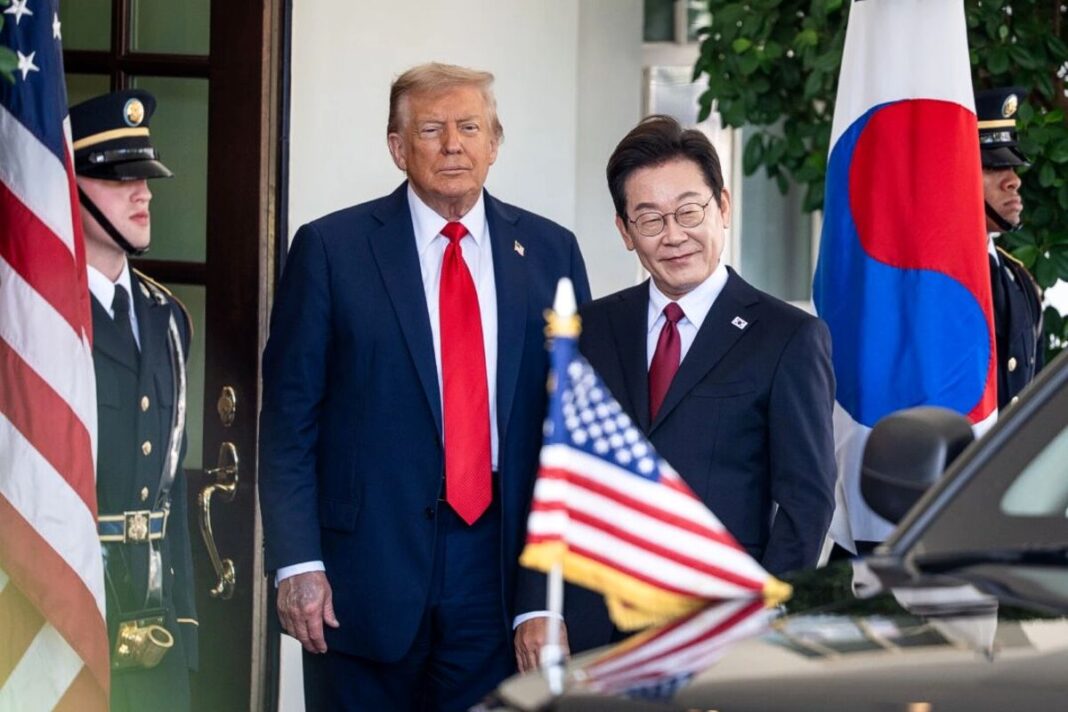


President Donald Trump said he would raise tariffs on South Korean goods from 15 percent to 25 percent over Seoul’s delay in implementing a 2025 trade deal.
The South Korean president’s office has said it will work to implement a 2025 trade deal with the United States after U.S. President Donald Trump announced his intent to raise tariffs on South Korea.
In statements published by Yonhap News Agency on Jan. 27, the South Korean presidential office said South Korean Industry Minister Kim Jung-kwan, who is currently in Canada, will travel to the United States to hold talks with U.S. Commerce Secretary Howard Lutnick. Likewise, South Korean Trade Minister Yeo Han-koo plans to meet with U.S. Trade Representative Jamieson Greer.
“The government will convey its commitment to implementing the deal to the U.S. side,” South Korean presidential spokesperson Kang Yu-jung said.
In a Jan. 26 Truth Social post, Trump announced his intent to raise U.S. tariffs on various South Korean goods—including automobiles, lumber, and pharmaceuticals—from 15 percent to 25 percent.
Trump did not specify how soon the tariff hike could take place. The White House provided no additional details about the timing for the tariffs when reached by The Epoch Times on Tuesday.
The U.S. Department of Commerce also did not respond to a request for comment by publication time.
In his Monday tariff announcement, Trump said South Korea’s legislature had not yet moved to implement a deal he and South Korean President Lee Jae Myung had reached in July and reaffirmed on Oct. 29. That deal was set to cap U.S. tariffs on South Korean goods and see the Asian nation invest $350 billion in the United States.
South Korea’s ruling Democratic Party submitted legislation to implement the trade deal with the United States in November.
Kim Hyun-jung, a South Korean Democratic Party spokesperson, on Tuesday said five bills are before the legislative National Assembly and have bipartisan support from the People Power Party, which is currently the second-largest party in the legislature and the main opposition party.
“Since President Trump has not mentioned the timing of the tariff increase, the key question is how quickly follow-up legislation and support systems, such as special laws, can be established to support the implementation of the Korea–U.S. agreement,” Kim said.
The South Korean Democratic Party spokesperson said the party looked forward to bipartisan cooperation with the People Power Party.
By Ryan Morgan