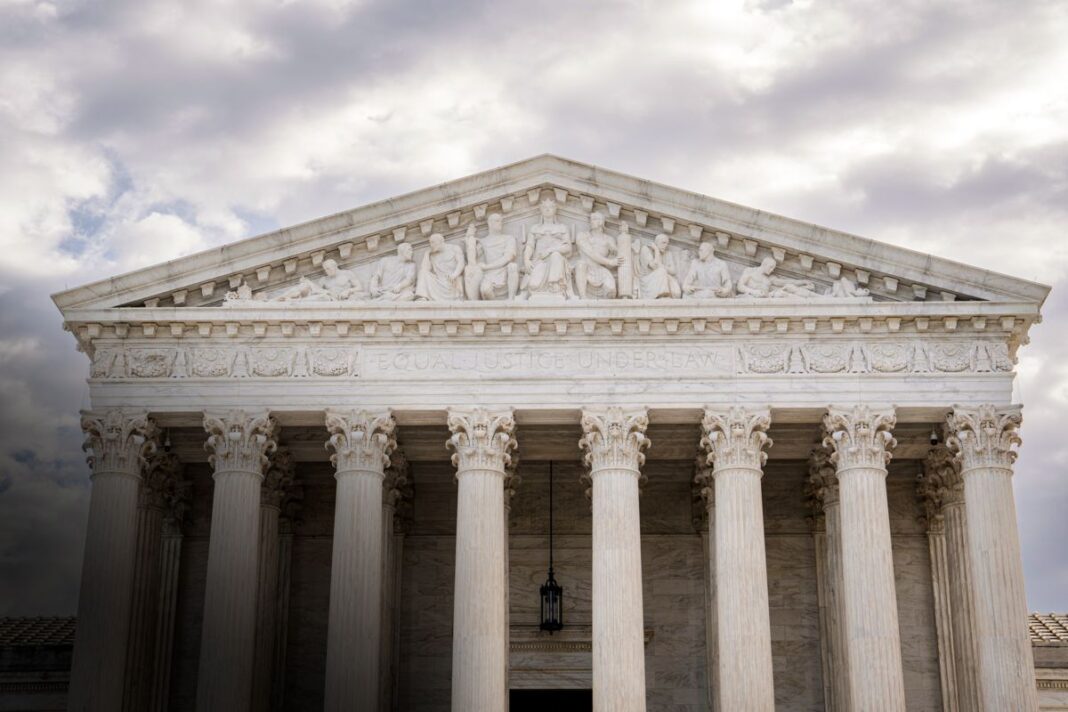
The case was brought by a therapist who alleged Colorado’s ban violated her right to free expression.
The Supreme Court on March 31 ruled against a Colorado ban on so-called conversion therapy for LGBT youth.
In an 8–1 decision, the justices said that a lower court failed to properly analyze whether the Colorado law violated the First Amendment. The court’s majority opinion was written by Justice Neil Gorsuch.
Two of the court’s three liberal justices joined the majority opinion.
The Colorado law “censors speech based on viewpoint,” Gorsuch said, and “Colorado may regard its policy as essential to public health and safety.”
“Certainly, censorious governments throughout history have believed the same. But the First Amendment stands as a shield against any effort to enforce orthodoxy in thought or speech in this country,” he said.
“It reflects instead a judgment that every American possesses an inalienable right to think and speak freely, and a faith in the free marketplace of ideas as the best means for discovering truth.”
The sole dissenter was Justice Ketanji Brown Jackson, who said the “fallout” from the new ruling could be “catastrophic.” She said her colleagues failed to consider “the potential long-term and disastrous implications of this ruling.”
Jackson said Colorado’s law was “based on the medical profession’s broad consensus that this medical treatment (which seeks to change a gay or transgender person’s sexual orientation or gender identity) is ineffective and harmful.”
“Ultimately, because the majority plays with fire in this case, I fear that the people of this country will get burned,” she added.
The case, Chiles v. Salazar, was brought by therapist Kaley Chiles, who said Colorado’s law unconstitutionally infringed on her ability to help minors struggling with gender dysphoria and unwanted same-sex attraction.
Conversion therapy is “any emotional or physical therapy used to ‘cure’ or ‘repair’ a person’s attraction to the same sex, or their gender identity and expression,” according to WebMD.
Twenty-three states and the District of Columbia ban conversion therapy for minors, according to a report by the Movement Advancement Project.
Colorado’s Minor Conversion Therapy Law allows officials to take away the licenses of health care professionals who are determined to have offered conversion therapy to minors.
Upon conviction, offenders can also be fined as much as $5,000.
The law prohibits licensed therapists from attempting to “change an individual’s sexual orientation, including efforts to change behaviors or gender expressions, or to eliminate or reduce sexual or romantic attraction or feelings toward individuals of the same sex.”
Chiles argued that the law banning conversion therapy encourages young people to change their sexual orientation or gender identity away from the heterosexual norm and prohibits the provision of counseling for same-sex desires or identification with the opposite gender.
By Sam Dorman and Matthew Vadum