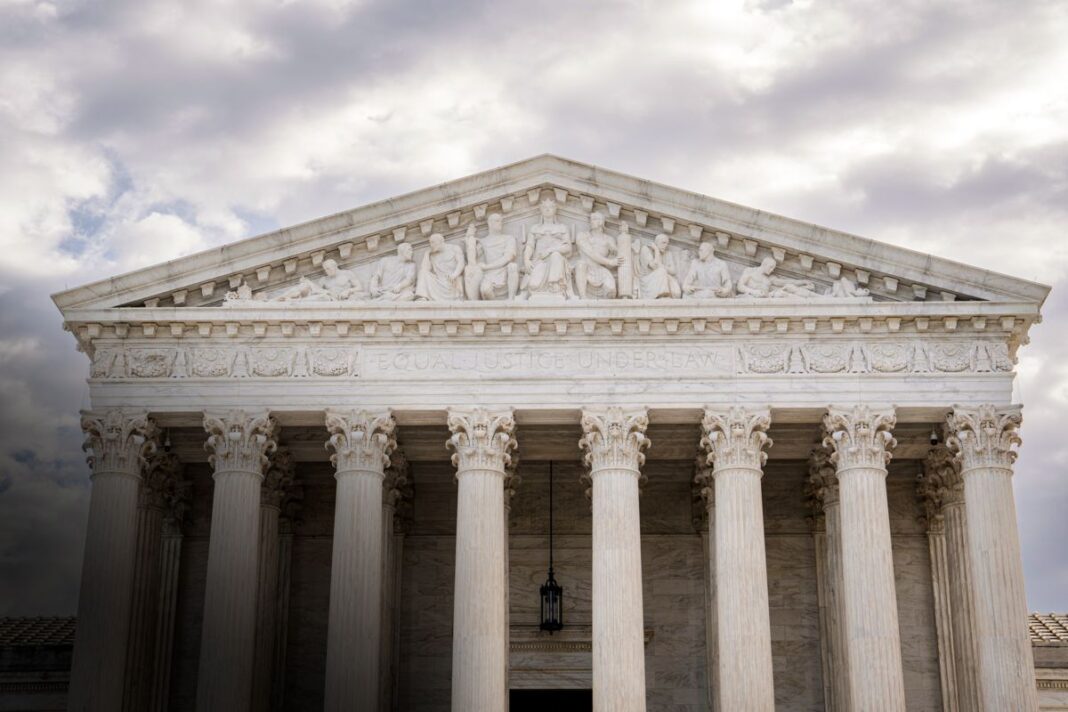
The 6–3 decision allowed a ’metering policy’ developed by the Obama administration and continued in Trump’s first term.
The Supreme Court on June 25 ruled that the government can turn away asylum-seekers at the border, clarifying a law that requires immigrants to be inspected when they arrive in the United States.
“This case presents a straightforward question: whether an alien who seeks to enter the United States from Mexico ‘arrives in the United States’ when he or she is still in Mexico,” Justice Samuel Alito wrote on behalf of the majority.
“In the decision below, the United States Court of Appeals for the Ninth Circuit answered ‘yes.’ That is wrong.”
The decision was 6–3, with Justices Sonia Sotomayor, Ketanji Brown Jackson, and Elena Kagan dissenting.
A group of 13 asylum seekers, led by immigrants’ rights group Al Otro Lado, or To the Other Side, had filed suit in 2017 against the government’s “metering” policy. That policy let border agents—usually at U.S. ports of entry—turn away asylum seekers to avoid overcrowding of border facilities.
A federal law says that “any alien who is physically present in the United States or who arrives in the United States … may apply for asylum,” regardless of legal status.
Arguments in the case had turned on the meaning of the phrase “arrives in.” Attorneys representing the immigrants argued that a person who presented himself at the border had, for legal purposes, “arrived.”
Metering began under President Barack Obama and continued until it was rescinded by President Joe Biden in 2021—although his administration continued to defend its legality.
The asylum seekers argue the policy violates the Immigration and Nationality Act, which requires immigration officers to inspect “an alien present in the United States who has not been admitted or who arrives in the United States.”
The majority ruling rejected that reading of the statute.
“An alien standing in Mexico does not ‘arrive in the United States’ by attempting, and failing, to set foot in this country. An alien ‘arrives in the United States’ only when he crosses the border,” Alito wrote.
Sotomayor took the opposite view in her dissent, noting that prior to 2016, asylum-seekers were allowed to cross into the U.S. “like any other traveler seeking to enter the United States.”
“The Court’s illogical interpretation is driven almost entirely by a fixation on a single word: ‘in,’” she wrote.
This is developing and will be updated.