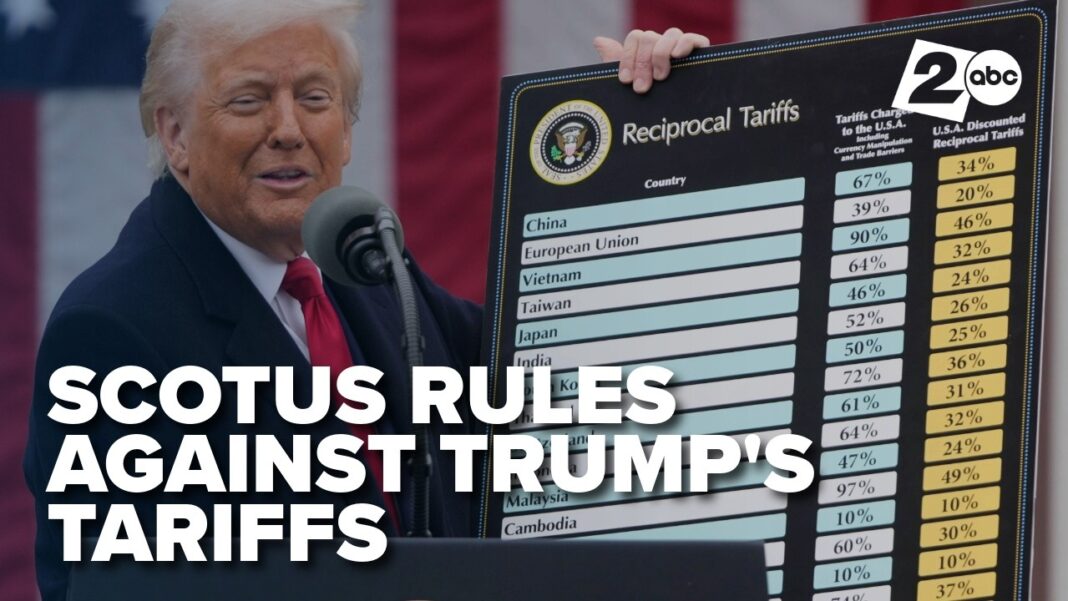
The court ruled 6-3 that Trump’s reciprocal tariffs were not authorized under the International Emergency Economic Powers Act.
The Supreme Court on Feb. 20 ruled 6–3 that some of President Donald Trump’s global tariffs exceeded an emergency powers law passed by Congress.
Chief Justice John Roberts wrote the majority opinion, stating that Trump’s tariffs didn’t fit with the language of the International Emergency Economic Powers Act. Trump had invoked that law to impose a series of tariffs, including reciprocal rates on dozens of countries and drug trafficking levies on Mexico, Canada, and China.
The administration argued that the law’s wording allowed tariffs by permitting the president to “regulate … importation.”
“The President asserts the independent power to impose tariffs on imports from any country, of any product, at any rate, for any amount of time,” Roberts said. “Those words cannot bear such weight.”
Justices Clarence Thomas, Brett Kavanaugh, and Samuel Alito dissented.
Kavanaugh penned a dissent in which he said that “tariffs are a traditional and common tool to regulate importation.”
Justice Elena Kagan wrote a separate opinion that was joined by Justices Sonia Sotomayor and Ketanji Brown Jackson.
The justices differed in how they applied something known as the “major questions doctrine,” which says Congress must be very clear if it wishes to delegate questions of major economic or political importance to the president. This is the doctrine that the Supreme Court used to strike down former President Joe Biden’s sweeping student loan forgiveness.
Justices Amy Coney Barrett and Neil Gorsuch joined Roberts in stating that Congress would have needed to be clearer in its language if it intended for presidents to issue these types of tariffs. Kavanaugh, meanwhile, suggested that doctrine shouldn’t apply to foreign affairs.
“In the foreign affairs realm, courts recognize that Congress often deliberately grants flexibility and discretion to the President to pursue America’s interests,” he said.
Kavanaugh also said refunding those impacted by tariffs would likely be a “mess.”
“The interim effects of the Court’s decision could be substantial,” he said. “The United States may be required to refund billions of dollars to importers who paid the IEEPA tariffs, even though some importers may have already passed on costs to consumers or others.”
With trillions of dollars at stake, the decision could have major implications for the nation’s economy. Trump’s tariffs have targeted a broad range of activities, but the ones in this case focused on combating drug trafficking and correcting trade imbalances with other countries.
In the weeks leading up to the decision, Trump repeatedly portrayed his tariffs as important for the nation’s economic and financial health.
“Pray that the United States Supreme Court allows our country to continue its unprecedented march toward unparalleled greatness!” he wrote in all caps in a Jan. 6 post on Truth Social.
Treasury Secretary Scott Bessent has said that the government could invoke other authorities to implement tariffs, although they are “not as efficient, not as powerful.”
U.S. Trade Representative Jamieson Greer similarly indicated in December that the administration had a backup plan.
Tariffs have helped the United States collect nearly $99 billion so far this fiscal year, which started on Oct. 1, 2025, according to the Daily Treasury Statement published on Jan. 7.
During oral argument on Nov. 5, 2025, the justices seemed skeptical of Trump’s bid to use the International Emergency Economic Powers Act to implement those tariffs.
The law allows presidents to regulate imports during times of emergency, but it was questionable whether that regulation included tariffs, and, in particular, Trump’s large-scale tariffs.
Multiple federal courts had ruled that Trump’s tariffs exceeded what was allowed under the law.
Days after oral argument, Trump indicated in a Nov. 11 post on Truth Social that a negative decision by the Supreme Court could implicate trillions of dollars.
“The ‘unwind’ in the event of a negative decision on Tariffs, would be, including investments made, to be made, and return of funds, in excess of 3 Trillion Dollars,” he said.
He added that the situation “would truly become an insurmountable National Security Event, and devastating to the future of our Country – Possibly non-sustainable!”
Andrew Moran contributed to this report.
By Sam Dorman
Read Full Article on TheEpochTimes.com