

If you bought gold during its 2023–2026 rally, you may be sitting on a large profit and a tax rule you have never heard of.
The IRS classifies physical gold, and even the popular bullion-backed gold exchange-traded funds (ETFs), as collectibles, a category shared with art, stamps, and antiques. That classification changes the tax bill when you sell. Most holders discover it at the worst possible moment: after the sale, when nothing can be done.
Here is the rule to understand before you sign anything.
Quick Answer: How Is Gold Taxed When You Sell?
Long-term gains on physical gold and bullion-backed ETFs are taxed as collectibles: at your ordinary income tax rate, capped at a maximum of 28 percent. That cap is the part many investors misunderstand and what a lot of media coverage gets wrong. If you are in the 12 percent bracket, you pay 12 percent, not 28 percent. The 28 percent figure only bites investors whose ordinary rate would otherwise be higher, and it compares unfavorably to the 15 or 20 percent long-term rates on gains on stocks.
Gold held for one year or less generally produces short-term gain taxed at ordinary income rates. State tax and, for some higher-income taxpayers, the 3.8 percent net investment income tax may apply separately. Choosing the year you sell can be a structural advantage, so learn the rules first.
The 28 Percent Rule—The Details
Two important details about the 28 percent rule:
- It’s a ceiling, not a flat rate. Long-term collectibles gains are taxed at whatever your ordinary rate is, up to 28 percent. Many retirees selling in a modest-income year owe far less than the headline rate.
- It only applies after one year. If you sell gold that was held for a year or less, the gain is short-term, taxed as plain ordinary income with no cap benefit at all. For someone in the 35 percent bracket, selling a month early costs more in tax than if they were to wait another month.
Higher earners should also budget for the 3.8 percent net investment income surtax and any state income tax, which stack on top for gold just as they do for stocks.
- It’s a ceiling, not a flat rate. Long-term collectibles gains are taxed at whatever your ordinary rate is, up to 28 percent. Many retirees selling in a modest-income year owe far less than the headline rate.
- It only applies after one year. If you sell gold that was held for a year or less, the gain is short-term, taxed as plain ordinary income with no cap benefit at all. For someone in the 35 percent bracket, selling a month early costs more in tax than if they were to wait another month.
Higher earners should also budget for the 3.8 percent net investment income surtax and any state income tax, which stack on top for gold just as they do for stocks.
The Same ‘Gold’ Is Taxed Three Different Ways
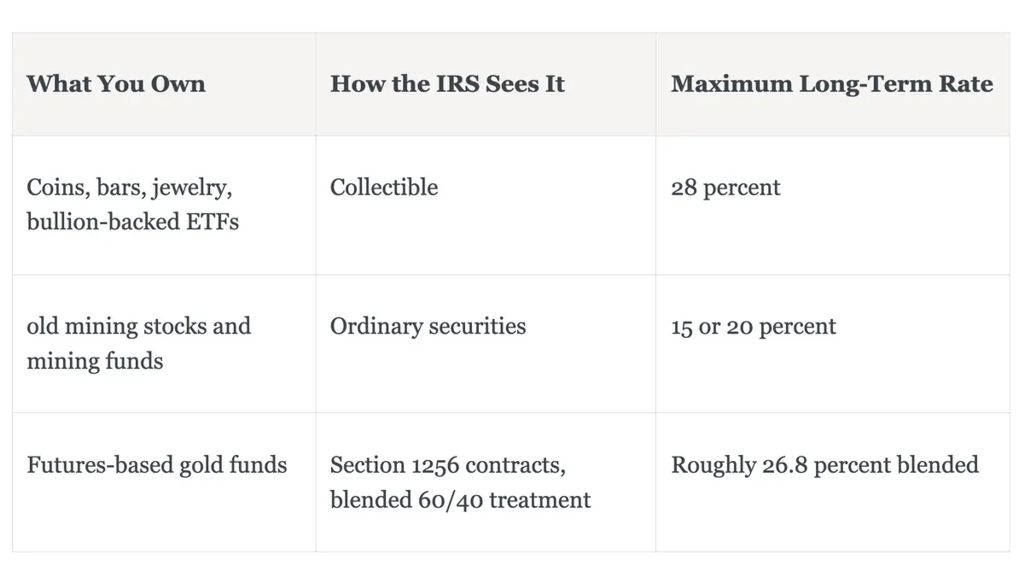
The ETF row surprises the most people. Funds that hold physical bars in a vault are typically structured as grantor trusts, so the IRS looks straight through the fund wrapper to the metal inside. You never touched a coin, but you are taxed as if you had.
Mining stocks, by contrast, are shares of companies, taxed like any other stock. Gold in a traditional IRA or 401(k) is generally taxed as ordinary income when withdrawn, not at the collectibles rate. Roth treatment differs.