

A wave of anti-ICE protests has spread to schools, and some parents are concerned about safety and what they describe as ideological indoctrination.
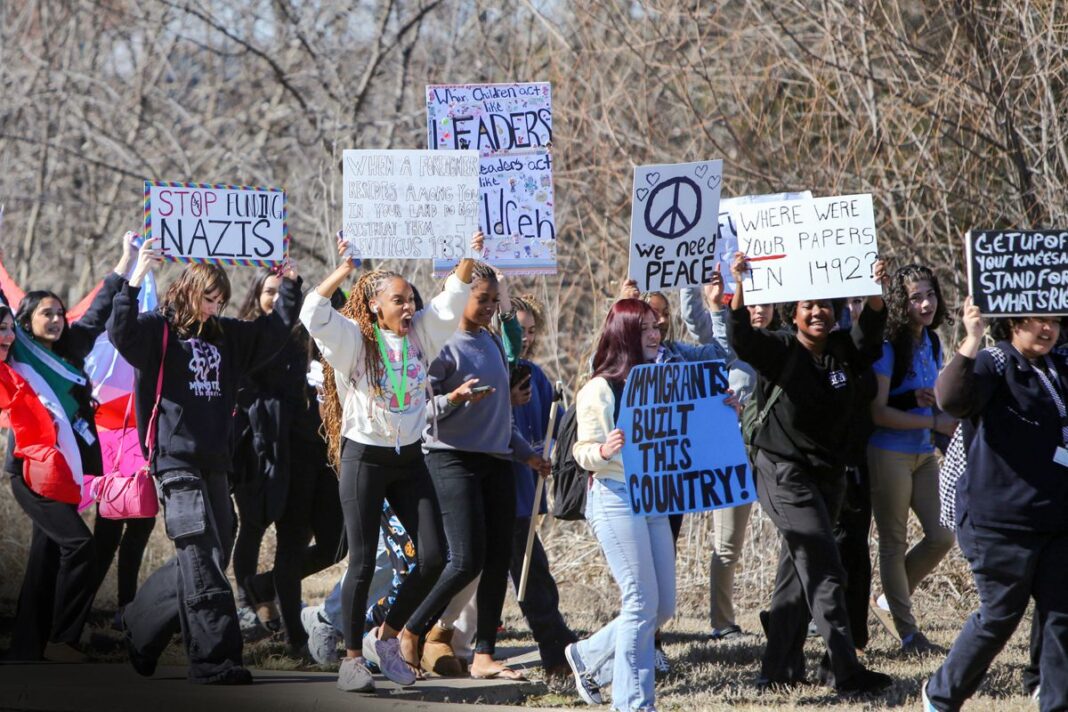
When Erika Franklin went to pick up her daughter from school on Jan. 30, she was stunned to see hundreds of students outside Olympic Middle School in Auburn, Washington—and to hear many of them screaming obscenities about Immigration and Customs Enforcement (ICE).
Franklin, 39, said she was aghast that this political activism and unruly behavior were happening while students should be in classrooms, being educated.
She scanned the crowd, looking for her 13-year-old daughter. Franklin worried that her seventh grader was caught up in the commotion, which included blocking traffic.
“My heart immediately just caught fire, and my stomach hurt,” Franklin told The Epoch Times on Feb. 4.
Franklin said her daughter had remained in class, but the teen appeared confused and afraid over the protest.
Social media users widely shared a video Franklin recorded of the protest and her reaction.
“I’m pulling my child from school today,” she says in the video.
Later in the video, Franklin tells school staff: “This is unbelievable. I can’t believe my kid is in this environment right now; I’m blown away. … I’m embarrassed as a parent and as an adult.”
In a separate video, Franklin tearfully apologizes to her daughter for the stressful situation and vows to transfer the teen to another school.
Similar scenes have been unfolding at schools across the nation in recent weeks.
The wave of anti-ICE protests began with adults and spread to schoolchildren after two confrontations with ICE and other federal immigration agents turned deadly in Minnesota in January.
School walkouts raise important questions about competing interests: child safety, parental rights, children’s rights, and schools’ responsibilities. Some of the walkouts have already resulted in violence and vandalism.
School Involvement
Many schools, in public statements, assert that they cannot infringe upon students’ free-speech rights.
Some parents disagree, saying those rights aren’t absolute. A 1969 Supreme Court ruling is on their side.
The court ruled in Tinker v. Des Moines Independent Community School District that “schools may limit student speech when it ’materially or substantially [interferes]’ with a school’s operations and its central mission, teaching students,” according to The National Constitution Center.
Even as Texas officials warned on Feb. 3 that the state will enforce penalties against students, schools, and staff for walkouts, protests have continued there.