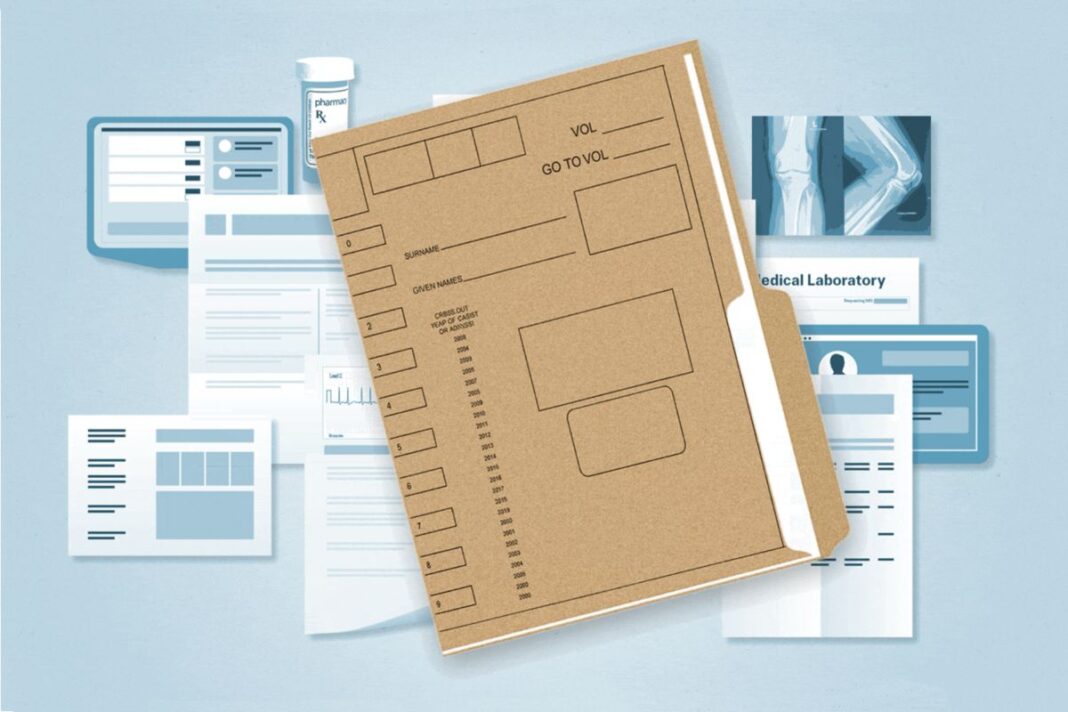


A compiled single record of an otherwise scattered medical history can be critical in preventing delayed diagnosis and unnecessary testing.
When Jennifer’s doctor asked about her last MRI, she paused. She knew the results were somewhere—an email, an online patient portal, maybe a CD from a hospital she no longer used—but she couldn’t remember the date or where to look. With no time to search, the visit moved on.
It’s a familiar moment in American exam rooms. As care spreads across specialists, hospitals, and health systems, medical records scatter with it. Many patients now receive care across multiple systems, often juggling two, three, or more portals that don’t communicate with one another.
As records fragment, the task of holding our health stories together increasingly falls to the patient. When key details are missing or hard to retrieve, diagnosis doesn’t pause. Clinicians move forward with whatever information surfaces first.
The emerging situation has turned record-keeping into more than a clerical task. It has become key to getting effective care and a way for patients to preserve context across visits, specialists, and years of care.
That’s where a medical “second brain” comes in. It’s a personal system for keeping essential health information—diagnoses, medications, test results, and care history—in one place, under the patient’s control. It doesn’t fix a fragmented health care system, but it can steady a patient’s experience by keeping critical details visible when decisions need to be made.
Why Do You Need a Medical Second Brain?
As doctor visits grow shorter and their patient loads heavier, their ability to reconstruct a patient’s history has withered. Clinicians may be attentive, but time is limited.
A portable medical record, or a medical second brain, is designed for that reality. Whether digital or on paper, it keeps essential details at hand when memory, portals, or time fall short.
The risks of missing information are well documented. Research on diagnostic error shows that incomplete or inaccessible records can delay diagnosis and lead to unnecessary testing. A 2015 report from the National Academies of Sciences, Engineering, and Medicine identified poor information flow and fragmented records as major threats to patient safety, especially during transitions between clinicians and care settings.
There’s evidence that patient-held records can help close those gaps. In a randomized trial published in BMJ Global Health, clinicians were significantly more likely to have essential information available when patients carried a portable health record, reducing time spent reconstructing history and frustration on both sides of the visit.
Availability can change how an encounter unfolds. When patients can clearly summarize their history or share key results, visits tend to move faster, and decisions come into focus.
Even then, critical context can be missed. That becomes even more likely when the system feels data-rich. Records may appear complete while containing errors, outdated information, or missing critical details. Even a polished medical history can be misleading if key facts are missing or wrong.
“Getting the correct diagnosis is entirely dependent on getting all the facts on the table, and they better be the correct facts,” Dr. Mark Graber, a professor emeritus of medicine at Stony Brook University and the founder of Community Improving Diagnosis in Medicine, told The Epoch Times in an email. “Just change a thing or two, like which symptoms are the most important ones, and the whole differential diagnosis changes.”
By Sheramy Tsai