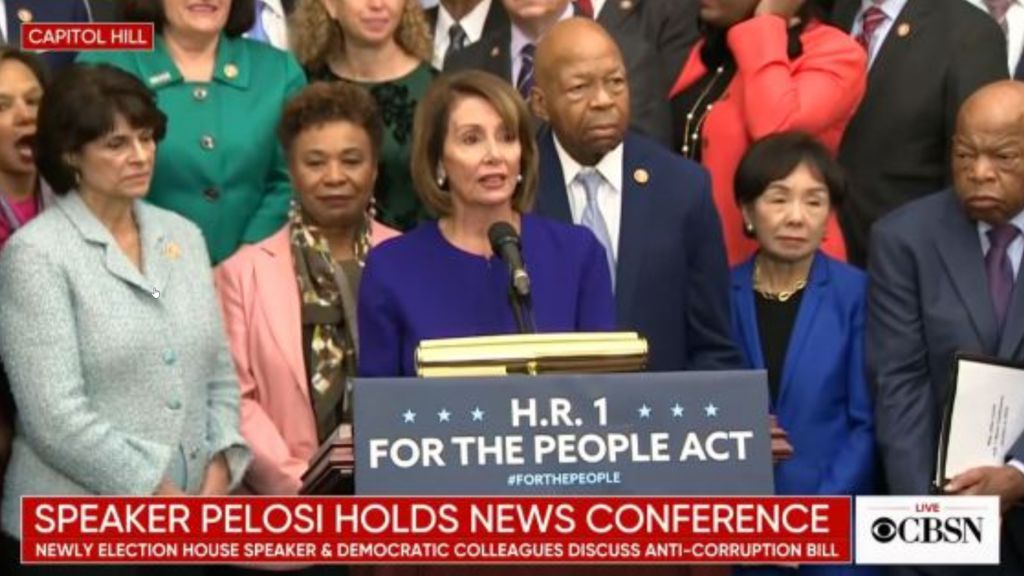


A group of over 100 conservative leaders and organizations, including ConservativeHQ.com, has released a letter analyzing the unconstitutional and deleterious effects on political participation of H.R. 1 and S.1, the Democrats’ bill to intimidate conservatives.
H.R. 1 and S. 1 would dramatically alter the First Amendment protections that Americans have enjoyed since the founding of our country. It would institute sweeping new burdens on their constitutionally protected rights to freely speak, publish, and organize into groups to advocate for the causes they support. In particular, H.R. 1 and S. 1 would impose onerous and unworkable regulatory standards on the ability of individual Americans and groups of Americans to discuss the policy issues of the day with elected officials and the public. This bill would also violate the privacy of advocacy groups and their supporters and stringently and excessively regulate political speech on the Internet.
As the letter points out, our Founding Fathers used pen names to encourage independence from Great Britain. Nearly 200 years later, the Supreme Court of the United States blocked the state of Alabama from demanding the supporter list of the NAACP, citing concerns about retribution against the group’s members and financial backers. And earlier last month, the Supreme Court agreed to hear a case challenging a California regulation forcing charities to hand over their supporter lists to the government.
Clearly, the purpose of H.R.1 and S.1 is to legalize exactly the kind of intimidation the Supreme Court found to be unconstitutional in the Alabama versus the NAACP case.
If passed, H.R.1 and S.1 the government would be in the business of:
Subjecting citizens who contribute to nonprofit organizations to harassment and intimidation by making their personal information available in a searchable government database. This mandate focuses public attention on the individuals and donors who support causes instead of on the messages communicated by those organizations, exacerbating the politics of division and personal destruction and further coarsening political discourse. This would have a considerable chilling effect on civic engagement and free speech.
Policing speech by Americans about legislative issues by expanding the definition of “electioneering communications” – historically limited to large-scale TV and radio campaigns targeted to the electorate in a campaign for office – to include online advertising that bears no relation to an election. This will subject far more issue ads to burdensome disclaimer requirements, which will coerce groups into truncating their message and make some advertising, especially online, practically impossible.
Indiscriminately regulating groups that incidentally or occasionally advocate on federal judicial nominations and require those groups to broadly expose their donors, even if those citizens had nothing to do with the groups’ speech about judicial nominees.
Forcing groups to publicly identify their supporters on the face of the ads themselves. Faced with the prospect of being inaccurately associated with what the law would consider (unjustifiably, in many or most instances) “campaign” ads in FEC reports and disclaimers, many donors will choose not to give to nonprofit groups.
Increasing regulation of the online speech of American citizens while purporting (and failing) to address the threat of Russian propaganda.
Expanding the universe of regulated online political speech by Americans beyond paid advertising to include communications on groups’ or individuals’ own websites and email messages.
Deterring American citizens from serving their country through political appointments by forcing them to disclose their donations to causes they have supported in the past.
Our elections will not be more honest, more informed, or more secure from foreign interference if we sacrifice the privacy of American citizens. But our democracy will be weakened if voices are eliminated from public debate through intimidation and overregulation.
Call the toll-free Capitol Switchboard (1-866-220-0044), tell Republican Representatives and Senators you are speaking on behalf of the millions of Americans who cherish and rely on the right to support causes they believe in without fear of harassment and intimidation, tell them you demand they oppose H.R. 1 and S. 1, the deceptively named “For the People Act.”
- H.R. 1
- S. 1
- First Amendment
- Free Speech
- Political Speech
- Donor lists
- Charities
- NAACP v. Alabama
- Nonprofit organizations
- Online advertising
- For the People Act
- Mail-in voting
- Voter ID
- Voter integrity
- Speech regulation
- intimidation
Read Original Article on ConservativeHQ.org
See text of the letter below analyzing the unconstitutional and deleterious effects on political participation of H.R. 1 and S.1, the Democrats’ bill to intimidate conservatives below:
February 1, 2021
The Honorable Nancy Pelosi
Speaker of the House of Representatives
U.S. House of Representatives
Washington, DC 20510
The Honorable Chuck Schumer
Majority Leader
U.S. Senate
Washington, DC 20510
The Honorable Kevin McCarthy
Republican Leader
U.S. House of Representatives
Washington, DC 20510
The Honorable Mitch McConnell
Republican Leader
U.S. Senate
Washington, DC 20510
Dear Speaker Pelosi, Republican Leader McCarthy, Majority Leader Schumer, and Republican Leader McConnell,
On behalf of the millions of Americans who cherish and rely on the right to support causes we believe in without fear of harassment and intimidation, we, the undersigned individuals and organizations, ask you to reject H.R. 1 and S. 1, the deceptively named “For the People Act.”
Nonprofit organizations serve a vital role in encouraging free speech and the free exchange of ideas. Privately supporting causes — and the organizations advancing those causes — is a fundamental freedom protected by the First Amendment.
Our Founding Fathers used pen names to encourage independence from Great Britain. Nearly 200 years later, the Supreme Court of the United States blocked the state of Alabama from demanding the supporter list of the NAACP, citing concerns about retribution against the group’s members and financial backers. And last month, the Supreme Court agreed to hear a case challenging a California regulation forcing charities to hand over their supporter lists to the government.
H.R. 1 and S. 1 would dramatically alter the First Amendment protections that Americans have enjoyed since the founding of our country. It would institute sweeping new burdens on their constitutionally protected rights to freely speak, publish, and organize into groups to advocate for the causes they support. In particular, H.R. 1 and S. 1 would impose onerous and unworkable regulatory standards on the ability of individual Americans and groups of Americans to discuss the policy issues of the day with elected officials and the public. This bill would also violate the privacy of advocacy groups and their supporters and stringently and excessively regulate political speech on the Internet. More specifically, H.R. 1 and S. 1 include numerous, sweeping provisions that would violate the First Amendment rights of Americans by:
• Subjecting citizens who contribute to nonprofit organizations to harassment and intimidation by making their personal information available in a searchable government database. This mandate focuses public attention on the individuals and donors who support causes instead of on the messages communicated by those organizations, exacerbating the politics of division and personal destruction and further coarsening political discourse. This would have a considerable chilling effect on civic engagement and free speech.
• Policing speech by Americans about legislative issues by expanding the definition of “electioneering communications” – historically limited to large-scale TV and radio campaigns targeted to the electorate in a campaign for office – to include online advertising that bears no relation to an election. This will subject far more issue ads to burdensome disclaimer requirements, which will coerce groups into truncating their message and make some advertising, especially online, practically impossible.
• Indiscriminately regulating groups that incidentally or occasionally advocate on federal judicial nominations and require those groups to broadly expose their donors, even if those citizens had nothing to do with the groups’ speech about judicial nominees.
• Forcing groups to publicly identify their supporters on the face of the ads themselves. Faced with the prospect of being inaccurately associated with what the law would consider (unjustifiably, in many or most instances) “campaign” ads in FEC reports and disclaimers, many donors will choose not to give to nonprofit groups.
• Increasing regulation of the online speech of American citizens while purporting (and failing) to address the threat of Russian propaganda.
• Expanding the universe of regulated online political speech by Americans beyond paid advertising to include communications on groups’ or individuals’ own websites and email messages.
• Deterring American citizens from serving their country through political appointments by forcing them to disclose their donations to causes they have supported in the past.
Our elections will not be more honest, more informed, or more secure from foreign interference if we sacrifice the privacy of American citizens. But our democracy will be weakened if voices are eliminated from public debate through intimidation and overregulation.
As a Member of Congress, you have taken an oath to support and defend the Constitution of the United States. H.R. 1 and S. 1 propose multiple violations of our First Amendment rights. On behalf of the millions of American citizens our organizations represent, we strongly urge you to oppose H.R. 1 and S. 1.
Sincerely,
See PDF Below for Signatures
See PDF of letter analyzing the unconstitutional and deleterious effects on political participation of H.R. 1 and S.1, the Democrats’ bill to intimidate conservatives below:
(H. R. 1, H.R. 1, H.R.1, HR 1, HR1,hr 1,hr1)