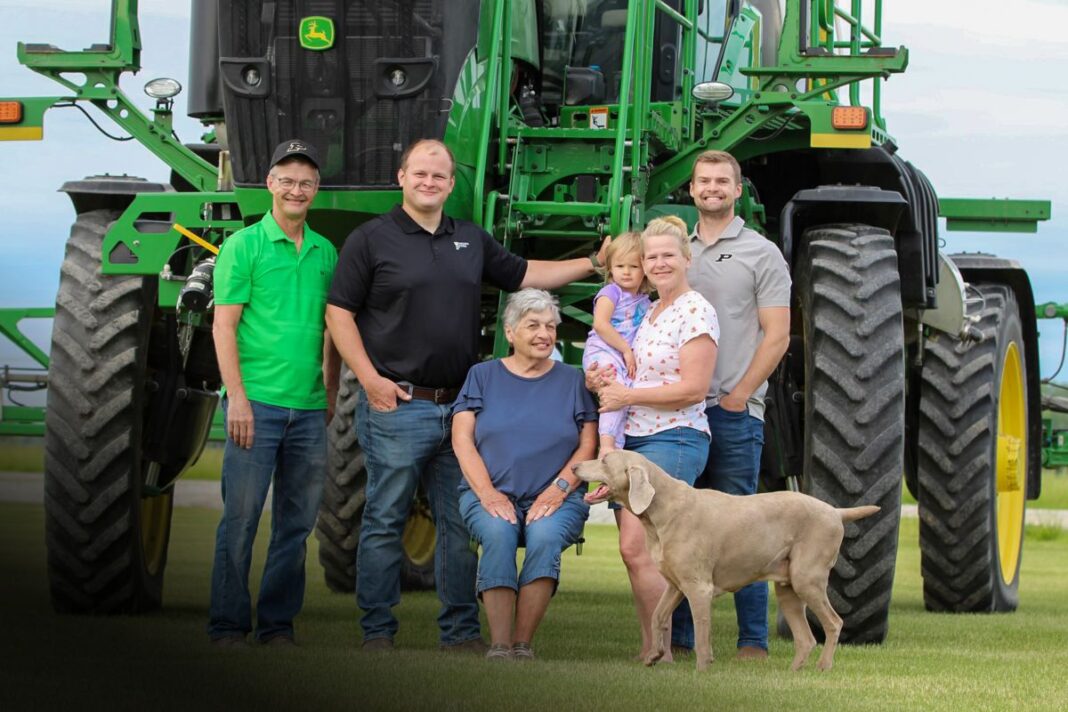


High prices and shrinking families threaten multigenerational farms in Indiana, but two young farmers believe their children will find success in the industry.
Family farms face tough challenges in today’s economy, but some young farmers are finding success—and believe their kids will, too.
In the Midwest, where agriculture is the top industry for many states, young farmers such as Tyler Everett are finding innovative ways to keep farms afloat across multiple generations.
At age 35, Everett’s a fifth-generation farmer living in Lebanon, Indiana. His family’s farm, Everett Farms, was established in 1919. Everett raises corn and soybeans on 1,500 acres, putting pride and sweat into his work like his father, grandfather, and great-grandfather before him. He has a wife, Brittney, and one young daughter.
“I farmed with … my grandpa, Aaron, before he passed away a few years ago,” Everett told The Epoch Times. “I still farm with my dad, and my grandmother is an active part of our farming operation.”
Everett said his business battles high input costs and low commodity prices, but his family tries to make good decisions and use money wisely to produce a good crop each year.
“We’re trying to make things last as long as possible,” he said. “I know a lot of farmers who buy a lot of new fancy equipment every year. I think this year we’re just kind of using what we have and we’re making what we have work, and we’re not trying to buy a bunch of new equipment. We’re making every piece of machinery count.”
The Everetts use variable rate seeding and fertilizer applications, which maximize savings by spreading the least amount of product on soil and crops. Other new technologies—such as GPS-guided sprayers and harvesters, which use satellite technology and automated steering to operate with inch-level accuracy—are helpful, but more expensive, Everett said.
The two main issues that can hurt family farms are taxes and land, he said, particularly when older family members pass on.
“People see land as a quick way to get rich and not as a long-term investment,” he said.
“Things like capital gains can really hurt people, too. Some families, if they don’t have a succession lined up, if grandpa and grandma both die, … the family might have to sell a third or a quarter of the property to pay the capital gains. So there are a lot of financial negative impacts of multigenerational farming.”
Many American farmers have a tradition of passing down farms from one generation to the next. But today, the United States has more farmers aged 75 and up than under 35, according to 2022 USDA census data. That, along with rising costs, weak commodity prices, shrinking families, and alternative career options, has put that tradition in jeopardy.
By Bruce Parker