

Americans are paying more for power while financing long overdue expansions and upgrades to the nation’s grid—and they aren’t happy about it.
If all politics is local, as former House Speaker Tip O’Neill said in tying politicians’ fortunes to constituents’ pocketbooks, then a voter’s electricity bill is about as local as an issue can get, landing on kitchen tables every month.
With electricity costs spiking for many of the nation’s 133 million households, this local issue could determine whether Republicans retain control of Congress or Democrats seize one or both chambers in November’s midterm elections.
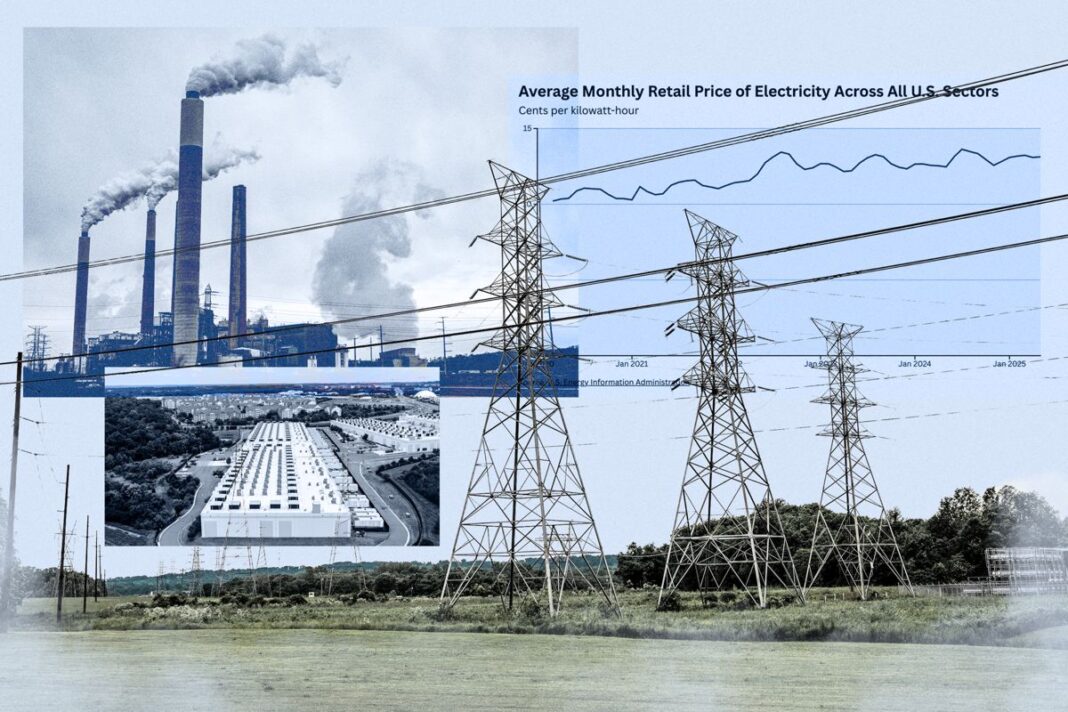
According to the U.S. Energy Information Administration, average residential electricity rates increased nationwide nearly 13 percent from April 2020 to April 2025. Since President Donald Trump returned to office in January 2025, they’ve increased 6 percent.
Electricity prices are expected to increase, on average nationwide, by another 6 percent in 2026, the administration projects, and as much as 40 percent by 2030, warns economic development finance firm ICF.
The reason is simple: supply and demand. The North American Electric Reliability Corp. projected in its 2026 long-term reliability assessment report that electricity demand will increase in the coming decade by 70 percent more than what was estimated in 2024. Many analyses find that overall demand will increase 25 percent by 2030.
The surge is driven by the development of power-hungry data centers, artificial intelligence computing, advanced manufacturing, and “the electrification of everything,” with the average home featuring up to 21 digital devices—all eating electricity all the time.
The solution is also simple: The nation’s 2,896 utility companies must increase the electricity their power plants produce with the most abundant, least expensive energy sources. Meanwhile, the nation’s seven major grid operators must add up to 7,500 miles a year to their 240,000-mile network of high-voltage transmission lines while also upgrading up to 100,000 miles of those live wires, through 2035.
But determining what solutions work best and what long-term investments to make is a complex $1 trillion challenge mired in partisan politics and buried in century-old federal, state, and local regulations.
Not only are utilities and regional transmission operators amping up from a standing start after nearly two decades of inertia, but many are scrambling to keep pace with swelling demand while also building out generation and transmission capacities to meet projected need.
The cost of these capital improvements is showing up in customers’ electricity bills, leading to heightened scrutiny of investment decisions and generation choices, as well as spurring debate about how individual communities want to develop, all while meeting a Trump administration mandate to expand rapidly to win the “AI arms race” with China.
The focus and investment is long overdue, said Robert Bryce, a film producer and author of a widely read Substack on the grid and seven books on energy policies, including, “A Question of Power: Electricity and the Wealth of Nations.”
“Given what we’ve seen in recent months, where both Republicans and Democrats are focusing on power prices, it’s clear that the days of ignoring the electric grid—and its pivotal role in our society—are over,” he told The Epoch Times. “That’s a good thing.”
By John Haughey