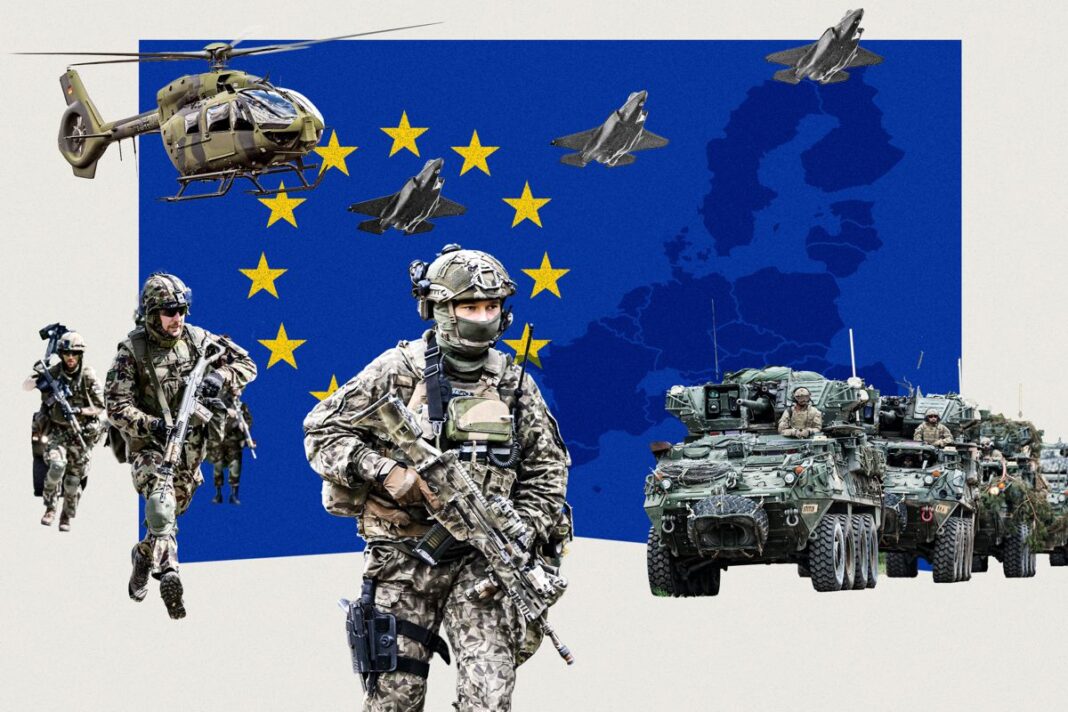


Divergent foreign policies and clashing national interests among EU members put a European army out of reach in the near term, analysts said.
President Donald Trump’s threats to withdraw the United States from NATO, as well as ongoing tensions over the Iran conflict, have reinvigorated calls among European leaders for military independence from the United States.
However, analysts have been skeptical of proposed alternatives, raising concerns about the timing and internal dynamics among European states.
Among the proposals are a standing European Union army, which Spain’s foreign minister floated earlier this month. According to multiple media outlets, Spanish Foreign Minister José Manuel Albares said the EU should not have to wait to see what the United States will do next.
His comments followed Trump’s decision to withdraw troops from Germany and his criticism of nations such as Spain, which has refused to let the United States use its bases and airspace during the war with Iran.
Trump has said that U.S. operations against the Iranian regime are beneficial to other countries’ security. He has also criticized NATO for not actively providing assistance during the conflict and said in late March that the United States therefore does not “have to be there for NATO.”
EU Defense Commissioner Andrius Kubilius told the European Parliament on Feb. 10: “European responsibility for defense demands an institutional framework for our cooperation. A European defense union.”
German Chancellor Friedrich Merz, French President Emmanuel Macron, and European Commission President Ursula von der Leyen have all said that the EU had to take responsibility for its own security.
However, EU foreign policy chief Kaja Kallas said in early February that creating a separate EU army alongside NATO would be “extremely dangerous,” arguing that its advocates “haven’t really thought this through practically.”
A Decades-Old Debate, Revived
The idea of a European army dates back to the Eisenhower administration, which once persuaded European leaders to agree to create one. The French Parliament blocked the project in 1954 and, for decades afterward, U.S. opposition to the army, as well as its commitment to NATO, kept the project off the table.
Since then, nations such as France and Germany have urged the continent to pursue strategic autonomy. Both Macron and former German Chancellor Angela Merkel backed the idea of an army during Trump’s first administration.