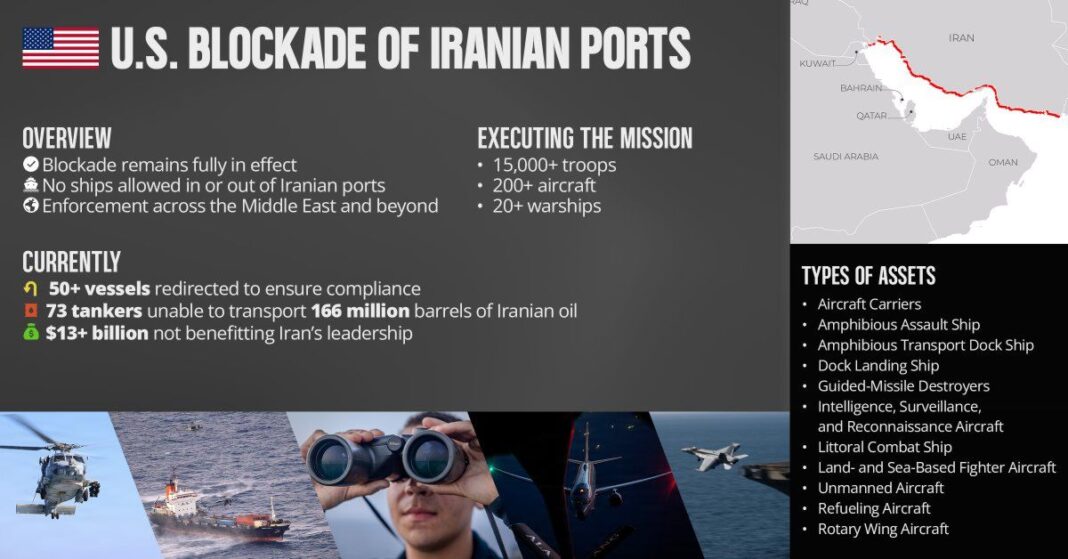


The vessels have a carrying capacity of more than 166 million barrels of Iranian oil worth over $13 billion.
The U.S. military is currently blocking more than 70 tankers from entering or leaving Iranian ports amid the ongoing Middle Eastern conflict.
“These commercial ships have the capacity to transport over 166 million barrels of Iranian oil worth an estimated $13 billion-plus,” the U.S. Central Command (CENTCOM) said in a May 8 post on X.
There are currently more than 70 tankers that U.S. forces are preventing from entering or leaving Iranian ports. These commercial ships have the capacity to transport over 166 million barrels of Iranian oil worth an estimated $13 billion-plus. pic.twitter.com/VBKfDwMwqJ
— U.S. Central Command (@CENTCOM) May 8, 2026
The U.S. military imposed a blockade on ships entering and leaving Iranian ports on April 13, a decision that came after the first round of peace talks between the United States and Iran ended without a result.
According to CENTCOM, the blockade continues to remain “fully in effect,” with enforcement action across the Middle East and beyond. Over 15,000 troops, more than 200 aircraft, and 20-plus warships have been deployed to execute this mission.
Blockading Iran’s ports puts pressure on the Middle Eastern country’s economy, as the regime’s major sources of revenue would be affected.
According to an April 13 post by the Foundation for Defense of Democracies, Iran’s crude oil exports would be the “first and most severe casualty.”
“Iran has been exporting roughly 1.5 million barrels per day, generating about $139 million daily based on wartime pricing assumptions,” the post said.
“Nearly all of that volume departs via Kharg Island, which handles over 90 percent of crude exports and lacks viable alternative routes outside the Persian Gulf.”
“A blockade would eliminate these flows almost immediately, cutting off the Islamic Republic’s primary source of foreign currency earnings,” it added.
The export of petrochemicals, valued at around $54 million per day, and other non-oil exports, such as minerals and metals, worth roughly $88 million per day, would also be affected, according to the foundation.
Moreover, Iran’s $159 million in daily imports, including food, machinery, and other inputs, would be disrupted, intensifying inflationary pressures in the country.
There has been no indication that the blockade would end soon.