What’s the problem?
The Chinese government has facilitated the mass transfer of Uyghur and other ethnic minority1 citizens from the far west region of Xinjiang to factories across the country. Under conditions that strongly suggest forced labour, Uyghurs are working in factories that are in the supply chains of at least 82 well-known global brands in the technology, clothing and automotive sectors, including Apple, BMW, Gap, Huawei, Nike, Samsung, Sony and Volkswagen.
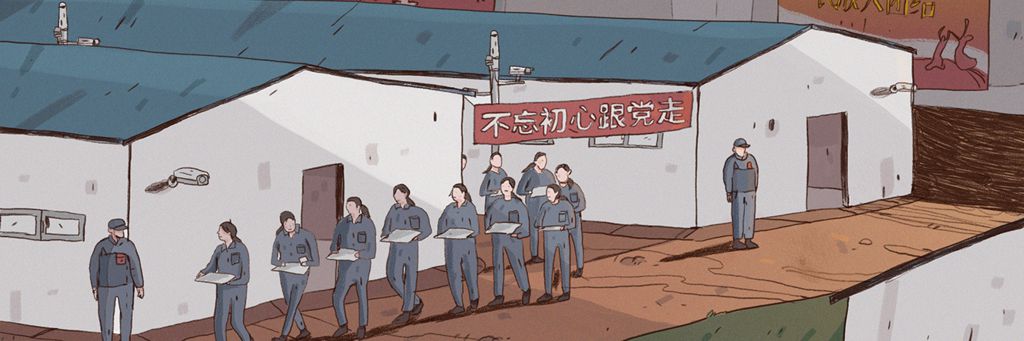
This report estimates that more than 80,000 Uyghurs were transferred out of Xinjiang to work in factories across China between 2017 and 2019, and some of them were sent directly from detention camps.2 The estimated figure is conservative and the actual figure is likely to be far higher. In factories far away from home, they typically live in segregated dormitories,3 undergo organised Mandarin and ideological training outside working hours,4 are subject to constant surveillance, and are forbidden from participating in religious observances.5 Numerous sources, including government documents, show that transferred workers are assigned minders and have limited freedom of movement.6
China has attracted international condemnation for its network of extrajudicial ‘re-education camps’ in Xinjiang.7 This report exposes a new phase in China’s social re-engineering campaign targeting minority citizens, revealing new evidence that some factories across China are using forced Uyghur labour under a state-sponsored labour transfer scheme that is tainting the global supply chain.
What’s the solution?
The Chinese government should uphold the civic, cultural and labour rights enshrined in China’s Constitution and domestic laws, end its extrajudicial detention of Uyghurs and other Muslim minorities in Xinjiang, and ensure that all citizens can freely determine the terms of their own labour and mobility.
Companies using forced Uyghur labour in their supply chains could find themselves in breach of laws which prohibit the importation of goods made with forced labour or mandate disclosure of forced labour supply chain risks.8 The companies listed in this report should conduct immediate and thorough human rights due diligence on their factory labour in China, including robust and independent social audits and inspections. It is vital that through this process, affected workers are not exposed to any further harm, including involuntary transfers.
Foreign governments, businesses and civil society groups should identify opportunities to increase pressure on the Chinese government to end the use of Uyghur forced labour and extrajudicial detentions. This should include pressuring the government to ratify the International Labour Organization’s (ILO) Convention on Forced Labour, 1930 (No. 29) and Protocol of 2014 to the Forced Labour Convention.9 Consumers and consumer advocacy groups should demand companies that manufacture in China conduct human rights due diligence on their supply chains in order to ensure that they uphold basic human rights and are not complicit in any coercive labour schemes.
Executive summary
Since 2017, more than a million Uyghurs and members of other Turkic Muslim minorities have disappeared into a vast network of ‘re-education camps’ in the far west region of Xinjiang,10 in what some experts call a systematic, government-led program of cultural genocide.11 Inside the camps, detainees are subjected to political indoctrination, forced to renounce their religion and culture and, in some instances, reportedly subjected to torture.12 In the name of combating ‘religious extremism’,13 Chinese authorities have been actively remoulding the Muslim population in the image of China’s Han ethnic majority.
The ‘re-education’ campaign appears to be entering a new phase, as government officials now claim that all ‘trainees’ have ‘graduated’.14 There is mounting evidence that many Uyghurs are now being forced to work in factories within Xinjiang.15 This report reveals that Chinese factories outside Xinjiang are also sourcing Uyghur workers under a revived, exploitative government-led labour transfer scheme.16 Some factories appear to be using Uyghur workers sent directly from ‘re-education camps’.
The Australian Strategic Policy Institute (ASPI) has identified 27 factories in nine Chinese provinces that are using Uyghur labour transferred from Xinjiang since 2017. Those factories claim to be part of the supply chain of 82 well-known global brands.17 Between 2017 and 2019, we estimate that at least 80,000 Uyghurs were transferred out of Xinjiang and assigned to factories through labour transfer programs under a central government policy known as ‘Xinjiang Aid’ (援疆).18
It is extremely difficult for Uyghurs to refuse or escape these work assignments, which are enmeshed with the apparatus of detention and political indoctrination both inside and outside of Xinjiang.19 In addition to constant surveillance, the threat of arbitrary detention hangs over minority citizens who refuse their government-sponsored work assignments.20
Most strikingly, local governments and private brokers are paid a price per head by the Xinjiang provincial government to organise the labour assignments.21 The job transfers are now an integral part of the ‘re-education’ process, which the Chinese government calls ‘vocational training’.22
A local government work report from 2019 reads: ‘For every batch [of workers] that is trained, a batch of employment will be arranged and a batch will be transferred. Those employed need to receive thorough ideological education and remain in their jobs.’23
This report examines three case studies in which Uyghur workers appear to be employed under forced labour conditions by factories in China that supply major global brands. In the first case study, a factory in eastern China that manufactures shoes for US company Nike is equipped with watchtowers, barbed-wire fences and police guard boxes. The Uyghur workers, unlike their Han counterparts, are reportedly unable to go home for holidays (see page 8). In the second case study of another eastern province factory claiming to supply sportswear multinationals Adidas and Fila, evidence suggests that Uyghur workers were transferred directly from one of Xinjiang’s ‘re-education camps’ (see page 18). In the third case study, we identify several Chinese factories making components for Apple or their suppliers using Uyghur labour. Political indoctrination is a key part of their job assignments (see page 21).
This research report draws on open-source Chinese-language documents, satellite imagery analysis, academic research and on-the-ground media reporting. It analyses the politics and policies behind the new phase of the Chinese government’s ongoing repression of Uyghurs and other Muslim minorities. It provides evidence of the exploitation of Uyghur labour and the involvement of foreign and Chinese companies, possibly unknowingly, in human rights abuses.
In all, ASPI’s research has identified 82 foreign and Chinese companies potentially directly or indirectly benefiting from the use of Uyghur workers outside Xinjiang through abusive labour transfer programs as recently as 2019: Abercrombie & Fitch, Acer, Adidas, Alstom, Amazon, Apple, ASUS, BAIC Motor, Bestway, BMW, Bombardier, Bosch, BYD, Calvin Klein, Candy, Carter’s, Cerruti 1881, Changan Automobile, Cisco, CRRC, Dell, Electrolux, Fila, Founder Group, GAC Group (automobiles), Gap, Geely Auto, General Motors, Google, Goertek, H&M, Haier, Hart Schaffner Marx, Hisense, Hitachi, HP, HTC, Huawei, iFlyTek, Jack & Jones, Jaguar, Japan Display Inc., L.L.Bean, Lacoste, Land Rover, Lenovo, LG, Li-Ning, Mayor, Meizu, Mercedes-Benz, MG, Microsoft, Mitsubishi, Mitsumi, Nike, Nintendo, Nokia, Oculus, Oppo, Panasonic, Polo Ralph Lauren, Puma, SAIC Motor, Samsung, SGMW, Sharp, Siemens, Skechers, Sony, TDK, Tommy Hilfiger, Toshiba, Tsinghua Tongfang, Uniqlo, Victoria’s Secret, Vivo, Volkswagen, Xiaomi, Zara, Zegna, ZTE. Some brands are linked with multiple factories.
The data is based on published supplier lists, media reports, and the factories’ claimed suppliers. ASPI reached out to these 82 brands to confirm their relevant supplier details. Where companies responded before publication, we have included their relevant clarifications in this report. If any company responses are made available after publication of the report, we will address these online.
ASPI notes that a small number of brands advised they have instructed their vendors to terminate their relationships with these suppliers in 2020. Others, including Adidas, Bosch and Panasonic, said they had no direct contractual relationships with the suppliers implicated in the labour schemes, but no brands were able to rule out a link further down their supply chain.
The report includes an appendix that details the factories involved and the brands that appear to have elements of forced Uyghur labor in their supply chains. It also makes specific recommendations for the Chinese government, companies, foreign governments and civil society organizations.
Citations and notes
Readers are encouraged to download the PDF to access the full and extensive citations and notes that accompany this report.
By Vicky Xiuzhong Xu , Danielle Cave , Dr James Leibold , Kelsey Munro & Nathan Ruser
Visit the Report Website at ASPI.org