

Let’s begin by defining the elephant in the room: racism. According to Merriam-Webster, racism is defined as “a belief that race is a fundamental determinant of human traits and capacities and that racial differences produce an inherent superiority of a particular race.”
Pretty straightforward. However, before we jump into the the article, there is an important aspect of “racism” that is almost ALWAYS ignored. Anyone can be racist. This is not an exclusively white thing. It is not a black, brown, yellow, green or purple thing. If the way you think about another person is based on nothing but the other person’s race, hate to break it to you, but that is racism. No matter what color either of the people are. Thinking like that is the actual definition of being a racist. So, just to set the record straight, yes, people of color can be racist. But that is a topic for another day, today we will look at how race is being twisted and weaponized to pit Americans against their fellow Americans.
Many of the people who spend the most time accusing others of racism often seem to embrace that exact mindset themselves. The modern political narrative surrounding race has become so twisted that simply pointing out facts, discussing statistics, or acknowledging uncomfortable realities is now frequently labeled “racist” by default. We have reached a point in society where truth itself is becoming controversial.
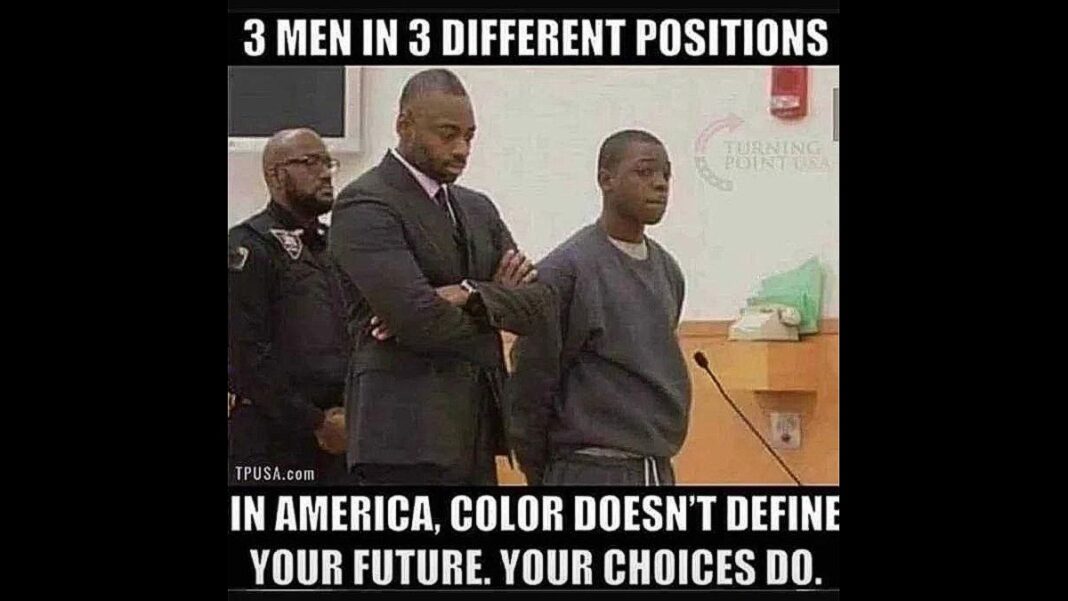
This article was actually inspired by an image I recently saw online. It showed a courtroom scene containing three black men: the defendant, his attorney, and a bailiff standing in the background. The caption read: “Three black men. Three different choices. Three different outcomes.”
That image was powerful because it exposed something many people no longer want to admit. What a person becomes is far less about the color of their skin and far more about the direction of their decisions. Same race. Different choices. Different outcomes. Their lives were not determined by pigmentation. They were determined by decisions, actions, discipline, responsibility, and personal direction.
That truth terrifies people who have built entire political ideologies around victimhood.
One of the greatest modern lies is the idea that minorities are somehow incapable of success without government intervention or white liberal “guidance.” Think about how insulting that mindset actually is. When someone constantly says, “those people need our help,” the obvious question becomes: why do they think “those people” need their help in the first place? Why do they think they are some sort of savior to others. Why do they project such righteous indignation? The answer is uncomfortable, but obvious.
Many elite white liberals have embraced the soft bigotry of low expectations of minorities. They claim compassion, but what they often project is superiority. They speak as though minorities are incapable of thriving without political caretakers managing their lives. The recent contention that black people are incapable of having or obtaining official identification in order to vote is just the latest in an ongoing string of claims that the Democrats make about what a specific color of person can or cannot do. Notice how many of the “saviors” at these protests are old, white people? Coming out to save the day for all those poor minorities who don’t know how to do anything? Really?
How is that not racism?
The irony is that many of the people they accuse of being racist are the very people who believe every individual, regardless of race, is capable of either success or failure based largely on choices, culture, discipline, environment, and effort. The courtroom image proves exactly that. Three men. Three paths. Three outcomes.
Some people choose to become victims. Others choose to become victors.
That distinction matters.
Modern society has become obsessed with teaching people how oppressed they are, instead of reminding them how capable they are. Entire industries now profit from outrage, grievance, division, and dependency. The victim mentality has become so deeply embedded into certain political movements that personal responsibility is often treated as offensive.
But here is the problem with victimhood: eventually it becomes identity. Once someone embraces the idea that the world is permanently against them, they stop trying to conquer obstacles and instead begin explaining away failures. A victim mentality creates stagnation. A victor mentality creates movement. Circling back to that picture. One victim mentality. Two victor mentalities. One criminal, one law enforcement officer, one attorney. Results reflect the facts.
And the proof exists everywhere.
Most people probably don’t know that America is home to the largest concentration of black millionaires in the world. There are approximately 1.75 million black millionaires in the United States, which represents roughly 90% of the black millionaires throughout the entire world. That means that there are only around 200,000 black millionaires outside of America.
Even using conservative estimates, approximately 1.75 million black millionaires in the United States with only the minimum qualifying net worth of one million dollars each would collectively represent at least $1.75 trillion in wealth. In reality, the number is likely far higher since many millionaires possess substantially more than the minimum threshold. Add to that the trillions of dollars in annual black consumer spending power, the enormous influence of black culture on global entertainment, music, sports, fashion, business, and media, and it becomes increasingly difficult to argue that black Americans are economically powerless in modern America. How are these numbers even be possible if America is such a racist country?
And there is even more proof. A black man was elected President of the United States not once, but twice. Black Americans have become judges, doctors, business owners, military leaders, entrepreneurs, entertainers, inventors, scholars, and some of the wealthiest and most influential people on Earth. None of these facts mean racism never existed or that injustice never occurred. Of course it did. But it completely destroys the narrative that success is somehow impossible in America for minorities, specifically black Americans.
In fact, if America were truly the irredeemably racist nation some claim it to be, these achievements would not exist on the scale that they do. That is just common sense.
Now let’s address another uncomfortable reality people desperately try to avoid: slavery did not begin with America, nor was it invented by white people. Slavery has existed throughout virtually all recorded human history. It existed in Africa, Europe, Asia, the Middle East, and among countless civilizations long before the United States ever existed.
And yes, another historical fact many people refuse to acknowledge is that African tribes and kingdoms participated in the capture and sale of other Africans into slavery. That reality does not absolve European buyers of responsibility, nor does it somehow make slavery acceptable. It was evil. Period. But if we are going to have honest conversations about history, then honesty cannot become selective simply because certain facts make people uncomfortable.
Personally, if I discovered that my own ancestors had participated in selling members of my own people into slavery, I would be furious with them. Not because the buyers were innocent, but because betrayal from within is one of the darkest forms of human behavior imaginable. It is one thing for outsiders to exploit the suffering of another group of people. It is another thing entirely for people to profit from the suffering of their own.
That is not hatred. That is honesty.
And honesty matters because modern political movements increasingly rely on simplified narratives rather than complicated truths. History is being reduced into emotionally satisfying slogans instead of factual reality.
Another irony that cannot be ignored is how many public figures spend years aggressively condemning white people, white culture, “white privilege,” colonization, slavery, and systemic oppression, only to later discover that their own ancestry is deeply connected to the very history they routinely attack.
Angela Davis, a lifelong racial activist who has repeatedly spoken about oppression, systemic racism, and white power structures, later discovered through ancestry research on PBS’s Finding Your Roots that part of her own lineage included a white ancestor who owned slaves. Maya Angelou, one of the most recognizable literary voices on race in America, also had ancestry tied to the deeply intertwined racial realities of the American South, including white ancestry connected to slavery-era relationships. Sunny Hostin, who has made numerous inflammatory public comments regarding white privilege and racial inequality on national television, publicly acknowledged discovering that members of her own family lineage were connected to slave ownership after appearing on Finding Your Roots.
The point here is not to personally attack these individuals. The point is to expose a reality that modern racial politics desperately tries to avoid: history is complicated. Bloodlines are complicated. Human civilization is complicated. The simplistic narrative that one group of people represents permanent evil while another represents permanent victimhood completely collapses the moment actual genealogy enters the conversation.
None of us choose our ancestors. None of us choose the century we were born into. None of us are personally responsible for the actions of people who lived hundreds of years before we existed. The sins of the father should not become the permanent burden of the son, especially when the son had absolutely nothing to do with those actions.
And yet modern society increasingly encourages exactly that kind of inherited guilt and inherited resentment.
Ironically, many of the loudest voices demanding that others “face history” become deeply uncomfortable when history becomes personal and starts revealing uncomfortable truths about their own lineage. That discomfort alone should tell people something important: human history does not fit neatly into modern political slogans.
That principle should apply equally to everyone.
Reality is far more complicated than activists want people to believe.
Another dangerous modern trend is the idea that statistics themselves are somehow racist. Think about how absurd that is. Statistics are tools. They are information. Their purpose is to identify patterns so problems can be addressed intelligently. If a certain community has higher crime rates, lower graduation rates, higher poverty rates, or greater family instability, the answer should not be to scream “racism” at anyone who points out the data. The answer should be to ask why those problems exist and what can be done to solve them. That’s why questioning is so important. Questions lead to answers. Answers lead to change. A system that punishes questioning eventually will stagnate and collapse.
What we have now is a society that increasingly attacks the messenger, rather than addressing the issue itself.
Worse yet, destructive behavior is often excused, normalized, or even glorified. Society has reached a point where discipline, self-respect, accountability, and personal dignity are treated as outdated ideas, while chaos, vulgarity, aggression, and irresponsibility are brushed aside as “cultural expression.” Then, when people react negatively to those behaviors, criticism is immediately reframed as racism instead of an honest conversation about standards and conduct.
Communities do not elevate themselves by glorifying dysfunction.
There was a time when many black leaders challenged their communities to strive for excellence, discipline, education, strong families, professionalism, and personal pride. They encouraged people to rise above stereotypes, not embody them. Today, far too many cultural icons glorify violence, criminality, promiscuity, drug abuse, materialism, and self-destruction. Then society wonders why certain environments continue to struggle.
That is not oppression. That is cultural decay. And where are the leaders willing to say it openly?
Where are the voices challenging young people to stop glorifying behavior that destroys their futures? Where are the calls for stronger families, greater accountability, better education, and more self-respect? Why is it considered offensive to encourage discipline, responsibility, and dignity?
Because victimhood has become profitable. Very profitable!
Politicians gain power from it. Media organizations gain ratings from it. Activists gain influence from it. Entire systems have been built around convincing people they are permanently oppressed instead of empowering them to overcome obstacles.
But history tells a different story.
One of the greatest insults modern victimhood culture places upon the descendants of slaves is the constant implication that they are weak, helpless, or permanently broken by history. The reality is exactly the opposite. Their ancestors endured conditions that would have destroyed many people entirely, yet they survived anyway. They fought to live. They fought to protect their children. They fought to create opportunities for future generations they themselves would never see.
And despite the horrific origins of slavery in America, nearly two million black millionaires now exist in the United States alone. That reality does not justify slavery. Nothing could. But it does demonstrate something incredibly important: the descendants of slaves did not merely survive. Many of them ultimately achieved extraordinary success.
That success was built upon generations of resilience, sacrifice, endurance, and determination. Instead of teaching people to see themselves primarily as victims of history, perhaps society should spend more time reminding them that they are also the descendants of survivors strong enough to overcome it.
That legacy should inspire strength, not permanent victimhood. There is an inner fortitude that was not forgotten, but stolen by those who would use the travesties of history as a way to continue the cycle of control that started at the dawn of slavery. The question that people need to answer is not “…was slavery wrong?”. We all know the answer to that. The question should be, “…who is actually benefiting from the continued focus on race?” That answer is also one that most people know, if they’re honest enough to admit it. When it comes to which political party, Democrats is the answer.
The black community deserves better than political manipulation, lowered expectations, dependency narratives, and cultural self-destruction. Every community deserves better than that.
At some point society must decide what it actually wants. Do we want to raise generations who see themselves primarily as victims of history, or generations who see themselves as capable of overcoming it?
Because those two mindsets lead to very different futures.
And if facts themselves are now considered racist simply because they are uncomfortable or don’t fit the narrative that some are trying to project, then as a society, we’re cooked.