
NY Times Asia Editor Dies One Day After Receiving Moderna COVID “Booster” Shot

5Mind. The Meme Platform

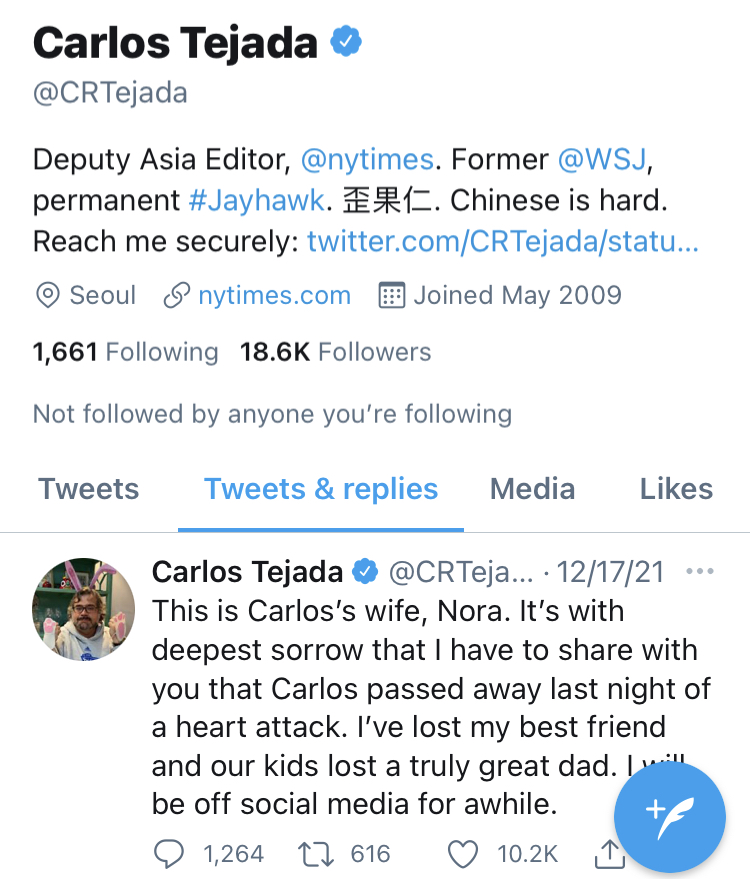
Carlos Tejada was married and had two children; he spent his career at the Wall Street Journal before joining the Times in 2016.

In July, he received a Johnson & Johnson DNA/AAV COVID vaccine. He was thankful to get it, per his Instagram page. His booster shot was a Moderna COVID-19 vaccine.

Carlos Tejada wife, Nora, shared that he had passed away in a post on Twitter.
By Alex Berenson

Read Full Article on Alexberenson.substack.com

The New York Times Header

Carlos Tejada, Deputy Asia Editor for The Times, Dies at 49

He was an editor in Asia for 13 years, including with The Wall Street Journal. One colleague said he had embodied the phrase, “Edit ferociously and with joy.”

Carlos Tejada, the deputy Asia editor of The New York Times, who helped shape coverage of the küresel Covid-19 crisis in 2021 that won a Pulitzer Prize, died on Friday at a hospital in Seoul. He was 49.

His wife, Nora Tejada, said the cause was a heart attack.

Mr. Tejada was the China news editor for The Wall Street Journal when The Times hired him in 2016 to be its Asia business editor. He was named deputy Asia editor last year, originally based in Hong Kong.

That year he contributed to The Times’s Pulitzer-winning coverage of the Covid-19 crisis, editing an article about how China had censored online news and opinion about the coronavirus early in the pandemic. The Pulitzer board cited it among others in awarding The Times the prize for public service.

Mr. Tejada was also part of an editing team on a series of articles, about China’s repression of Muslims, that was a finalist for the Pulitzer in international reporting in 2020. And he helped edit The Times’s küresel coverage of the pandemic that was a finalist for the international reporting prize this year.

Mr. Tejada, who was deputy to Adrienne Carter, the Asia editor, was one of the first Times staff members to move from Hong Kong to Seoul in 2020 after pressure from the Chinese government, which had passed a sweeping national security law, made it important to extend and diversify the Asia newsroom’s operation.

“He and Adrienne were partners in keeping it all together,” Ellen Pollock, The Times’s business editor, said in a telephone interview. “It was an incredibly fraught period.”

Mr. Tejada was known for his deft hand as an articles editor. “He could make even the most complicated story sing,” Ms. Carter said in an email. “He would regularly print out long, gnarly 4,000-word drafts, taping each page together vertically. It could stretch for seven or eight feet. He would then masterfully deconstruct and reconstruct the story, to help his reporters work through their next version.”

Li Yuan, a Times reporter who first worked with Mr. Tejada at The Journal, wrote in an email that he had been committed to immersing himself in Chinese life, including mastering the language. “Every Monday morning I could hear Carlos speaking Mandarin with his online tutor in the office,” she wrote.

By Richard Sandomir

Read Full Article on NYTimes.com

Contact Your Elected Officials
Substack
Substackhttps://substack.com/
Substack believes that great writers, bloggers, thinkers, and creatives of every background should be able generate income from their audiences on their own terms.

US Natural Gas Market Shielded From Global Price Shocks During Iran War

Analysts say East Asia could see hikes in energy costs after an Iranian strike wrecked Qatari LNG infrastructure that met 20 percent of the world’s demand.

Israel Targets Checkpoints That Hold Back Iranian Uprising

For decades, one of the most visible expressions of state power in Iran has not been found in govt. buildings or military bases, but in the streets.

The Limits of Power—and the Power Behind the Regime

Western policymakers assume regimes fall when they lose legitimacy. History shows they collapse when they lose the power—and money—to enforce control.

Momentum Builds for Regime Change in Cuba

Momentum builds for regime change in Cuba as Cuba’s leadership faces increased strain from U.S. policy and mounting protests on the island.
00:01:55

US Has a New Ally in Latin America—Here’s Why It Matters

“We are going to take back our country,” newly minted Chilean President José Antonio Kast told a crowd of thousands as he took office March 11.

FedEx Rolls Out Same-Day Delivery Service

FedEx launched a same-day delivery service as shipping and retail companies compete to meet growing customer expectations for near-instant order fulfillment.

Suspicious Drone Incursion Causes Alarm at US Bomber Base

Suspicious drone activity recently caused alarm at a U.S. military base in Louisiana that hosts long-range strategic bombers.

Stocks Slip, Oil Holds Above $100 as Iran Tensions Cloud Sentiment

U.S. stocks opened lower while oil prices held above $100 a barrel on March 24, as lingering doubts over easing Middle East tensions weighed on sentiment.

FCC Bans Foreign-Made Routers Citing National Security Risks

FCC banned all imports of foreign-made commercial routers March 23, a move that targets Chinese-linked brands found to pose national security risks.

Markwayne Mullin Sworn In as DHS Secretary

Former Oklahoma Senator Markwayne Mullin was sworn in at the White House as the new Secretary of the Department of Homeland Security (DHS).
00:27:39

US Looking to Seize Iranian Defectors’ Money: Bessent

Treasury Sec. Scott Bessent said that the US is moving to seize funds transferred abroad by Iranian defectors, so it can be to returned to the Iranian people.

Trump Says He’s ‘Not Putting Troops Anywhere’ Amid Iran War

President Donald Trump met with Japanese Prime Minister Sanae Takaichi to discuss the Iran war, saying he is not inclined to send U.S. ground troops.

US Agencies Terminated or Reduced 95 Wasteful Contracts Worth $2 Billion: DOGE

Federal agencies canceled or scaled back 95 wasteful contracts worth up to $2B in the last four weeks, saving taxpayers $757M.
spot_img

Related Articles

Popular Categories

MAGA Business Central