There is a dangerous shift happening in this country, and it has nothing to do with tax policy, border debates, or even elections themselves. It has to do with language. Not casual disagreement or political opinion, but the kind of language that reshapes reality in the minds of the people hearing it. We are watching words that once described some of the most horrific regimes in human history get thrown around as everyday insults. Terms like fascist, Nazi, and Hitler are no longer reserved for systems that imprisoned, tortured, and murdered millions. They are now used as political labels, repeated so often that they begin to sound normal.
That normalization is not harmless. It is not just exaggerated speech. It is the foundation of something far more dangerous, because when words lose their meaning, people lose their ability to recognize what is real.
There is a reason those words carried weight in the first place. They were not created as metaphors or emotional expressions. They were used to describe real events, real suffering, and real brutality that left permanent scars on humanity. Under Joseph Stalin, millions of people were imprisoned, starved, tortured, and executed. Entire populations were forced into labor camps where survival itself was unlikely. Families disappeared overnight without explanation, and questioning authority was often the last thing a person ever did.
Under Adolf Hitler, political opposition was not debated or challenged through speech. It was eliminated. Critics were arrested, imprisoned, and in many cases killed. Millions of innocent people were systematically exterminated in one of the most horrific chapters in human history. Under Vladimir Lenin, the Red Terror made it clear that suspicion alone could be enough to justify execution. There were no protections, no meaningful trials, and no safety for those who found themselves on the wrong side of power.
In those systems, people did not openly criticize leadership and then go about their day. They did not gather publicly to insult those in power and then return home safely. They did not post their opinions, taunting authorities, for others to see. They disappeared. That is what real tyranny looks like. It is not loud, it is not debated, and it does not tolerate opposition.
Now compare that to what we are seeing today. People freely accuse political figures of being dictators, fascists, and worse. Those accusations are repeated constantly through media, social platforms, and public statements. They are often presented without evidence, without context, and without any real understanding of what those words actually mean or imply. Over time, repetition replaces proof. The accusation itself becomes the reality in the minds of those hearing it.
This is where the real danger begins, because repetition builds belief, and belief drives behavior.
No one wakes up one day and decides to commit political violence in isolation. There is a progression that leads to that point and the worst thing is that the people doing it know what their doing. It is a systematic and intentional process, deployed to achieve a specific outcome. It begins with exposure to an idea, continues with reinforcement of that idea, and eventually becomes a belief that feels completely justified to the person holding it. When someone hears over and over again that a specific individual is not just wrong, but evil, not just a political opponent, but a threat comparable to history’s worst monsters, that framing changes how that individual is perceived. It removes the possibility of disagreement and replaces it with a sense of urgency.
At that point, the situation is no longer about politics. It becomes something else entirely in the mind of the person who believes it. If they accept the idea that they are facing something truly dangerous, something on the level of what history has already shown us, then their actions will reflect that belief. What might seem unthinkable to one person can feel justified to another who believes they are preventing something catastrophic.
This is not speculation. This is a pattern that has played out before, and it always begins the same way. People are taught to see others not as individuals, but as threats. They are told, repeatedly, that the danger is real and immediate. Over time, that message settles in, and once it does, the line between thought and action becomes thinner.
But why is this happening? Why do certain Democrats seem that the only thing they can focus on or talk about is Donald Trump? Is it fear for the future of America, or is it something far more sinister?
As each day passes, more accusations, investigations, audits, and revelations point toward something far larger than ordinary waste or bureaucratic incompetence. This is not someone slipping a few dollars out of the public coffers. We are talking about government systems where hundreds of billions of dollars may be lost annually to fraud, improper payments, waste, abuse, and mismanagement. The Government Accountability Office has reported that fraud alone may cost the federal government nearly half a trillion dollars each year. This shows just how large and layered the problem really is, a problem that might have been happening for decades.
When rhetoric reaches a fever pitch, a thinking person should ask why. Is the panic coming from a deep and selfless love of country, or is it coming from people who understand that long-protected systems may finally be examined closely enough to expose what has been hidden? Truth has a way of changing how people act. You can often hear it in their voices and see it on their faces. The louder the objection becomes, the more reasonable it is to ask whether the objection is really about justice, or about fear.
Elon Musk made a point from his PayPal experience that fits this moment almost perfectly. He said, in substance, that the people who complain the loudest when fraud is challenged are often the fraudsters themselves. That does not prove guilt by itself, but it does describe a common human reaction. People who are innocent may ask questions. People who are exposed may panic. People who have benefited from a corrupt system may not object because they care about fairness. They may object because the investigation threatens the conditions which have protected them.
In our digital age, hiding wrongdoing is harder than it has ever been. Records exist. Transfers exist. Emails exist. Databases exist. Even when money is misdirected, disguised, or pushed through layers of agencies, vendors, nonprofits, contractors, and programs, the trail does not always disappear. It may become difficult to follow, but difficult is not the same as impossible. That one word, nearly, is what should worry the people who thought they were untouchable. Nearly impossible to trace still means traceable.
That is why accountability matters. If public officials, bureaucrats, contractors, political allies, or connected organizations have taken advantage of government systems to enrich themselves, reward friends, or redirect taxpayer money into protected channels, then it is not merely a financial crime. It is a betrayal of public trust. Every dollar stolen, wasted, or fraudulently obtained is a dollar taken from the working Americans who were forced to pay into the system. It is a dollar not used for veterans, roads, schools, seniors, public safety, or citizens who actually needed help.
This is where the rhetoric connects directly to the fear. Donald Trump represents a reckoning to people who believe the systems that protected them may no longer be safe. Whether someone likes him or hates him is not the point. The point is that if he threatens the networks, habits, and arrangements that allowed people to live comfortably off public money, then those people have a very strong motivation to want him destroyed politically, legally, socially, and, as we are now seeing, perhaps even physically by those who have absorbed the most extreme version of the rhetoric.
That is the part Americans need to understand. When someone poses a threat to a way of life that others have become accustomed to, especially if that way of life is opulent, protected, and funded by other people’s money, desperate people may do desperate things. If the accusations are loud enough, vicious enough, and constant enough, they can create the illusion that destroying the threat is not only acceptable, but necessary. Because, for them, it absolutely is necessary.
And if anyone in power is knowingly allowing lies, hysteria, and inflammatory accusations to spread because it protects corruption, then that person is not simply playing politics. That person is helping create the conditions for violence. There is no excuse for that. Public service is supposed to be a sacred trust, not a personal enrichment scheme, not a protection racket, and not a hiding place for people who use the generosity of this nation as their private piggy bank.
Time honors all facts. It may not happen as fast as we want. It may not unfold as cleanly as it should. But eventually, records surface, people talk, numbers stop adding up, and the truth begins to move from suspicion to evidence. That is what corrupt people fear most. Not disagreement. Not criticism. Not political opposition. They fear exposure. They fear being found out. They fear being caught. And most of all, they fear being punished for the things they have done.
It may also be worth considering another angle that rarely gets discussed honestly. What we are seeing right now could help explain why so many politicians publicly attack wealthy individuals, especially billionaires, while at the same time relying on networks of wealth and influence to sustain their own power. There is an inherent tension there that most people recognize but few are willing to say out loud. Influence, access, and money have always been intertwined in politics, but the dynamic changes when someone enters that system who is not dependent on it in the same way.
A person who has built significant personal wealth operates under a different set of incentives than someone whose entire career and financial trajectory depend on remaining inside the political structure. Whether one agrees with Donald Trump or not, he represents a version of that difference. He is not financially dependent on the traditional pathways that have historically shaped political careers. That reality changes how he is perceived by those who are accustomed to operating within a system where influence can be negotiated, exchanged, or leveraged.
There is also a broader concern that many Americans have raised over time, and it deserves to be acknowledged even if it is uncomfortable. Some long-term public officials enter politics with modest means and leave with significant personal wealth. That alone does not prove wrongdoing, but it does raise reasonable questions about how that transformation occurs within a system that is supposed to be rooted in public service. When those questions are asked, they are often dismissed or deflected rather than addressed directly, which only adds to public skepticism.
This is not a new concern. When Ross Perot ran for president in 1992, one of the ideas he introduced was the concept of applying business discipline to government operations. The idea resonated with many Americans because it framed government not as an abstract institution, but as something that should be accountable, efficient, and measurable. That concept challenged the way many people viewed the role of government, and it also introduced a level of scrutiny that some in the political system were not comfortable with.
The fear, for some, may not be about personality or rhetoric at all. It may be about disruption. When someone enters a system who is not easily influenced through traditional means, it creates uncertainty for those who have learned how to operate within it. That uncertainty can quickly turn into resistance, and that resistance can become amplified through messaging, narratives, and public positioning.
At the end of the day, the question is not whether someone can be liked or disliked, supported or opposed. The question is whether the systems that govern the country are being used in the way they were intended. If they are not, then scrutiny is not only justified, it is necessary. And if scrutiny creates fear in certain corners, the natural follow-up question is simple. What exactly is it that they are afraid of being exposed?
When fear of exposure is combined with a loss of control, the result is predictable. The rhetoric intensifies, the accusations become more extreme, and the line between truth and narrative quickly disappears. What starts as messaging quickly turns into belief, and once that belief takes hold, it no longer stays confined to words.
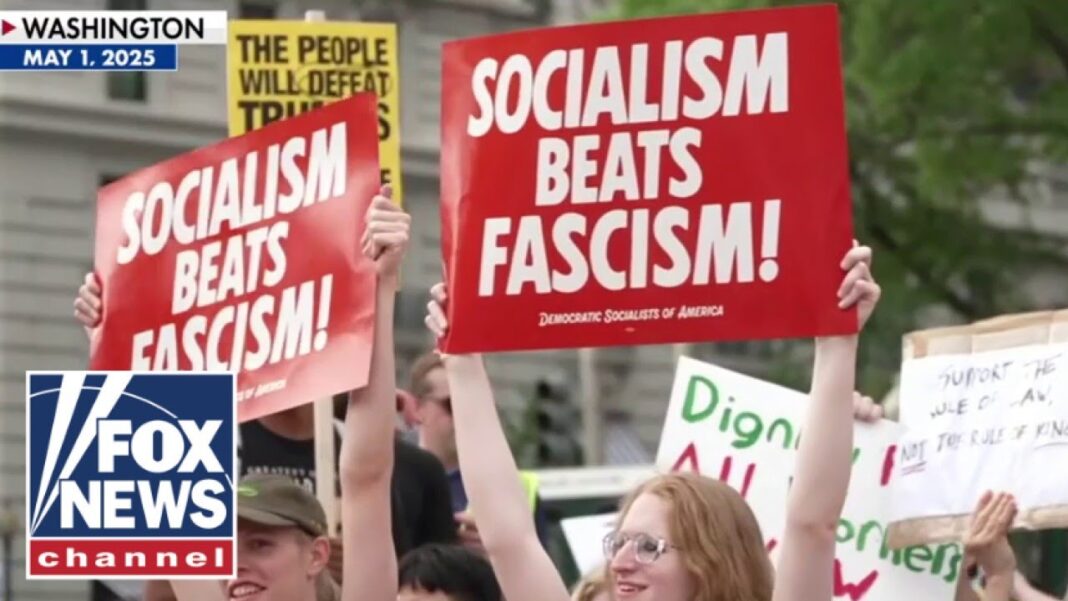
What makes the current moment so concerning is not simply that strong language is being used. It is that the language being used carries a level of historical weight that is being completely ignored. When terms like fascist or Nazi are used casually, they lose their connection to the real atrocities they once described. At the same time, they gain a new role as tools of emotional manipulation. They are no longer being used to describe reality. They are being used to shape it.
When that kind of language is directed at a specific person and repeated consistently, it creates a narrative that becomes difficult for some individuals to separate from truth. If the individual is unstable, if they are already prone to extreme thinking, or if they are deeply influenced by the sources they trust, the result can be exactly what we have seen. A belief forms, that belief hardens, and eventually it can lead to violence.
This is where cause and effect becomes unavoidable. Words influence perception. Perception influences belief. Belief influences behavior. Ignoring that chain does not make it disappear. It only allows it to continue unchecked.
None of this means that people should not speak, criticize, or challenge those in power. That is a fundamental and important part of a free society. The issue is not criticism. The issue is the escalation of that criticism into something so extreme that it no longer resembles reality. When everything becomes “Hitler,” when every disagreement becomes “fascism,” the language stops serving its original purpose. It no longer informs. It inflames.
The truth is not always comfortable. It is often ugly, harsh, and difficult to face. The historical reality behind the words being used today is proof of that. Those truths should not be softened or ignored, because they exist as warnings. They show us exactly what happens when power goes unchecked and when people are no longer allowed to think or speak freely.
But those same truths also show us something else. They show us how dangerous it is to misuse that history, to take words that were meant to describe real horror and turn them into everyday talking points. Because when those words are stripped of their meaning, they do not disappear. They evolve into something else, something that can shape belief in ways that are no longer grounded in reality.
Violence does not begin with action. It begins with justification. And justification begins with the words people are taught to believe. If we continue down a path where extreme accusations are treated as normal conversation, where historical evil is reduced to political insult, we should not be surprised when someone eventually acts on what they have been convinced is true.
Because when a person truly believes they are facing something monstrous, even if that belief is based on nothing but falsehoods used to create this exact response, they will convince themselves that stopping it is not just an option, but a necessity.
That is when all that we have worked for as a country, and a society, will truly be at risk.