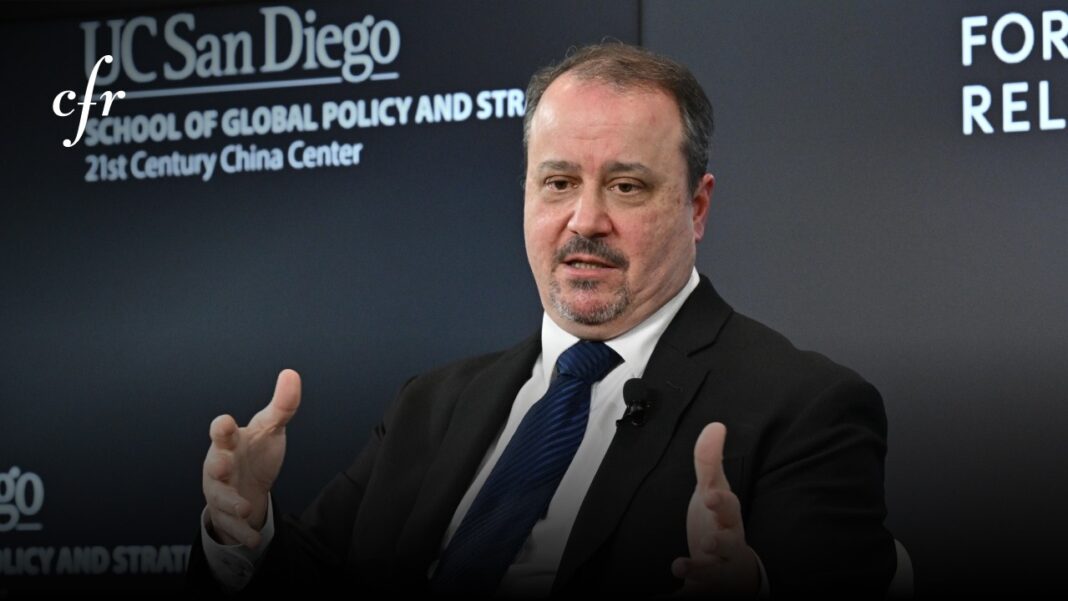


A senior trade official in the U.S. administration says Prime Minister Mark Carney’s current strategy to “antagonize” U.S. President Donald Trump is certainly impacting negotiations around the review of the North American free trade deal.
Deputy U.S. Trade Representative Rick Switzer made the comments on April 22 during a conversation with the Council on Foreign Relations, an American think tank.
Switzer said Canada and certain other countries have chosen to make their disputes with the United States “personal,” to their detriment.
“I think Carney has made it personal. I think it’s political malpractice for the prime minister of Canada to pit, politically, himself against any president,” he said.
Switzer works under U.S. Trade Representative Jamieson Greer, who also criticized Canada during his congressional testimony on April 22. Greer said the Canadian and U.S. economic models “don’t fit together very well,” citing Ottawa’s pursuit of greater “globalization” while saying Washington seeks to “correct for the problems of globalization.”
Switzer said Mexico has been working more cooperatively than Canada with the United States to resolve trade issues ahead of the July review of the Canada-United States-Mexico Agreement (CUSMA).
The trade official attributed the discrepancy to the leadership of Mexican President Claudia Sheinbaum, saying she recognizes the importance of the U.S. economic relationship and is willing to work through issues to avoid jeopardizing ties.
Greer visited Mexico earlier this week and met directly with Sheinbaum, while Switzer noted no comparable meeting took place with Carney. During the meeting, the United States and Mexico agreed to launch formal bilateral talks on the CUSMA review at the end of May.
Carney was elected in 2025 running on an “elbows up” slogan of standing up to the United States. In a speech earlier this year in Davos, Switzerland, he delivered thinly-veiled criticism directed at Trump and his policies.
Earlier this week, Carney released a video explaining his approach to trade, in which he said that close ties to the United States have become “weaknesses.” Carney has set the goal to double non-U.S. exports in the next decade amid increased U.S. protectionism.
Switzer said Canada needs to accept the reality that the Canadian and U.S. economies are deeply tied by virtue of geography, and said Ottawa should work through issues with Washington.
“They can’t move shop,” said Switzer. “They can have a weak economy that is underperforming and not doing well, and Carney can feel superior, or they can have an economy that participates with as a part of the U.S. economy.”
By Noé Chartier