



Over the past few decades, America has experienced a gradual but significant decline in many areas, leading some to argue that the country is in decline and leading to a state of decay and ruin. The pace of the decline recently has been quickening.
This decline is multifaceted. Most notable is the ongoing culture war that many describe as a modern-day Sodom and Gomorrah. The economy though still quite powerful has many wondering whether the credit explosion can be sustainable to continue without a major crash. Geopolitically we seem to be a the doorstep of WWIII. Political infighting and corruption are today’s norms leading many to believe America is in a “late-stage empire” phenomenon.
See a video below where Chris Hedges describes a potential decline of America unless some intervention or revolution does not occur to save itself from decay and ruin.
This begs the question many are asking. Can America be saved via some “strong intervention,” or is it doomed to fall into decay and ruin? A “strong intervention” can take place in various forms – revolution, civil war, or an election of a great leader that can “right the ship” through various mechanisms.
Throughout history, societies have risen and fallen. Sometimes, these declines have been gradual, while at other times, they have been sudden and catastrophic. When a society begins to falter, it can be difficult and contentious to determine whether to intervene and try to save it or allow it to collapse and then rebuild itself.
On the one hand, there are those who argue that strong intervention is necessary to save a failing society. This approach emphasizes the need for quick and decisive action to prevent further deterioration and restore stability. Proponents of this approach believe that societies can be saved if the right policies and resources are put in place and that allowing a society to collapse can lead to unnecessary suffering, instability, and even chaos.
Supporters of strong intervention point to successful cases where societies have been saved through intervention. For example, some believe the first American civil war was an event that “righted a misguided ship” that would then usher in the rise of the greatest country in the 20th century that the world has ever seen.
On the other hand, some argue that failing societies must be allowed to collapse, go through a period of suffering, and possibly be resurrected later into a better form. This approach emphasizes the need for societies to be held accountable for their actions and to experience the consequences of their choices. Proponents of this approach believe that failing societies are often the result of systemic problems that cannot be solved through short-term interventions and that allowing society to collapse can be a necessary step toward creating lasting change.
Ultimately, the question of whether failing societies can be saved via strong intervention or must be allowed to collapse is a complex and difficult one. There are valid arguments to be made on both sides, and much will depend on the specific circumstances of each case. The potential choice of approach and solutions may largely depend on the severity of the crisis, the underlying causes of the problem, and the political, economic, and social context in which it is taking place.
This begs another question. Has America fallen so far into a place where the “strong intervention” approach is simply no longer viable?
Whether America has past the state of no return is of debate. If you believe it has, it may be interesting to postulate what happens next. Being a Sunday Thoughts and regardless of your belief in religious teachings, we may be able to glean ideas from the past – at least from a historical or from a historical metaphoric perspective.
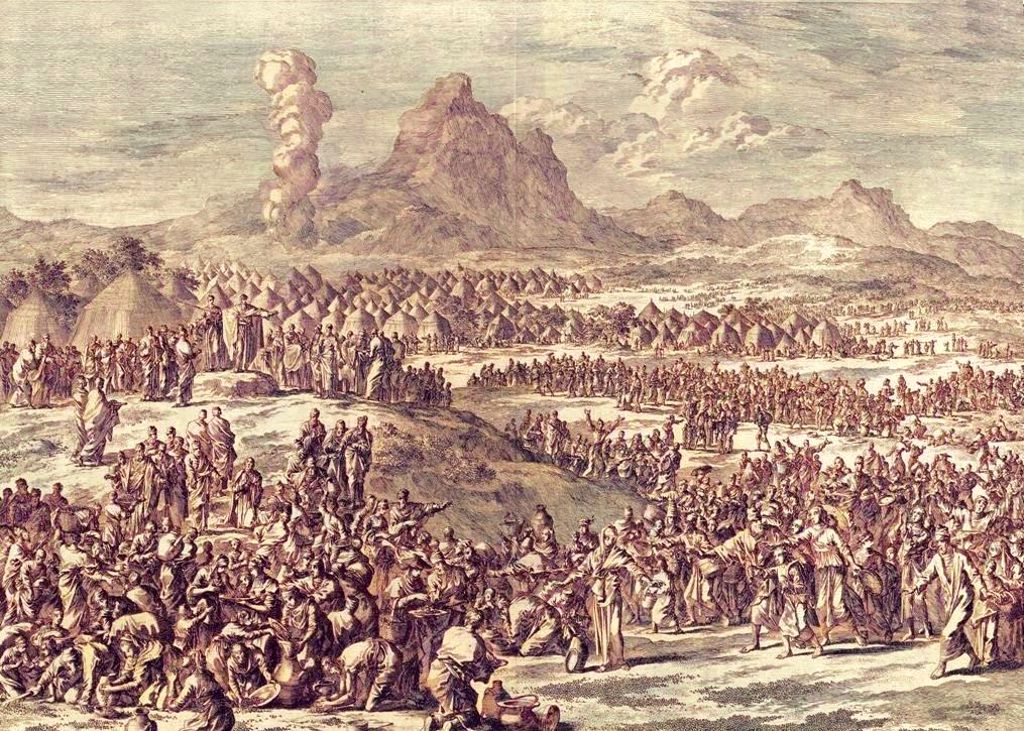
The Biblical story of the Israelites wandering in the desert for 40 years before entering the “Promised Land” is a strong narrative in the Old Testament. According to the Biblical story, the Israelites were enslaved in Egypt, but God chose Moses to lead them out of bondage and towards the land promised to their ancestors. After a series of miraculous events, including the parting of the Red Sea, the Israelites fled into the desert.
Once in the desert, the Israelites faced a series of challenges that tested their faith and endurance. They quickly ran out of food and water and began to grumble and complain against Moses and God. Despite their lack of faith, God provided them with manna from heaven and even water from a rock, sustaining them for the journey ahead. Despite God’s provision, the Israelites continued to struggle with disobedience and rebellion. God cursed them with forty years of wilderness wandering until the unbelieving generation died off (Hebrews 3:7-19), never stepping foot in the “Promised Land.”
This very brief recollection of the Exodus of the ancient Israelites from Egypt can give us a window into what may have to happen to America today. The key point here is that America may have to endure a generation or two of hardship and wandering through a metaphoric desert so that the nefarious actors we see today pass. Though not a guarantee, perhaps then America can return to its greatness.
Give us your take in the comment section below on whether America’s “ship can be righted” via “strong intervention,” be required to go through a long period of wandering, or be doomed to fall onto the scrap heap of history like so many other countries and empires before.
By Tom Williams