

A federal district court had ordered that a second black-majority congressional district be created in the state after finding black voters underrepresented.
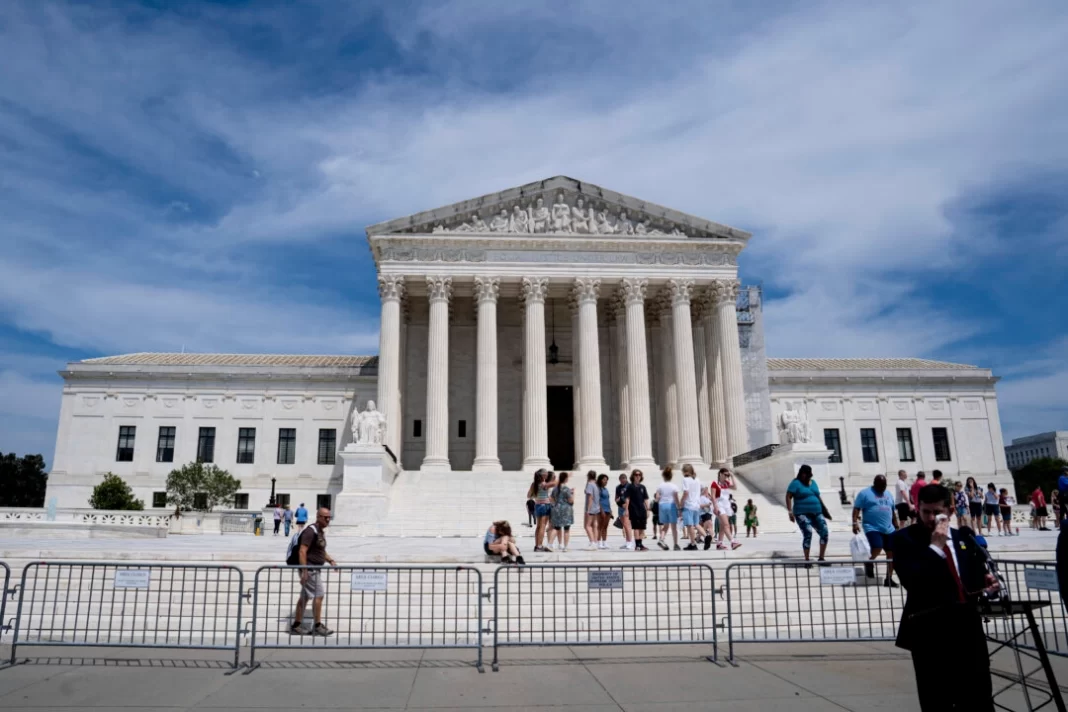
The U.S. Supreme Court on April 29 limited the use of race-based redistricting in a legal challenge to Louisiana’s congressional map.
The nation’s highest court ruled 6–3 in Louisiana v. Callais that race could not be used when drawing boundaries for the state’s electoral districts.
The case rests on whether a lower court-ordered creation of a second black-majority congressional district in Louisiana was constitutional. A federal district judge had ordered the state to create the second district to comply with the anti-discrimination provisions of the 1965 federal Voting Rights Act.
U.S. District Judge Shelly Dick of the U.S. District Court for the Middle District of Louisiana ruled that an earlier version of the state’s electoral map, which included only one black-majority congressional district, discriminated against black voters, who constitute almost a third of the state’s population.
In other words, the judge found that Louisiana’s failure to add a second black-majority congressional district likely violated Section 2 of the Voting Rights Act.
Section 2 prohibits voting practices or procedures that discriminate based on race, color, or membership in a large language-minority group such as American Indian, Asian American, Alaskan Native, or American Hispanic.
Courts have held that the Voting Rights Act, in certain circumstances, allows states to take race into account when drawing electoral boundaries, but electoral maps drawn explicitly based on race are unconstitutional. The statute has been interpreted by the courts to forbid racial gerrymandering when it dilutes minority voting power.
In the Louisiana case, a group of non-black voters sued, arguing that the map with two black-majority districts discriminated against non-minorities by engaging “in explicit, racial segregation of voters.”
Later, a divided panel of federal judges in the Western District of Louisiana agreed with the non-black voters that the electoral map with two black-majority districts was an unconstitutional racial gerrymander that disfavored non-black voters. Gerrymandering is the manipulation of electoral district boundaries to favor a particular party or constituency.
The Supreme Court heard oral arguments in the case in October 2025. It first heard the case in March of that year, but the justices did not issue a ruling and made the unusual decision to hold a second oral argument.
The majority opinion was written by Justice Samuel Alito. Justices Elena Kagan, Sonia Sotomayor, and Ketanji Brown Jackson dissented.
“Section 2 of the Voting Rights Act of 1965 … was designed to enforce the Constitution—not collide with it,” Alito wrote. “Unfortunately, lower courts have sometimes applied this Court’s [Section 2] precedents in a way that forces States to engage in the very race-based discrimination that the Constitution forbids.”
Compliance with Section 2 can “provide a compelling reason for race-based districting,” but the section “does not impose liability at odds with the Constitution, and it should not have imposed liability on Louisiana for its 2022 map,” he wrote.
Complying with the section “could not justify the State’s use of race-based redistricting here,” and even though the state made “understandable” efforts to comply with the district judge’s ruling, the redrawn map with a second black-majority congressional district was nonetheless “an unconstitutional racial gerrymander,” Alito said.
Alito said that Section 2 needed to be reinterpreted in light of Rucho v. Common Cause (2019), which held that the Constitution does not forbid gerrymandering for partisan purposes.
After that ruling was handed down, plaintiffs in voting discrimination lawsuits began “dressing their political-gerrymandering claims in racial garb,” he said.
“If race and politics are not disentangled and a [Section 2] claim is cynically used as a tool for advancing a partisan end, the [Voting Rights Act’s] noble goal will be perverted.”
This is a developing story and will be updated.