
This Feature of Obamacare Was Supposed to Cut Costs. It Did the Opposite.

5Mind. The Meme Platform
A judge’s ruling that some payments to insurers were illegal set off a cost spiral.

Insurance premiums are just one piece of the health care affordability puzzle for many Americans. Out-of-pocket expenses, which are less predictable, also impact the family budget.

Those out-of-pocket costs for deductibles, copayments, and the like now average more than $1,600 a year per person. That’s on top of insurance premiums, which run about $27,000 for a family plan.

Obamacare aimed to help with both expenses—premiums and out-of-pocket costs—by providing federal subsidies for low-to-middle-class Americans. Both are based on household income as a percentage of the Federal Poverty Level (FPL)

There are two kinds of subsidies, one to help with premiums and the other for out-of-pocket spending.

The first subsidies, called advance premium tax credits, are paid directly to insurance companies to reduce premium payments. These are open to people making up to about $62,600 per year, or around $107,000 for a family of three.

The second subsidies, called cost-sharing reductions, reduce the copayments, deductibles, and out-of-pocket maximums on certain insurance plans for people making a bit less, about $39,000 for an individual or some $66,600 for a family of three.

Together, these subsidies were supposed to make health insurance highly affordable for everyone.

Yet this plan, like some other provisions of the Affordable Care Act, had unforeseen consequences, due to 16 words from Article I of the U.S. Constitution: “No money shall be drawn from the Treasury, but in Consequence of Appropriations made by Law.”

Here’s how cost-sharing reductions, which were meant to save money, wound up costing insurers, consumers, and taxpayers even more money than before.

Silver Plans Only

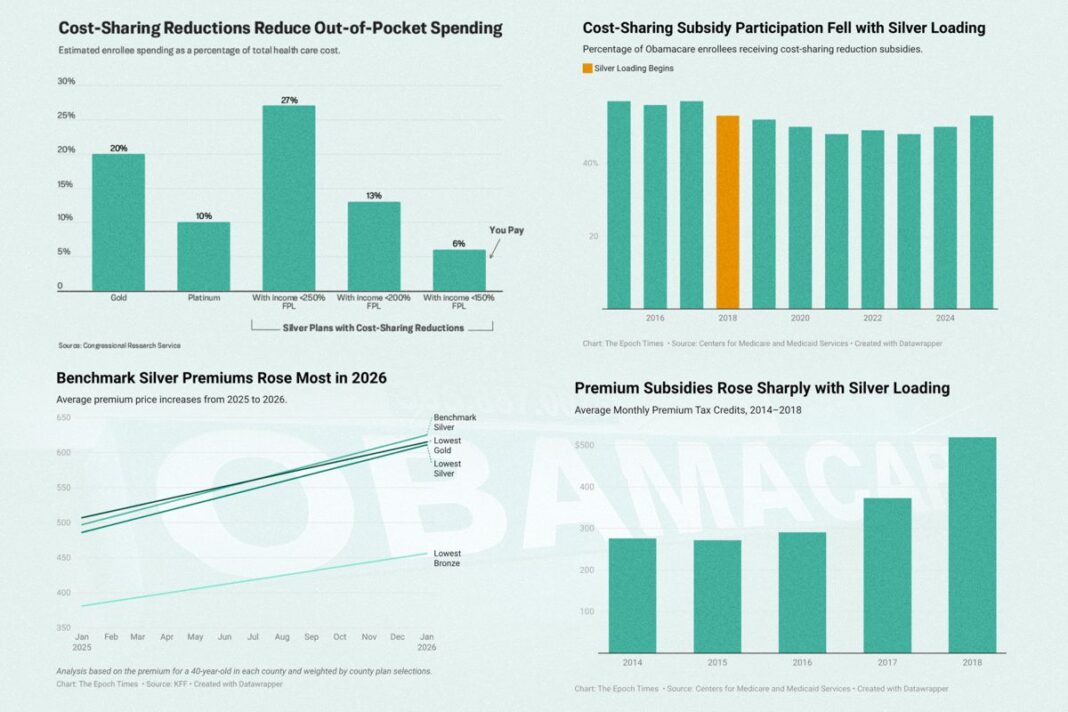
People who qualify for cost-sharing reductions could see their spending on deductibles, copayments, and out-of-pocket maximums reduced up to 80 percent.

The only catch is that they must select a silver-tier insurance plan to get the benefit.

Obamacare offers four levels of plans: bronze, silver, gold, and platinum. Bronze plans have the lowest premiums, but the deductibles, copayments, and out-of-pocket maximums are higher. Platinum plans have the highest premiums, but lower out-of-pocket requirements.

Silver plans are somewhere in the middle and are usually the most popular choice.

On average, customers with a silver plan would pay about 30 percent of their health costs out-of-pocket, not counting premiums. The insurance company would pay about 70 percent.

With cost-savings reductions, that ratio would change. The insurance company would pick up between 73 percent and 94 percent of the cost, leaving customers to pay as little as 6 percent of provider charges.

For some enrollees, a silver plan could leave them with lower out-of-pocket expenses than even a pricier platinum plan.


By Lawrence Wilson

Read Full Article on TheEpochTimes.com

Contact Your Elected Officials
The Epoch Times
The Epoch Timeshttps://www.theepochtimes.com/
Tired of biased news? The Epoch Times is truthful, factual news that other media outlets don't report. No spin. No agenda. Just honest journalism like it used to be.
00:02:08

A Movie That’ll Keep You Awake: A Great Awakening

So how does someone (me) who thinks they’ve just seen the greatest movie ever (A Great Awakening), persuade you to watch it?

Ring That Bell

If I could travel back in time to 1776,...

Thoughts On America 250

Before you, American reader, is the honor, blessing, and privilege of celebrating the 250th anniversary of our nation. A nation toward which God has been merciful, shining His great grace.
00:09:03

Two birthdays apart

The Bicentennial was not just a commemoration of 200 years of independence – it was a coast‑to‑coast block party of red, white and blue.
00:02:31

Is Charlie Kirk’s Assassination Looking More Like a Conspiracy?

Enough videos have been posted to the internet, plenty...

9 Takeaways From Fauci’s COVID Diaries

Fauci’s diary was collected by the Department of Health and Human Services and released by Sen. Rand Paul (R-Ky.) ahead of a hearing with Fauci on July 29.
00:06:01

Anthony Fauci Invokes Fifth Amendment, Refuses to Answer Questions

Dr. Anthony Fauci on July 29 declined to answer questions from senators following the release of a diary he compiled while working in government.
00:00:38

Johnson & Johnson to Pay $5.5 Billion in Settlement to Resolve Baby Powder Lawsuits

Johnson & Johnson said it will pay $5.5 billion to resolve outstanding lawsuits alleging that its baby powder and other talc products caused ovarian cancer.
00:00:38

Energy Department Issues Emergency Order to Secure Power Grid in 17 US States

The Dept of Energy (DOE) has issued an order to tackle an energy emergency situation across 17 U.S. states triggered by hot weather conditions.
00:01:42

2 Small Businesses Sue Trump Admin Over New Forced Labor Tariffs

wo small businesses have filed a lawsuit to block new tariffs imposed by the Trump administration on dozens of trading partners.

Trump Imposes Tariffs on 60 Countries Over Forced Labor

The United States will impose new tariffs ranging between rates of 10 percent and 12.5 percent on more than 60 trading partners beginning on July 24.
00:01:36

Secret Service Agent in Vance’s Detail Under Investigation Over Leaks, Spokesperson Says

The Secret Service announced that it has placed a member of VP JD Vance’s security detail on administrative leave for allegedly leaking information.
00:59:35

Trump Admin Pausing $1 Billion in Medicaid Payments to 2 States

The federal government is pausing more than $1 billion in Medicaid payments to two states, Health Secretary Robert F. Kennedy Jr. said on July 21.
spot_img

Related Articles

Popular Categories

MAGA Business Central