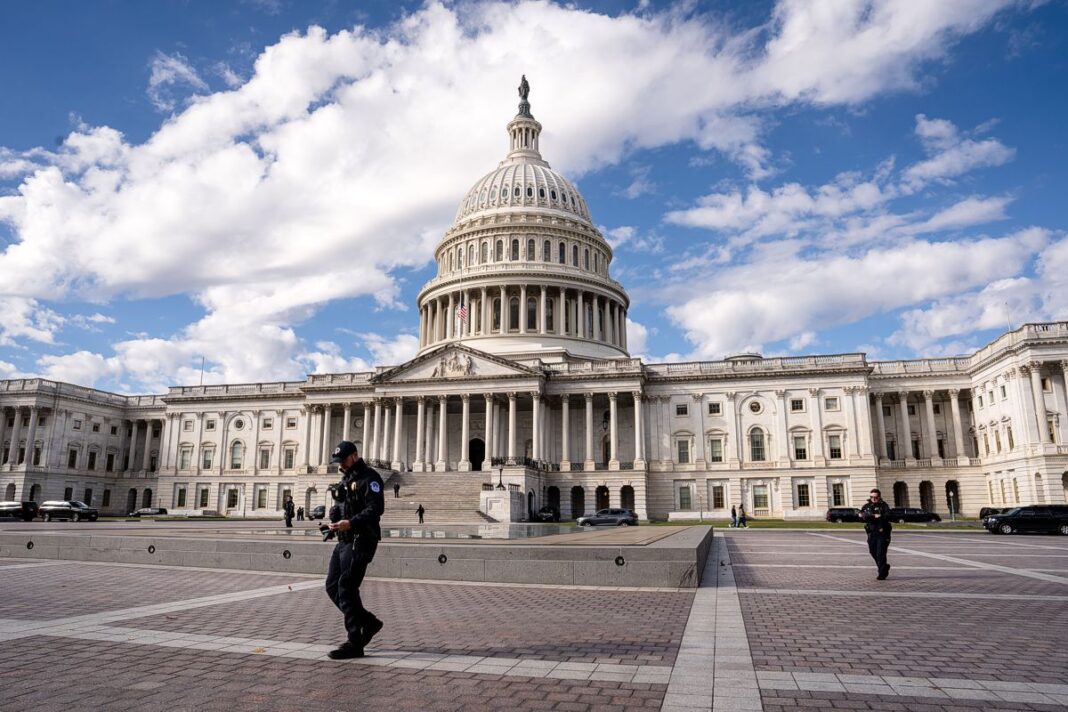
The latest assassination attempt will likely force Secret Service to revamp operations, experts said.
WASHINGTON—The attempted assassination of President Donald Trump at the White House Correspondents’ Dinner on April 25 has raised fresh questions about the adequacy of presidential protection and exposed significant security flaws at the event, held at the Washington Hilton hotel.
Surveillance footage shows the suspect, identified as Cole Allen, 31, sprinting through a security checkpoint in an attempt to reach the hotel ballroom, while security officers appear to be disassembling metal detectors.
At about 8:40 p.m., multiple shots rang out as Secret Service agents rushed to intercept and detain Allen before he reached the ballroom. About 2,500 guests, including the president, first lady, and senior administration officials, were present at the venue. The suspect was allegedly armed with a shotgun, a handgun, and multiple knives.
A Secret Service agent fired multiple times at Allen but missed, according to an affidavit by an FBI agent. The officer was shot once in the chest but was saved by his ballistic vest; he was released from the hospital later that evening.
After the incident, Secret Service Director Sean Curran said there had been no security failures.
“It shows that our multi-layered protection works,” Curran said.
Despite the Secret Service’s safety protocols, experts flagged potential security loopholes at the Washington Hilton that night.
Hotel Guests Pose Security Risk
Law enforcement officials said that Allen, a resident of Torrance, California, was a registered guest at the hotel. Like potentially hundreds of other hotel guests, Allen did not go through security screening upon arrival at the hotel a day before the event.
This lack of screening the day before also allowed him to bring weapons into the building, a former police officer told The Epoch Times.
Allen’s guest status helped him move freely within the premises and carry out his plan to rush through the security checkpoint on the night of the event, according to security experts.
“Knowing the president’s coming to that hotel and not knowing who the guests are” could have created a security loophole, said Billy Ray Hunter, who previously worked on the SWAT team at the Alachua County, Florida, sheriff’s office.
He said all hotel guests should have received background checks if they were going to be staying at the hotel at the same time as a Trump-attended event.
“It literally could have been a bomb that someone took in. … They could have brought the whole thing down on everyone,” Hunter said.
Dean Golemis, a former New York City Police Department detective and certified police instructor, agreed that the biggest loophole was what he called a lack of “security posture in the days leading up to the event at the hotel.”
“They were just very fortunate the other night that there weren’t multiple gunmen running into the building,” Golemis told The Epoch Times. “I don’t think they had the resources in place to handle an attack on multiple fronts.”
Allen traveled by train from Los Angeles to Chicago and then to Washington, acting Attorney General Todd Blanche said on April 26. Golemis said he believes that Allen took the train rather than flying to avoid airport security.
On April 6, Allen made a reservation at the Washington Hilton for three nights, Friday through Sunday, according to the Justice Department. He arrived in Washington at roughly 1 p.m. on April 24 and checked into the hotel later that day.
“A registered guest with a room key bypassed the outer and middle perimeters entirely, leaving only a single metal detector checkpoint,” Gerard Filitti, senior counsel at The Lawfare Project, a New York City-based think tank, told The Epoch Times.
“This created an unacceptable single point of failure in an era of elevated threats of political violence, and shows why high-value events like this require hardened federal venues or full-facility lockdowns.”
On April 27, Allen was federally charged with attempting to assassinate the U.S. president, transporting a firearm and ammunition across state lines to commit a felony, and discharging a firearm during a crime of violence.
On the same day, the Justice Department released photos of the weapons Allen allegedly brought to the hotel, including a shotgun, handgun, and four different knives.
By Emel Akan and Jacob Burg