

As U.S. blockade holds, Iran’s inability to store tens of millions of barrels of oil could alter the course of the war, analysts say.
The storage clock is ticking as tankers that exported 3.2 million barrels of crude oil per day remain bottled up in Iranian ports due to the blockade by the U.S. Navy.
The blockade is part of a global vise denying Tehran $13 billion in monthly revenues and seeking to paralyze Iran’s petroleum industry by forcing it to shut down when it runs out of space to store what it can’t ship.
Since U.S. President Donald Trump imposed the blockade on April 13, at least 1.5 million barrels of Iranian oil have been stored every day because there’s no place to move it.
Those barrels are starting to pile up. According to consensus industry estimates, including by UK-based Energy Aspects, up to 68 million barrels of Iran’s 122 million barrel maximum storage was full in late April, with space for 20 million to 30 million barrels more.
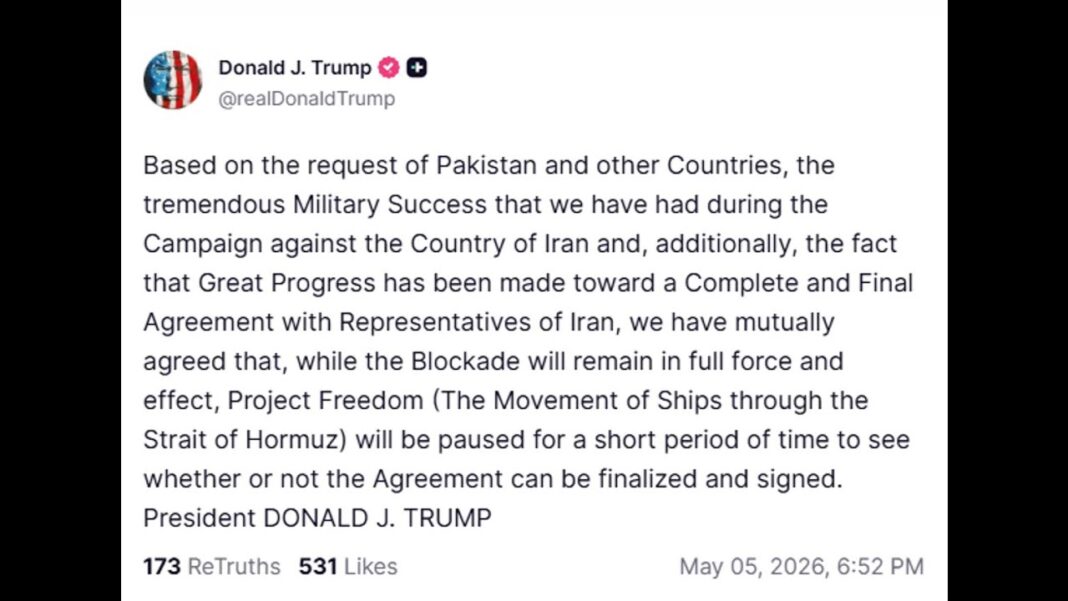
The squeeze is rattling Islamic Republic leaders, Trump said in an April 28 Truth Social post.
“Iran has just informed us that they are in a ‘State of Collapse.’ They want us to ‘Open the Hormuz Strait,’ as soon as possible, as they try to figure out their leadership situation,” the president wrote.
The president has expressed confidence that Iran will soon meet his demands to terminate nuclear weapons development, end support for terrorist groups, and withdraw its territorial claim—and control—of the strait.
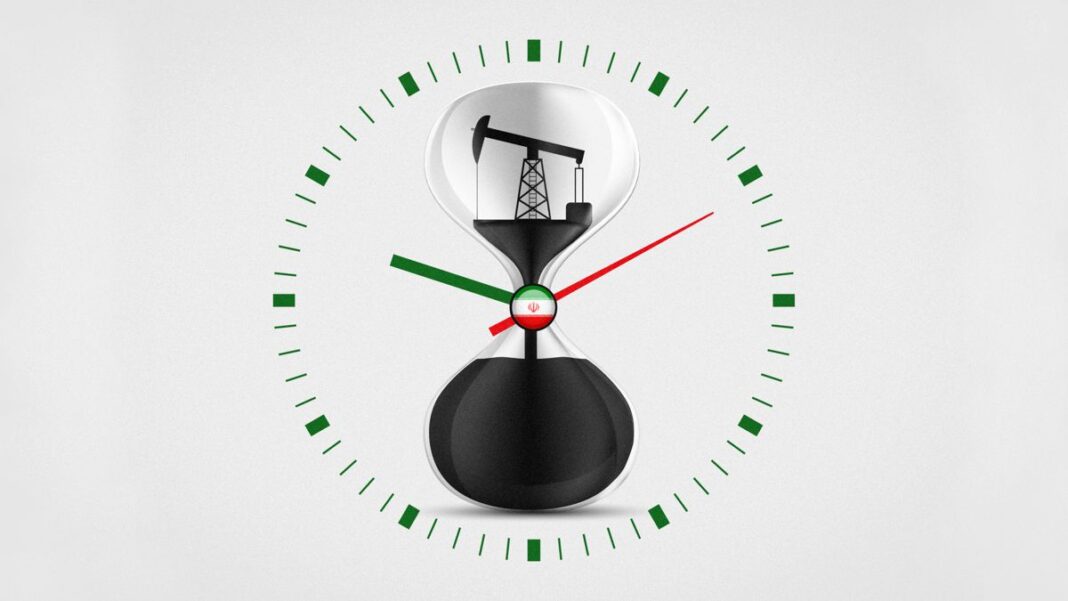
To calculate when these “state of collapse” concessions will manifest, time and space become coefficients in a pencil-and-napkin math equation. The answer is a so-called storage clock. It has one fulcrum constant: More time equals less space.
Kpler and JP Morgan analysts were among those in late April doing storage clock math, projecting that Iran would run out of time and space within 15 to 22 days—mid- to late May—if it can’t ship oil.
“Iran is being pushed into a storage-driven shut-in cycle,” analyst Homayoun Falakshahi wrote in a separate April 29 Kpler analysis. “Iran faces imminent forced shut-ins, with storage saturation likely within ~20–24 days, triggering rapid production cuts.”
Energy Aspects projected in late April that it could take up to seven weeks, or until mid-June, for the blockade to force shut-ins and shutdowns. Analyses by Wood Mackenzie, Atlantic Council, the Center for Strategic International Studies, and the Center on Global Energy Policy at Columbia University, among many others, offer timelines that fall between.
Some maintain Iran’s storage clock has already expired. The Institute for the Study of War and The Critical Threats Project at the American Enterprise Institute said Iran’s storage was depleted as of April 29.
The Foundation for Defense of Democracies projected there would be a shutdown by April 25.
“Extremely important topic is the storage clock,” foundation senior fellow Miad Maleki, a former U.S. Treasury executive, wrote in an X post. He estimated Iran had approximately 20 million barrels of storage left on April 12 and predicted that within 13 days of maxing out capacity, “Iran must shut-in wells.”
By John Haughey