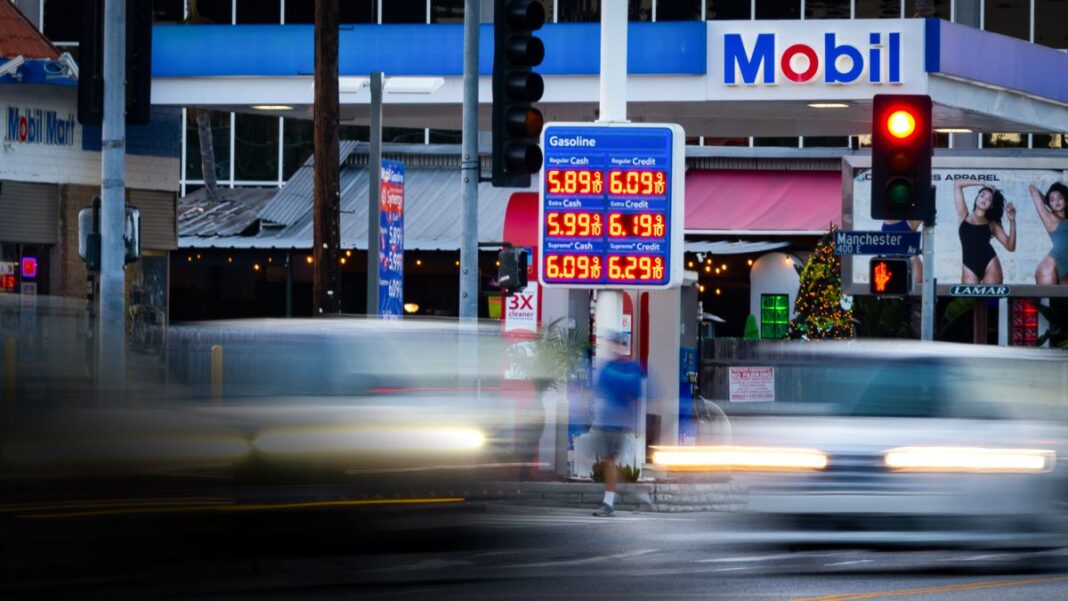


U.S. gas prices have jumped as the Iran war disrupts global supply, exposing America’s ties to world markets despite its energy independence.
Average gas prices in the United States have gone up almost 40 percent since March 1. The reason appears straightforward: Iran has blocked the Strait of Hormuz in response to the U.S. military operation that decapitated its regime and degraded its military. Hundreds of tankers trapped behind the strait can’t deliver their oil, depriving the world of 7 to 10 percent of its supply.
While that explains drastic price increases and even shortages in Europe and Asia, the United States gets almost no oil through the strait. In theory, the country should be energy-independent, as it is a net petroleum exporter.
But in reality, the United States is highly intertwined with the global oil market, and there’s little chance it could disentangle itself from it, according to experts who spoke to The Epoch Times.
“Oil is a fungible commodity that can be shipped anywhere in the world, and that is why everyone is impacted by the events,” said Patrick De Haan, petroleum analyst with gas price tracker GasBuddy.
Countries facing shortages are willing to pay top dollar for U.S. oil.
“There’s huge demand to export the product. So that draws the prices up,” said Paul Sankey, an oil market analyst and president of Sankey Research.
If the U.S. government were to impose limits on oil exports, it would likely cause more problems than it would solve, the experts said.
Light Sweet Versus Heavy Sour
Not all crude oil is made the same. The oil produced in the United States through fracking is called “light sweet.” It’s the easiest to refine and contains few impurities such as sulphur.
Much of Middle Eastern oil is categorized as “medium.” It’s still fairly easy to process, but it’s thicker and contains more sulphur. Canada largely produces “heavy sour” oil. It’s even thicker and more sulphurous. Venezuela, despite its gigantic reserves, produces mostly very heavy, sour oil that few refineries can process.
“Most of our refineries were built at least half a century ago now,“ said David Blackmon, an energy policy analyst and adviser. ”They were set up to refine heavier grades of crude oil coming in from the Middle East and Mexico, the big producing countries at that time, because we were heavily dependent on foreign oil during those days.”
Refineries have been adjusting to processing lighter grades, Sankey noted.
But switching from one grade to another remains difficult, said Keming Ma, former process engineer at a major refinery in Asia. It’s easier to change the oil than the refinery.
“They blend the oil with a different grade to accommodate the refinery,” he said.
In fact, refineries have an incentive to maintain their setup for heavier oil, according to Robert Dauffenbach, an energy expert and professor emeritus at the University of Oklahoma’s Price College of Business.
“These companies have invested billions of dollars into being able to take advantage of the price spread between heavier sour crude, which, quite frankly, can’t be run at every single refinery, so it tends to be cheaper,” he said.
And so the United States exports about 5 million barrels of largely light oil daily, while importing more than 6 million barrels of largely heavy oil.
“We’re kind of maxed out on the amount of light, sweet crude we can run out of refineries,” Dauffenbach said.
And there’s another reason why heavier oil is desirable.
Refineries separate crude oil through distillation into fractions from the lightest, such as methane and propane, through petrol (gasoline), and then into heavier oils, such as kerosene, diesel, and heating oil, until only asphalt is left. The lighter the crude, the less of the heavier fractions it yields.
“We import heavy sour … because we need it for our refineries to make heavier products like diesel and jet fuel,” said Tracy Shuchart, a senior economist at NinjaTrader Group.
By Petr Svab