

The ongoing dispute between Texas and the United States over illegal immigration is not just a legal matter; it is a dispute that will determine the extent of federal power and the scope of state sovereignty. It’s a pivotal moment that could lead to the devolution of many federal domestic powers to the states, potentially shifting the balance of power in favor of state governments.
Can Texas defend itself? Can the federal government force Texas and other states to bear the significant financial and social cost of illegal immigration and other federal policies? These are pressing questions that demand immediate attention.
While U.S. Supreme Court precedent finds these types of disputes non-justiciable political questions, (matters better resolved by the political branches of government), there is legal precedent under the Tenth Amendment that likely shifts the responsibility for and cost of illegal immigration from the states to the federal government.
Has Texas been invaded?
Texas hangs its cowboy hat on two provisions of the Constitution, Article I, section 10 (“Compacts clause”) and Article IV, section 4 (“Guarantee Clause”). The Compacts Clause prohibits states from engaging in war unless the state is invaded or “in such imminent danger as will not admit of delay.” The Guarantee Clause mandates that the United States guarantee each state a Republican form of government and “protect each of them [states] against invasion.”
The Keyword in both clauses is “invade,” or derivations of the term.
The few etymologists dissecting these terms conclude that millions of illegals entering the U.S. is not an invasion. A study by The Tenth Amendment Center traces the term from the first English dictionary in 1755. The term “invasion” has been consistently characterized as a foreign military power equipped with weapons intending to commit physical violence against another country.
A Texas Public Policy Center study, “The Meaning of Invasion Under the Compact Clause of the U.S. Constitution” (2022), concludes that when the Constitution was drafted, the term ‘invades’ involved two core concepts: entry and enmity (intent to act in armed conflict). The Foundation’s definition of invasion includes state and non-state warfare that seeks to’… overthrow the lawful sovereignty of the state.” Under this reasoning, cartel activities could be an “invasion” if Texas can establish violent intent to challenge its sovereignty.
The Supreme Court has historically refused to address cases involving the Compact and Guarantee Clauses. In Luther v. Borden, 1849, the court was asked to determine the lawful claimant to the Rhode Island government due to an insurrection. The court held the Guarantee Clause is a legislative power residing in Congress; therefore, it is a non-justiciable political question.
In 1912, corporations in Oregon argued that a state law authorizing initiatives and referendums violated the Guarantee Clause since it allowed a popular vote, contrary to a Republican form of government. The Supreme Court again held the issue to be a political question. In 1956, Congress delegated its powers to resolve violent conflicts to the President.
In 2023, Texas sought to void Department of Homeland Security (“DHS”) enforcement guidelines. Texas argued that by prioritizing the arrest and removal of noncitizen suspected terrorists, DHS violated federal law by not arresting and removing a more significant number of illegal immigrants. The court dismissed the case for lack of standing since DHS did not prosecute any states litigating the issue.
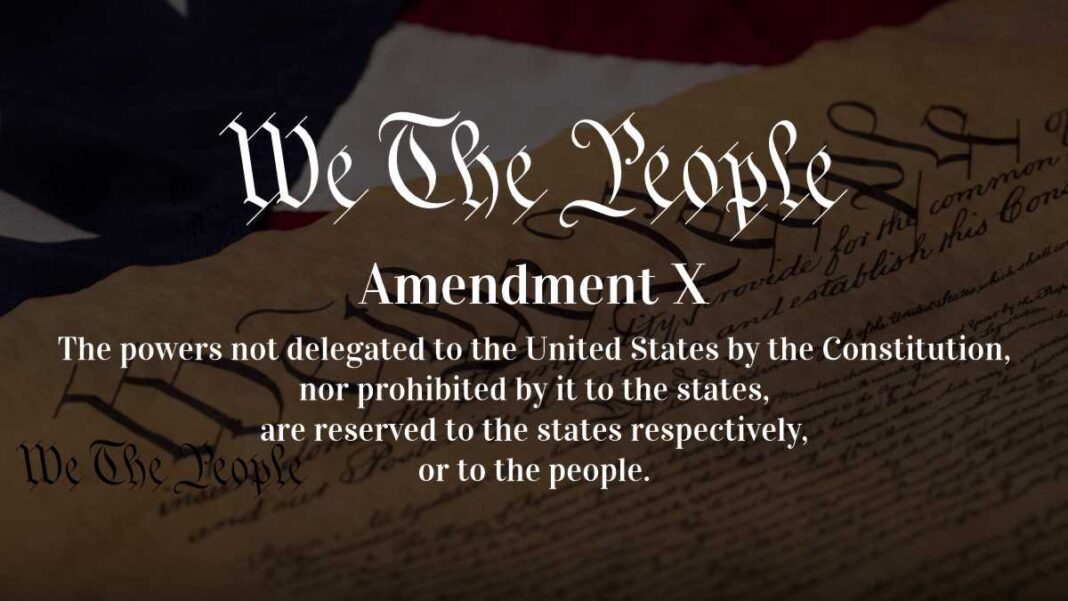
To more forcefully challenge the federal government, Texas should assert that the federal government is compelling it to use state resources to implement federal policy, which is a clear violation of its Tenth Amendment rights. The Tenth Amendment, which reserves powers not delegated to the U.S. by the Constitution to the states or the people, is a crucial safeguard against federal overreach. While the Supreme Court often dismisses Tenth Amendment cases, it has recognized one clear limit to federal power over states.
In a 1992 case, New York vs. U. S., the Supreme Court chiseled a Tenth Amendment path for states to defeat claims of federal authority that force states to pay for costly federal programs. In that case, Congress enacted legislation mandating that states dispose of all low-level nuclear waste generated within the state or take title to all the waste, including liability for its long-term disposal. The court held that while Congress had the authority under the Commerce Clause to regulate low-level nuclear waste, it only had the power to regulate the waste directly. As such, Congress sought to commandeer New York’s legislative process, a power that violates the Tenth Amendment.
The Federation for American Immigration Reform estimates that illegal immigration costs states $116 billion annually and Texas $13.4 billion annually.
Similar to New York v. U.S., the federal government is de facto commandeering state legislative and appropriation processes, meaning it is effectively taking control of these processes, by making Texas and all other states responsible for the cost of managing federal immigration policy. While the Supreme Court may view controversies under the Compacts and Guarantee clauses as non-justiciable, it cannot avoid federal actions forcing states to assume the massive cost of illegal immigration. If the federal government has the sole power to regulate immigration, as it claims, it must exercise such power directly and pay for it.
William L. Kovacs, author of Devolution of Power: Rolling Back the Federal State to Preserve the Republic. His previous book, Reform the Kakistocracy, received the 2021 Independent Press Award for Political/Social Change. He served as senior vice president for the U.S. Chamber of Commerce and chief counsel to a congressional committee. He can be contacted at wlk@ReformTheKakistocracy.com